Showing posts with label flight. Show all posts

Monday, 16 June 2014

Cathay Pacific cancels flight operations


KARACHI: Repercussions of the brazen terrorist attack on Pakistan’s largest airport, the Jinnah International have begun to surface with Cathay Pacific discontinuing flights to Pakistan from the 28th of June.

Cathay Pacific had earlier suspended flights to Karachi following the terrorist attack on Sunday 8th June, however operations resumed on the 13th of June after a change in the airline’s flight schedule.

According to sources, the airline has intimated the Civil Aviation Authority regarding its decision. The Hong Kong based airline had been operating two flights to Karachi.

Monday, 9 June 2014

Flight operations resume at Karachi airport


KARACHI: Flight operations resumed at the Karachi airport at 4:00 PM with the first flight departing for Islamabad.

Operations had been suspended after heavily armed militants launched an assault on Pakistan´s busiest airport in Karachi, leaving at least 30 dead including 10 militants in a six-hour siege that the army quelled at dawn on Monday.


Explosions and gunfire rang out as the attackers, equipped with suicide vests, grenades and rocket launchers, battled security forces in one of the most brazen attacks in years in Pakistan´s biggest city.

Authorities said all 10 militants were killed and that the bodies of 18 victims, including security personnel and four airport workers, had been identified at the Jinnah Postgraduate Medical Centre (JPMC).

Tehreek-e-Taliban Pakistan (TTP) has accepted the responsibility of the attack.

Sunday, 6 April 2014

China search vessels find no clues for missing flight

  • In this image taken from video, a member of a Chinese search team uses an instrument to detect electronic pulses while searching for the missing Malaysia Airlines Flight 370, on board the patrol vessel Haixun 01, in the search area in the southern Indian Ocean on Saturday.
    AP/CCTV via AP Video In this image taken from video, a member of a Chinese search team uses an instrument to detect electronic pulses while searching for the missing Malaysia Airlines Flight 370, on board the patrol vessel Haixun 01, in the search area in the southern Indian Ocean on Saturday. 
     
  • A woman ties a message card for passengers aboard the missing Malaysia Airlines flight MH370, at a shopping mall in Kuala Lumpur on Saturday.
    AP A woman ties a message card for passengers aboard the missing Malaysia Airlines flight MH370, at a shopping mall in Kuala Lumpur on Saturday.
After detecting signals possibly from the black box of the missing Malaysian plane, China’s search vessels failed to find any confirmed clues today to conclusively establish that the pings are from the MH370.
Vessels of China’s ministry of transport searching for the missing passenger jet have searched a total of 136,000 square kilometres by midday on Sunday, Zhuo Li, an official with the China Maritime Search and Rescue Center, said.
The centre had mobilised 62 merchant ships for their assistance in the search, he said.
Haixun 01 of the ministry and two Navy vessels continued the underwater search in southern Indian Ocean, three other ships were searching on the water surface. Two other vessels were searching in eastern Indian Ocean, Mr. Zhuo was quoted by official Xinhua news agency as saying.
China pressed 18 vessels, eight helicopters and three fixed-wing aircraft to trace the plane missing since March 8, along with 239 people on board.
Earlier in the day, three separate but fleeting sounds from deep in the Indian Ocean offered new hope in the hunt for the missing Malaysian airliner, as officials rushed to determine whether they were signals from the plane’s black boxes before their beacons fall silent.
The head of the multinational search being conducted off Australia’s west coast confirmed that a Chinese ship had picked up electronic pulsing signals twice in a small patch of the search zone, once on Friday and again on Saturday.
On Sunday, an Australian ship carrying sophisticated deep-sea sound equipment picked up a third signal in a different part of the massive search area.
“This is an important and encouraging lead, but one which I urge you to treat carefully,” retired Australian Air Chief Marshall Angus Houston, who is coordinating the search, told reporters in Perth.
“We have an acoustic event. The job now is to determine the significance of that event. It does not confirm or deny the presence of the aircraft locator on the bottom of the ocean,” Mr. Houston said, referring to each of the three transmissions.
China’s official Xinhua News Agency reported on Saturday that the patrol vessel Haixun 01 on Friday detected a “pulse signal” at 37.5 kilohertz (cycles per second) the same frequency emitted by flight data recorders aboard the missing plane in the southern Indian Ocean.
The British Navy ship HMS Echo, which is fitted with sophisticated sound-locating equipment, is moving to the area where the signals were picked up and will be there in the next day or two, Houston said.
The Australian navy’s Ocean Shield, which is carrying high-tech sound detectors from the U.S. Navy, will also head there, but will first investigate the sound it picked up in its current region, about 300 nautical miles (555 kilometres) away, he said.
Australian air force assets are also being deployed into the Haixun 01’s area to try to confirm or discount the signals’ relevance to the search, Houston said.
In Kuala Lumpur, families of passengers aboard the missing plane attended a prayer service on Sunday that also drew thousands of Malaysian sympathizers.
“This is not a prayer for the dead because we have not found bodies. This is a prayer for blessings and that the plane will be found,” said Liow Tiong Lai, the president of the government coalition party that organized the two-hour session.
Two Chinese women were in tears and hugged by their caregivers after the rally. Many others looked somber, and several wore white T-shirts emblazoned with the words “Pray for MH370”.
Two-thirds of the passengers aboard Flight 370 were Chinese, and a group of relatives has been in Kuala Lumpur for most of the past month to follow the investigation. Mr. Liow said some of them were planning to go home on Sunday.
After weeks of fruitless looking, the multinational search team is racing against time to find the sound-emitting beacons and cockpit voice recorders that could help unravel the mystery of the plane. The beacons in the black boxes emit “pings” so they can be more easily found, but the batteries last for only about a month.
Investigators believe Flight 370 veered way off-course and came down somewhere in the southern Indian Ocean, though they have not been able to explain why it did so.
The crew of the Chinese ship reportedly picked up the signals using a hand-held sonar device called a hydrophone dangled over the side of a small runabout something experts said was technically possible but extremely unlikely.
The equipment aboard the Ocean Shield and the HMS Echo are dragged slowly behind each ship over long distances and are considered far more sophisticated than those the Chinese crew was using.
Footage aired on China’s state-run CCTV showed crew members in the small boat with a device shaped like a large soup can attached to a pole. It was hooked up by cords to electronic equipment in a padded suitcase as they poked the device into the water.
“If the Chinese have discovered this, they have found a new way of finding a needle in a haystack,” said aviation expert Geoffrey Thomas, editor-in-chief of AirlineRatings.com. “Because this is amazing. And if it proves to be correct, it’s an extraordinarily lucky break.”
There are many clicks, buzzes and other sounds in the ocean from animals, but the 37.5 kilohertz pulse was selected for underwater locator beacons because there is nothing else in the sea that would naturally make that sound, said William Waldock, an expert on search and rescue who teaches accident investigation at Embry-Riddle Aeronautical University in Prescott, Arizona.
“They picked that (frequency) so there wouldn’t be false alarms from other things in the ocean,” he said.
But after weeks of false alarms, officials were careful on Sunday not to overplay the development.
“We are hopeful but by no means certain,” Australian Prime Minister Tony Abbott said of the detection of the signals.
“This is the most difficult search in human history. We need to be very careful about coming to hard and fast conclusions too soon,” Mr. Abbott told reporters during a visit to Japan.
The agency was formally told about the second Chinese detection on Saturday “in absolutely the normal way”, he said.
“China is sharing everything that is relevant to this search. Everything,” Mr. Houston said.
Still, the search agency will be adding a Chinese-speaking liaison officer “to make sure nothing falls through the cracks,” he said.
The signals detected by the Chinese ship were in the southern high priority zone, Mr. Houston said.
Up to 12 military and civilian planes and 13 ships took part in the search on Sunday of three areas totalling about 216,000 square kilometres (83,400 square miles). The areas are about 2,000 kilometres (1,200 miles) northwest of the Australian west coast city of Perth.

Friday, 28 March 2014

Floating objects seen in Flight 370 search area


KUALA LUMPUR: They are the most tantalizing clues yet: 122 objects spotted by satellite, floating in the turbulent Indian Ocean where officials believe the missing Malaysian jetliner went down. But bad weather, the passage of time and the sheer remoteness of their location kept answers out of the searchers' grasp.

Nineteen days into the mystery of Flight 370, the discovery of the objects that ranged in size from 3 feet to 75 feet, offered "the most credible lead that we have," a top Malaysian official said Wednesday.

With clouds briefly thinning in a stretch of ocean known for dangerous weather, aircraft and ships from six countries combed the waters far southwest of the Australian coast. Crews saw only three objects, one of them blue and two others that appeared to be rope.

But search planes could not relocate them or find the 122 pieces seen by a French satellite. Limited by fuel and distance, they turned back for the night.

That echoed the frustration of earlier sweeps that failed to zero in on three objects seen by satellites in recent days. Forecasters warned that the weather was likely to deteriorate again Thursday, possibly jeopardizing the search for the Malaysia Airlines Boeing 777 that vanished early March 8 en route from Kuala Lumpur to Beijing.

With the search in motion, Malaysian officials again sought to assuage the angry relatives of the flight's 153 Chinese passengers. But Defense Minister Hishammuddin Hussein also expressed exasperation. About two-thirds of the missing are Chinese, but Hishammuddin pointedly said Chinese families "must also understand that we in Malaysia also lost our loved ones," as did "so many other nations."

The latest satellite images, captured Sunday and relayed by French-based Airbus Defense and Space, are the first to suggest a debris field from the plane, rather than just isolated objects. The items were spotted in roughly the same area as other objects previously seen by Australian and Chinese satellites.

Clouds obscured the latest satellite images, but dozens of objects could be seen in the gaps. At a news conference in Kuala Lumpur, Hishammuddin said some of them "appeared to be bright, possibly indicating solid materials."

Australian officials did not say whether they received the French imagery in time for search planes out at sea to look for the objects, and did not return repeated phone messages seeking further comment. None of the three objects spotted by searchers Wednesday "were considered to be distinctive to MH370 or relevant to the satellite imagery," Australian Maritime Safety Authority officials said.

If the objects are confirmed to be from the flight, "then we can move on to deep sea surveillance search and rescue, hopefully, hoping against hope," Hishammuddin said.

But experts cautioned that the area's frequent high seas and bad weather and its distance from land complicated an already-trying search.

"This is a really rough piece of ocean, which is going to be a terrific issue," said Kerry Sieh, director of the Earth Observatory of Singapore. "I worry that people carrying out the rescue mission are going to get into trouble."

"We're facing an extremely challenging environment, and 'unprecedented' is an overused word that in this case applies," said John Cox, a former airline pilot and accident investigator who is now president and CEO of Safety Operating Systems, an aviation safety consultancy.

The search resumed Wednesday after fierce winds and high waves forced crews to take a break Tuesday. Twelve planes and five ships from the U.S., China, Japan, South Korea, Australia and New Zealand were participating, hoping to find even a single piece of the jet that could offer tangible evidence of a crash and provide clues to the rest of the wreckage.

Malaysia said Monday that an analysis of the final known satellite signals from the plane showed that it had gone down in the sea, with no survivors.

That data greatly reduced the search zone to an area estimated at 1.6 million square kilometers (622,000 square miles), about the size of Alaska. Wednesday's search focused on an 80,000-square-kilometer (31,000-square-mile) swath of ocean about 2,000 kilometers (1,240 miles) southwest of Perth.

"We're throwing everything we have at this search," Australian Prime Minister Tony Abbott told Nine Network television.

"This is about the most inaccessible spot imaginable. It's thousands of kilometers from anywhere," he later told Seven Network television. "We will do what we can to solve this riddle."

Malaysia has been criticized over its handling of one of the most perplexing mysteries in aviation history. Much of the most strident criticism has come from relatives of the 153 missing Chinese passengers, some of whom expressed outrage that Malaysia essentially declared their loved ones dead without recovering a single piece of wreckage.

At a hotel banquet room in Beijing on Wednesday, a delegation of Malaysian government and airline officials explained what they knew to the relatives. They were met with skepticism and even ridicule by some of the roughly 100 people in the audience, who questioned how investigators could have concluded the direction and speed of the plane. One man later said he wanted to pummel everyone in the Malaysian delegation.

"We still have hope, but it is tiny, tiny," said Ma Xuemei, whose niece was on the flight. "All the information has been confusing and unreliable."

China dispatched a special envoy to Kuala Lumpur, Vice Foreign Minister Zhang Yesui, who met Najib and other top officials, the official Xinhua News Agency reported.

China, which has warships and an icebreaker in the search zone, has backed the demands of the Chinese families who want detailed information on how Malaysia concluded the jet went down — details that Hishammuddin said Malaysia handed over Wednesday.

China's support for families is the likely reason why authorities — normally extremely wary of any spontaneous demonstrations that could undermine social stability — permitted a rare protest Tuesday outside the Malaysian Embassy in Beijing. Relatives chanted slogans, threw water bottles and briefly tussled with police who kept them from a swarm of journalists.

Though officials believe they know roughly where the plane is, they don't know why it disappeared shortly after takeoff. Investigators have ruled out nothing — including mechanical or electrical failure, hijacking, sabotage, terrorism or issues related to the mental health of the pilots or someone else on board.

The search for the wreckage and the plane's flight data and cockpit voice recorders is a major challenge. It took two years to find the black box from Air France Flight 447, which went down in the Atlantic Ocean on a flight from Rio de Janeiro to Paris in 2009, and searchers knew within days where that crash site was.

The batteries on the recorders' "pingers" are designed to last 30 days. After that, the pings begin to fade in the same way that a flashlight with failing batteries begins to dim, said Chuck Schofield of Dukane Seacom Inc., a company that has provided Malaysia Airlines with pingers in the past. Schofield said the fading pings might last five days before the battery dies.

The Australian Maritime Safety Authority, which is coordinating the southern search operation, said a U.S. pinger locator arrived in Perth along with a Bluefin-21 underwater drone. The equipment will be fitted to the Australian navy ship the Ocean Shield, but AMSA could not say when they would be deployed.

Sieh said the seafloor in the search area is relatively flat, with dips and crevices similar to the part of the Atlantic Ocean where the Air France wreckage was found. Depths in search area range from 10,000 to 15,000 feet (3,000 to 4,500 meters).

"The idea of searching a potential area larger than the state of Texas is simply daunting," said Peter Goelz, a former managing director of the U.S. National Transportation Safety Board. "We will need an extraordinary stroke of luck to recover floating debris, let alone identify where the wreckage is (on the ocean floor). It is just overwhelming the challenge that the investigators are facing." (AP)

Wednesday, 19 March 2014

Missing Malaysia airlines plane: Files were deleted from flight simulator

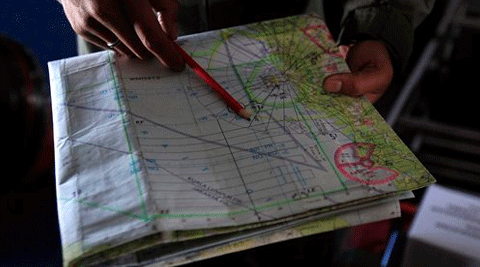
A pilot of a Royal Malaysian Air Force CN-235 aircraft shows a map during a search and rescue operation for the missing Malaysia Airlines plane over the waters at Malacca straits, Malaysia, Thursday, March 13, 2014. (AP)
A pilot of a Royal Malaysian Air Force CN-235 aircraft shows a map during a search and rescue operation for the missing Malaysia Airlines plane over the waters at Malacca straits, Malaysia.

Investigators are trying to restore files deleted last month from the home flight simulator of the pilot aboard the missing Malaysian plane to see if they shed any light on the disappearance, Malaysia’s defense minister said Wednesday.
Hishammuddin Hussein told a news conference that the pilot, Capt. Zaharie Ahmad Shah, is considered innocent until proven guilty of any wrongdoing. He said members of Zaharie’s family are cooperating in the investigation.
Files containing records of the simulations carried out on the program were deleted on Feb. 3, Malaysian police chief Khalid Abu told the news conference.
Malaysia Airlines Flight 370 with 239 people aboard went missing March 8 on a night flight from Kuala Lumpur to Beijing. Malaysian authorities have not ruled out any possible explanations, but have said the evidence so far suggests the flight was deliberately turned back across Malaysia to the Strait of Malacca. They are unsure what happened next.
Investigators have identified two giant arcs of territory spanning the possible positions of the plane about 7½ hours after takeoff, based on its last faint signal to a satellite. The arcs stretch up as far as Kazakhstan in central Asia and down deep into the southern Indian Ocean.
Police are considering the possibility of hijacking, sabotage, terrorism or issues related to the mental health of the pilots or anyone else on board, and have asked for background checks from foreign agencies on all foreign passengers.
Hishammuddin said background checks have been received for all the foreigners except those from Ukraine and Russia — which account for three passengers. He said none of the checks has turned up anything suspicious.
Relatives of passengers on the missing airliner have grown increasingly frustrated over the lack of progress in the search after 12 days. Planes sweeping across vast expanses of the Indian Ocean and satellites peering on Central Asia have turned up no new clues in the hunt.
“It’s really too much. I don’t know why it is taking so long for so many people to find the plane. It’s 12 days,” Subaramaniam Gurusamy, 60, said in an interview from his home on the outskirts of Kuala Lumpur. His 34-year-old son, Pushpanathan Subramaniam, was on the flight heading to Beijing for a work trip.
“He’s the one son I have,” Subaramaniam said.
Before Wednesday’s news briefing at a hotel near the Kuala Lumpur airport, Chinese relatives of passengers held up a banner and started shouting at the venue before police escorted them out.