Showing posts with label moon. Show all posts

Friday, 6 June 2014

More evidence that Earth collision formed Moon: study


WASHINGTON: German scientists said Thursday that moon samples collected during the 1960s and 1970s have shown new evidence that the moon formed when a young Earth collided with another celestial body.

The smashup between an early form of Earth and a planetary body named Theia some 4.5 billion years ago is put forth by what scientists call the Giant Impact Hypothesis of moon formation.

While most experts support the notion, they say the only way to confirm such an impact is to study ratios between the isotopes of oxygen, titanium, silicon and others.

Until now, researchers studying lunar samples that arrived on Earth via meteorites have found that the Earth and moon were quite similar in makeup.

But using samples collected from the lunar surface by NASA´s Apollo 11, 12 and 16 moon missions, and more advanced scientific techniques, scientists found something new.

"They were able to detect a slightly but distinctly higher composition of the oxygen isotope in the lunar samples," said the study in the journal Science." This very small difference supports the Giant Impact Hypothesis of moon formation."

According to theoretical models of the collision, the moon would have formed mostly from Theia, at between 70-90 percent, with some 10-30 percent coming from Earth.

But researchers now say the moon could be a 50/50 mixture of Earth and Theia remnants, though more study is needed to confirm.

"The differences are small and difficult to detect, but they are there," said lead author Daniel Herwartz of Georg-August-Universitat Gottingen.

"We can now be reasonably sure that the Giant collision took place."

The findings will be presented at the Goldschmidt geochemistry conference in California on June 11. (AFP)
 

More evidence that Earth collision formed Moon: study


WASHINGTON: German scientists said Thursday that moon samples collected during the 1960s and 1970s have shown new evidence that the moon formed when a young Earth collided with another celestial body.

The smashup between an early form of Earth and a planetary body named Theia some 4.5 billion years ago is put forth by what scientists call the Giant Impact Hypothesis of moon formation.

While most experts support the notion, they say the only way to confirm such an impact is to study ratios between the isotopes of oxygen, titanium, silicon and others.

Until now, researchers studying lunar samples that arrived on Earth via meteorites have found that the Earth and moon were quite similar in makeup.

But using samples collected from the lunar surface by NASA´s Apollo 11, 12 and 16 moon missions, and more advanced scientific techniques, scientists found something new.

"They were able to detect a slightly but distinctly higher composition of the oxygen isotope in the lunar samples," said the study in the journal Science." This very small difference supports the Giant Impact Hypothesis of moon formation."

According to theoretical models of the collision, the moon would have formed mostly from Theia, at between 70-90 percent, with some 10-30 percent coming from Earth.

But researchers now say the moon could be a 50/50 mixture of Earth and Theia remnants, though more study is needed to confirm.

"The differences are small and difficult to detect, but they are there," said lead author Daniel Herwartz of Georg-August-Universitat Gottingen.

"We can now be reasonably sure that the Giant collision took place."

The findings will be presented at the Goldschmidt geochemistry conference in California on June 11. (AFP)

Tuesday, 29 April 2014

Moon will block the sun in first solar eclipse Tuesday


SYDNEY: The moon will block the sun in the first solar eclipse of the year on Tuesday (April 29), and stargazers in Australia have some of the best seats on the planet.

Two online skywatching groups — the Slooh community telescope and the Virtual Telescope Project — will provide live webcasts of the solar eclipse from Australia, beginning at 2 a.m. EDT (0600 GMT) on Tuesday. You can watch those solar eclipse webcasts live on Space.com. It will be Tuesday afternoon local time across Australia during the eclipse, with the sun setting before the event concludes.

Solar eclipses occur when the moon passes between the sun and earth, as seen from the surface of the earth, and blocks part or all of the sun's disk. When the moon and sun align perfectly, a total solar eclipse occurs. Because the moon's orbit around earth is tilted, the moon and sun don't align in an eclipse every month.

Tuesday's solar eclipse will be what scientists call an annular solar eclipse. The event, also known as a "ring of fire" solar eclipse, occurs when the sun is too far from earth to completely obscure the sun's disk. The result is a bright ring of sunlight around the moon's silhouette, as viewed from the earth's surface.

But on Tuesday, the potentially dazzling "ring of fire" eclipse will only be visible from one uninhabited spot in Antarctica, where the only audience may be penguins on the frigid landscape.

"This is a thoroughly bizarre eclipse," Slooh astronomer Bob Berman said in a statement. "When Slooh brings its live feeds from Australia, and we watch in real time as the inky black hemisphere of the moon partially obscures the sun, the greatest thrill might be an awareness of what's occurring — unseen by any human — in a tiny region of Antarctica."

The April 29 solar eclipse will begin at 1:15 p.m. local time in Perth, the capital of Western Australia, and end at 3:59 p.m. local time. The time of greatest eclipse occurs at 2:41 p.m., when the moon will obscure about 65 percent of the solar disk. The event will begin later in the day for observers in Melbourne (3:58 p.m. local time) and Sydney (4:13 p.m.), with the sun setting before the eclipse ends.

Tuesday's solar eclipse is the second eclipse of 2014 after the total lunar eclipse on April 15. The next total lunar eclipse will occur on Oct. 8 and will be primarily visible from the Pacific Ocean and its bordering coastlines. A partial solar eclipse visible from most of the United States and parts of Canada will then follow on Oct. 23.

Monday, 10 March 2014

Apollo asteroid to hurtle between moon and Earth today

The asteroid 2014 DX110, is expected to make its closest approach on Wednesday
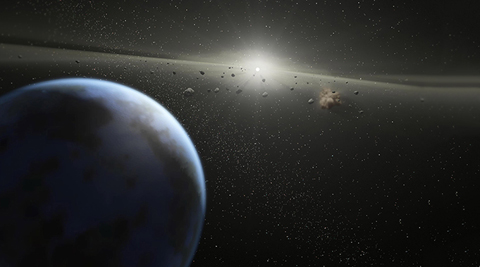
The asteroid 2014 DX110, is expected to make its closest approach on Wednesday. (Reuters)
A newly discovered asteroid will hurtle between the moon and the Earth on Wednesday. It will be passing by Earth on March 5 at around 21:06 Universal Time (UT)/ 4:06 PM EST close enough to dip inside the orbit of the moon.
The asteroid, named 2014 DX110, was revealed just four days ago by the Pan-STARRS 1 survey and astronomers tracking it already have a good idea of its size and its orbit around the sun.
It is about 20-30 metres wide and about 16,000 metric tons. It’s specifically an Apollo asteroid — so called because its orbit is larger than Earth’s orbit and takes it on a path that crosses Earth’s orbit.
It is approximately 217,000 miles from the Earth.
The asteroid is no threat to Earth or the Moon – it makes a pass 232,800 miles from our natural satellite one hour and 22 minutes after its closest passage from the Earth.
But if 2014 DX110 actually did hit Earth at some point, it would be comparable to the asteroid that exploded over Chelyabinsk, Russia, back in February of last year.
Both the Slooh Space Camera and the Virtual Telescope Project will be broadcasting their flies of the asteroid on Wednesday starting at 4 am ET from the Slooh site, and at 3:30 pm ET from the Virtual Telescope page.
Fortunately for the moon, though, it’s not in the path of 2014 DX110 — the asteroid actually misses the moon with a wider margin than it does the Earth.
Since October 2008, dozen of asteroids have passed through the Earth. Although the closest one was found to be the asteroid 2011 CQ1 passed within 7,294 miles of us on Feb 4, 2011.