Showing posts with label Philippines. Show all posts

Sunday, 27 April 2014

US, Philippines reach deal on troops

Filipino activists burn a mock U.S. flag as they hold a short protest in Manila, Philippines on Sunday. The group is opposing the visit of U.S. President Barack Obama and a looming pact that will increase the American military presence in the Philippines. Photo: AP
 
Filipino activists burn a mock U.S. flag as they hold a short protest in Manila, Philippines on Sunday. The group is opposing the visit of U.S. President Barack Obama and a looming pact that will increase the American military presence in the Philippines. Photo: AP
The United States and the Philippines have reached a 10-year pact that would allow a larger U.S. military presence in this Southeast Asian nation as it grapples with increasingly tense territorial disputes with China, according to two Philippine officials and a confidential government primer seen by The Associated Press on Sunday.
The Enhanced Defense Cooperation Agreement, which would give American forces temporary access to selected military camps and allow them to preposition fighter jets and ships, is due to be signed on Monday at the Department of Defense in the Philippine capital, Manila, shortly before the arrival of President Barack Obama, the officials said. Mr. Obama’s visit is the last leg of a four-country Asian tour that also took him to Japan, South Korea and Malaysia.
The two officials spoke on condition of anonymity as they were not authorized to discuss details of the pact ahead of its signing.
A Philippine government primer on the defence accord did not indicate how many additional U.S. troops would be deployed “on temporary and rotational basis,” but it said that the number would depend on the scale of joint military activities to be held in Philippine camps.
The Philippine Constitution bars permanent U.S. military bases. Under the agreement, a Filipino base commander would have access to entire areas to be shared with American forces, according to the primer.
Disagreements over Philippine access to designated U.S. areas within local camps had hampered the negotiations for the agreement last year.
The agreement would promote better coordination between U.S. and Filipino forces, boost the 120,000-strong Philippine military’s capability to monitor and secure the country’s territory and respond to natural disasters and other emergencies. “Pre-positioned materiel will allow for timely responses in the event of disasters natural or otherwise,” the primer said.
The presence of foreign troops is a sensitive issue in the Philippines, a former American colony.
The Philippine Senate voted in 1991 to close down major U.S. bases at Subic and Clark, northwest of Manila. However, in 1999, it ratified a pact with the United States allowing temporary visits by American forces. That paved the way for hundreds of U.S. forces to hold counterterrorism combat exercises with Filipino troops dealing with insurgents in the country’s south.
This time, the focus of the Philippines and its underfunded military has increasingly turned to external threats as territorial spats with China in the potentially oil-and gas-rich South China Sea heated up in recent years. The Philippines has turned to Washington, its longtime defense treaty ally, for help modernize its navy and air force, among Asia’s weakest.
Chinese paramilitary ships took effective control of the disputed Scarborough Shoal, a rich fishing ground off the northwestern Philippines, in 2012. Last year, Chinese coast guard ships were deployed to another contested offshore South China Sea territory, the Second Thomas Shoal, where they have been trying to block food supplies and rotation of Filipino marines aboard a grounded Philippine navy ship in the shallow waters of the remote coral outcrops.
The Philippines’ desire to bolster its territorial defense has dovetailed with Washington’s intention to pivot away from years of heavy military engagement in the Middle East to Asia, partly as a counterweight to China’s rising clout.
Such convergence would work to deter China’s increasingly assertive stance in disputed territories, Philippine analyst Ramon Casiple said. But it could also further antagonize Beijing, which sees such tactical alliance as a U.S. strategy to contain its rise, and encourage China to intensify its massive military buildup.

Wednesday, 12 March 2014

China blocking Philippines’ vessels a provocative move: US

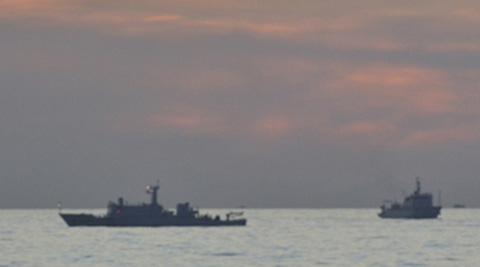
China withdrew one of three ships engaged in a standoff with Philippines vessels in a disputed area of the South China Sea on April 13, 2012 as both sides pursued talks to defuse the dispute.
Concerned by reports that China has blocked two vessels of the Philippines in the South China Sea, the US on Wednesday described it as a provocative move that raised tensions.
“We are troubled by reports that China’s Coast Guard blocked efforts by two Filipino vessels to re-supply the Philippines’ outpost at Second Thomas Shoal. This is a provocative move that raises tensions,” State Department spokesperson Jen Psaki said.
“Pending resolution of competing claims in the South China Sea, there should be no interference with the efforts of claimants to maintain the status quo,” she said.
The Philippines has maintained a presence at Second Thomas Shoal since 1999, as other claimants have maintained a presence elsewhere in the South China Sea, she added.
“The regular resupply and rotation of personnel positioned in the South China Sea at locations that have existed since before the Declaration of Conduct in the South China Sea was issued by ASEAN and China in 2002 is consistent with maintenance of the status quo. Other claimants regularly resupply and repair their outposts without interference,” Psaki said.
“Freedom of navigation and overflight is a linchpin of security in the Pacific. Safe and unimpeded lawful commerce, freedom of navigation, stability, and respect for international law must be maintained,” said the spokesperson.

Sunday, 9 March 2014

Philippines has ’right’ to defend its territory like China: PM spokesman

imageMANILA: The Philippines also has the right to defend every inch of its territory, President Benigno Aquino's spokesman said on Sunday, after China made a similar warning.
Spokesman Herminio Coloma's remarks came after China's foreign minister Wang Yi said on Saturday said his country would vigorously defend its sovereignty against "unreasonable demands from smaller countries".
Although he was referring to Japan, which has its own territorial dispute with China, his remarks could also cover China's other territorial dispute with the Philippines and other countries over parts of the South China Sea.
"It is the right of every country to defend its national territory. That is also the principle we are following," Coloma told reporters, commenting on the Chinese minister's remarks.
Coloma added that the Philippines was basing its position on the principles of international law like the United Nations Convention on the Law of the Sea or UNCLOS.
The Philippines and China, along with Brunei, Malaysia, Taiwan and Vietnam are all claimants to parts of the South China Sea, a major sea lane and rich fishing ground which is believed to sit on vast mineral deposits.
The Philippines has also expressed growing concern at the increased aggressiveness of the Chinese in pressing their claim to almost all of the waters, even up to the coasts of its neighbours.
The Philippine government has sought UN arbitration under UNCLOS to settle the dispute but China has rejected the move.
Last month the Philippines lodged a protest after the Chinese coastguard allegedly attacked Filipino fishermen off a disputed South China Sea shoal with water cannon on January 27. Beijing rejected the protest.

Philippines has ’right’ to defend its territory like China: PM spokesman

imageMANILA: The Philippines also has the right to defend every inch of its territory, President Benigno Aquino's spokesman said on Sunday, after China made a similar warning.
Spokesman Herminio Coloma's remarks came after China's foreign minister Wang Yi said on Saturday said his country would vigorously defend its sovereignty against "unreasonable demands from smaller countries".
Although he was referring to Japan, which has its own territorial dispute with China, his remarks could also cover China's other territorial dispute with the Philippines and other countries over parts of the South China Sea.
"It is the right of every country to defend its national territory. That is also the principle we are following," Coloma told reporters, commenting on the Chinese minister's remarks.
Coloma added that the Philippines was basing its position on the principles of international law like the United Nations Convention on the Law of the Sea or UNCLOS.
The Philippines and China, along with Brunei, Malaysia, Taiwan and Vietnam are all claimants to parts of the South China Sea, a major sea lane and rich fishing ground which is believed to sit on vast mineral deposits.
The Philippines has also expressed growing concern at the increased aggressiveness of the Chinese in pressing their claim to almost all of the waters, even up to the coasts of its neighbours.
The Philippine government has sought UN arbitration under UNCLOS to settle the dispute but China has rejected the move.
Last month the Philippines lodged a protest after the Chinese coastguard allegedly attacked Filipino fishermen off a disputed South China Sea shoal with water cannon on January 27. Beijing rejected the protest.