Showing posts with label isi. Show all posts

Friday, 6 June 2014

Treason charge: Geo/Jang Group serves Rs50 bn notice on govt, ISI, Pemra


ISLAMABAD: Pakistan’s most popular and most loved media group Geo and Jang Group has served a legal notice on the Ministry of Defence, Inter-Services Intelligence (ISI) and Pakistan Electronic Media Regulatory Authority (Pemra) for defaming and maligning the group by accusing it of working on an anti-Pakistan agenda, inciting and fuelling violence against the group, pressuring cable operators to black out Geo channels, the failure of Pemra to get the Supreme Court order to restore Geo channels implemented, and has asked all to publicly apologise within 14 days and pay damages of Rs50 billion.
In its legal notice, the group — which played a role in the Pakistan Movement, in the creation of Pakistan and came into existence much before these institutions — has alleged that because of the uncalled for, baseless allegations of being traitors and furthering an anti-Pakistan agenda, more than 8,000 journalists, workers and professionals attached to the group and their families are not only being harassed but also attacked and tortured across Pakistan.

Geo and the Jang Group have served the notice on the Federation of Pakistan and the ISI through the Ministry of Defence and on Pemra and have demanded that all must publicly apologise to the group and all its workers and their families for levelling absolutely baseless, wrong and shameful allegations without any proof and endangering the lives of thousands of professionals attached with the group.

The lawyers of the Geo and Jang group have made it clear in categorical and the strongest terms in the legal notice served on the ISI and Pemra that the group shall initiate appropriate legal proceedings against all of them in a court of competent jurisdiction for direct damage to repute caused to their clients (Geo and Jang Group and its workers) and also actual losses that they are suffering on a daily basis.

The legal notice served by Geo and the Jang Group on the Ministry of Defence, ISI and Pemra on June 5, 2014 reads;“Legal notice under section 8 of defamation ordinance, 2002.”“We, on behalf and instructions of the Independent Media Corporation (Pvt) Limited (IMC), Independent Newspaper Corporation (Pvt) Limited (INCL), News Publications (Pvt) Limited (NPL), Independent Music Group (Pvt) Limited (IMG), (hereinafter referred to as ‘our clients’) are writing to address you as follows:

“1. That together all our clients along with dozens of other companies from the ‘Jang/Geo Group’, the leading electronic and print media group of Pakistan broadcasting TV channels with the highest rating namely ‘Geo News’, ‘Geo Entertainment’, ‘Geo Tez’, ‘Geo Kahani’ and ‘Geo Super’. The Jang Group also publishes newspapers having the widest circulation in Pakistan namely “Daily Jang” and “The News”.

“2. That our clients are actively involved in the field of journalism, making and broadcasting national/international news, articles, interviews, mega events and current affairs and are considered as the most reliable sources of information by the public at large and enjoy an incontrovertible, overwhelming, unequivocal and an unparalleled reputation both at the national and international level.

“3. That on 19.4.2014, one of the leading columnists and anchorpersons of Pakistan, Hamid Mir, who is associated with our clients, was attacked in Karachi. In the environment of extreme tension and under tremendous pressure of the family of Hamid Mir, our clients’ channel Geo News broadcast a statement of Hamid Mir’s brother Amir Mir.

“4. That subsequent to the above, ISI sent a complaint to the Ministry of Defence which without even providing any evidence/proof, contained baseless and untrue allegations that “Geo Network has a history of acting illegally in furtherance of anti Pakistan agenda.”

“5. That upon receipt of the complaint of ISI, the Ministry of Defence immediately without verification of the allegations levelled in it, forwarded the said complaint containing the allegations regarding our clients having a history of acting on an anti-Pakistan agenda, as it is, to Pemra seeking immediate suspension and cancellation of Geo News’ licence.

“6. That after receiving the above complaints from the ISI through the Ministry of Defence, Pemra too, without seeking any proof/evidence of anti-Pakistani activities of our clients, issued a show cause notice to our clients, accusing them of being involved in anti-Pakistan activities.

“7. That the show-cause notice of Pemra was distributed all over Pakistan including the media of Pakistan that has caused great reputational loss to our clients.

“8. That despite our clients’ various requests to the ISI, the Ministry of Defence and Pemra to provide them evidence on the basis of which such a heinous allegation was levelled by them against our clients, no proof/evidence has been provided to them so far.

“9. That all of you have thus defamed our clients by levelling such false statements to injure their reputation, to lower them in the estimation of others and to reduce them to ridicule, unjust criticism, dislike, contempt or hatred against which this statutory notice is being served to all of you.

“10. That in addition to the reputational loss that our clients have suffered at your hands, this false and malicious allegation due to the current tense political situation in the country, was deliberately aimed at provoking and inciting the masses to engage in physical violence against our clients and thousands of their employees including journalists, putting all their lives at serious risk. You have succeeded in achieving the purpose of the false allegations as soon after having levelled them a smear campaign against our clients has also been started on the ground that our clients are traitors/anti-Pakistan.

“11. That due to your illegal threats and pressure on the cable operators of the country, they first shuffled/showed on last number of the spectrum, the transmission of our clients’ channels, ‘Geo News’, ‘Geo Entertainment’, ‘Geo Kahani’ and ‘Geo Tez’ and now the transmission of these channels have been completely suspended throughout the country.

“12. That similarly, distribution of our clients’ newspapers has also been disturbed/banned in different parts of the country. The newspapers’ distribution vans of our clients are being set ablaze on a daily basis and the employees of our clients have also been threatened and tortured in various parts of the country, on the pretext that our clients are Anti-Pakistan.

“13. That despite our clients’ repeated requests, Pemra and the Ministry of Information and Broadcasting in utter violation of the statutory provisions have failed to restore the transmission of Geo News and other channels of our clients on their previous position.

“14. That in the above background, our clients have approached the Supreme Court of Pakistan. On 26.05.2014, the Supreme Court disposed of our clients’ application on the basis of Pemra’s counsel, Ibrahim Satti and Pemra’s head legal department, Zahid Malik’s undertaking that Pemra “shall abide by the terms of order dated 13.08.2012 passed in Constitution Petition No 51 of 2010, by which the report of Javed Jabbar, the mediator, was made part of the said order and that the Pemra will ensure that there is no shifting of the channels contrary to or in violation of the order dated 13.08.2012.

“15. That it is, however, regretfully noted that despite clear direction of the Supreme Court, Pemra has till to date not ensured implementation of the SC order in letter and spirit which shows that all of you, in collusion to each other, are bent upon damaging our clients.

“16. That due to your illegal actions, our clients are on a daily basis suffering huge financial loss as transmission of their channels has been illegally suspended and distribution of their newspapers has also been disturbed due to which they are not receiving any advertisements.

“17. That we on behalf of our clients request you to immediately provide our clients all the documentary evidence/proof in support of your allegations that our clients are involved in anti-Pakistani activities.

“18. That in view of the foregoing, our clients having no other option hereby call upon all of you to do the following within 14 days of this legal notice:

i. To stop levelling such defamatory statements;

ii. To broadcast or publish retraction or clarification for accusing our clients as traitors or anti-Pakistan;

iii. To publish an apology in a newspaper and make one through a TV interview in the same manner and in the same prominence;

iv. To restore the transmission of our clients’ channels ‘Geo News’, ‘Geo Entertainment’, ‘Geo Kahani’ and ‘Geo Tez’ to their previous positions all over Pakistan;

v. Not to harass cable operators to illegally suspend the transmissions of our clients’ channels;

vi. Though the defamation caused is immeasurable in monetary terms however, to pay our clients direct reputational damage and actual damage that come around almost to be Rs50,000,000,000 (Fifty billion rupees only).

“20. That if you fail to do the above within 14 days from the date of this legal notice, we have strict instructions from our clients to initiate appropriate legal proceedings against all of you in a court of competent jurisdiction for direct reputational damage caused to our clients and also actual losses that they are suffering on daily basis.

“21. That this legal notice is being served to you without prejudice to all the rights that our clients may be enjoying against you under the prevailing laws.”

Thursday, 24 April 2014

Army men used to criticise ISI but faced no treason charges


ISLAMABAD: Though many media men and journalists are out to prove that Hamid Mir, Geo and Jang Group are traitors merely because Hamid Mir had alleged before the attack on him that he will be attacked by the ISI chief and some other ISI individuals, there are countless examples where regular army officials, even a sitting ISI chief, made more serious allegations against the prime intelligence agency but were never declared traitors.
Geo and Jang Group have repeatedly issued statements that they have the highest regard for all institutions. Despite the fact that Hamid Mir was hundred percent convinced that he will be attacked, the channel only aired the news after he was attacked informing the people what the assessment of Hamid Mir was without giving a final judgment as to who carried out the attack.

Was Hamid Mir the only one to point out some problems or some rogue elements within the ISI? No. There are many from within the armed forces, even former DG ISI Lt Gen Ahmad Shuja Pasha and many retired officers including former COAS Gen (retd) Pervez Musharraf, who clearly hinted at grave problems within the intelligence outfit. Many experts have termed such revelations as “ISI within ISI” and analysed that apparently these “rogue” elements are stronger and influential.

It is also an important point that politicians, bureaucrats, and everyone is attacked and criticised for anything but few people consider generals as “sacred cow”, over and above any criticism despite the fact that they are involved in violence against innocent citizens. Reports of judicial commissions establish the involvement of ISI elements in such violent activities. The biggest office of the state is the office of the president and even it is never spared from criticism.

It was Ahmad Shuja Pasha who at the time of his appearance before the Abbottabad Commission confessed that “ISI had brutalised many decent people”. However, Pasha had added, “ISI mindset, culture and methodology were changing.” Before this Abbottabad Commission, Pasha slammed former army chief Gen (retd) Pervez Musharraf for bowing down to the Americans.

Pasha had disclosed that Musharraf had caved in to the US so promptly that the Shamsi airbase was given to them for drone strikes in Pakistan. Pasha was made to confess before the Abbottabad Commission that the Abbottabad incident was the result of lack of capacity, inadequate knowledge and wrong attitude. Pasha had even admitted of enforced disappearances, notwithstanding the fact the ISI had no detention powers.

While many in the media are trying to unnecessarily defend the ISI and are not ready to admit that correct criticism will help the institution improve, Pasha’s statement endorses report of the Umar Cheema Commission that the agency remained involved in terrible things like kidnappings and torturing citizens.

When Pasha said so, it was not treason but when Hamid Mir said the same on the basis of credible information, it is treason despite the fact that he is admitted in hospital after sustaining six bullets and is unable to walk.

Gen (retd) Musharraf in his 2011 interview with ABC in USA said, “It is possible that rogue members of the Inter-Services Intelligence (ISI) and the military knew of Osama bin Laden’s hideout in Abbottabad.

“As a policy, the army and the ISI are fighting terrorism and extremism, al Qaeda and the Taliban. But rogue elements within are a possibility.“As I said, at the lower level, somebody (could be) following a policy of his own and violating the policy from above is a possibility.”

Top army officials have admitted that when Musharraf was attacked twice, some ISI officials were involved. But it was not treason as though it was hundred percent proved and these incidents killed many individuals.

These statements proved the existence of rogue elements within the ISI and pointing out this fact would have helped the ISI improve and cleanse its ranks of such elements.Former minister of state for religious affairs Dr Amir Liaquat Hussain stated on May 5, 2005 that then President Musharraf had faced threats from within. He had elaborated that some elements from within the institutions could attack to kill the former army chief. But it was not treason though the role of ISI “individuals” was clearly pointed out.

If there are rogue elements within the ISI or any other institution, they could be mentioned, criticised and blamed. There are no holy cows which could never be touched even if found involved in illegal activities or highhandedness against innocent civilian citizens. When any official of such a disciplined institute is involved in any such activity, the head of the organisation is always blamed as it is incomprehensible that he is not in the picture. A senior journalist, during a private meeting, tried to inquire from Pasha about the involvement of his agency’s officials in kidnapping and torturing Umar Cheema. Pasha was unable to deny but failed to deliver a direct response.

The Judicial Commission has concluded that the role of agencies in the Umar Cheema case was eminent.Keeping aside Pakistan, any wrongdoings of intelligence agencies are highlighted, questioned and criticised in civilised world by professional journalists. In the USA, the American media exposed CIA’s many wrongdoings, including the worst i.e. desecration of Holy Quran in Guantanamo Bay. Majority of the US people who have respect and dignity get united against the American government and elite intelligence agency CIA and get many wrongs reversed.

However, in Pakistan Hamid Mir’s own friends in the media are letting him down, so discussing his opponents is not important. Even in India, the independent Indian media used to expose scandals against its own army and a shameful scandal was reported about the Indian Army chief in recent years. All this brought improvements in those institutions of India. But all this is treason here in Pakistan and consequently the situation and professional excellence of security institutions is also not hidden from anyone.

Not only top army officials made such allegations against the ISI with all proofs and certainty but even top politicians did so but that was never treason. Pakistan’s present interior minister and the then leader of the opposition Chaudhry Nisar Ali Khan made speeches taking the name of DG ISI and alleging him of involvement in illegal and unconstitutional activities. In his interview with Hamid Mir in Capital Talk, Nisar has even said that DG ISI Ahmad Shuja Pasha was making and strengthening a political party – PTI. He never gave any evidence but that was not treason. Today Nisar says he has never seen anyone making allegation this way in the entire world.

Commission didn’t exonerate ISI of murder allegations


ISLAMABAD: The Judicial Commission on Saleem Shahzad case had recommended the accountability of intelligence agencies through legislation noting that currently the ‘legal and organisational foundations of the two major agencies (ISI and IB) rest on mere executive orders.’ The commission stressed on ‘an urgent need for laying down a comprehensive statutory framework’ for them.
Terming it ‘high time’ to bring the agencies under legal framework, the commission had recommended their accountability at three levels: within the agency and before the minister-in-charge; before a parliamentary committee; and before a judicial forum. Defining the role of agencies, the commission said they must be kept at a distance from ‘press censorship, liaising with political parties and the conduct of foreign policy.’

The commission had recommended internal documentation and procedure of inquiry in order to investigate the allegations of misconduct by agency officials. “Without the relevant documentation, no investigation would have much chances of success and it would be hard to rule out the possibility of the agencies’ involvement in incidents like the murder of Saleem Shahzad,” the commission noted.

Highlighting the need for parliamentary oversight of the agencies, the commission said it will serve two purposes: (i) improving the efficiency of agencies; (ii) preventing excesses through oversight and ensuring public confidence in the agencies.

It further noted that in extreme cases where internal review as well as parliamentary review is not sufficient, the agencies may also be held accountable to a specially constituted judicial forum.

A special judicial oversight mechanism may be set up for dealing fairly and effectively with complaints against the agencies, whether emanating from the media or from other sectors of the society, the commission said. “While the forum should be of a general nature, particular importance should be given in this regard to the complaints of the press.”

The role of agencies had come under question. Like Hamid Mir, Saleem Shahzad had also conveyed threats to his life from the ISI and the commission had not absolved the agency of the allegations directing the police to investigate the names named by the slain journalist, Saleem.

Although, threats and acts of intimidation are denied by the ISI, the commission report noted, “Yet from the statements of the above named, the commission cannot hold that their understanding and perception about the threats etc. extended to them are misconceived, simply for the reason that it had been refuted by the ISI official.”

When so many senior and respected journalists have come forward to record their perception, noted the commission, that they found certain words, gestures and acts of ISI officials as intimidating and threatening, then it is hard to dismiss it lightly, “merely on account of a bald denial by ISI.”

“Therefore, from the overwhelming material available on the record, the commission is convinced that there are sufficient reasons to believe that the agencies, including ISI, have been using coercive and intimidating tactics in dealing with those journalists who antagonise the agency’s interest.”

Neither did the government act upon the commission’s recommendations nor did the police pursue the investigation into the Saleem Shahzad’s murder.

As far as the commission’s recommendations about legislation for intelligence agencies are concerned, it declared them ‘necessary to ensure that the agencies remain law-abiding and also that the public perceives them as such.’

This would require a serious effort from parliament, the report said. The commission report goes on: ‘In various countries of the world, intelligence agencies were first created under executive orders, but subsequently brought on a statutory footing to improve their level of accountability. It is high time we brought the same change in Pakistan.”

Whatever the details, the framework adopted for intelligence legislation must ensure constitutional standards of accountability.

The agencies can be held accountable at three levels: within the agency and before the minister-in-charge; before a parliamentary committee (and thus the parliament and the public); and before a judicial forum, said the report.

For improving the system of Internal Administrative Accountability for the agencies, the commission proposed statute should delineate, among other things, the purpose and object of various agencies.

Duties which fall beyond the competence of these agencies, such as press censorship, liaising with political parties and the conduct of foreign policy should be expressly excluded from their mandate. Given our current crisis, being explicit about these matters would be more than worth it, said the commission report.

The chain of command of the agencies should be clearly demarcated, the report added. The structure should be designed such that the minister-in-charge as well as the head of the agency is able to ensure internal administrative accountability. Therefore, in case of an alleged wrongdoing, the first level of inquiry should be from within the agencies. In this regard, it may be useful to set up an internal but independent office for review, such as a counsel general, an inspector general of intelligence (Australia) or auditor, whose job is to assist the minister-in-charge and/or the head of the agency in ensuring compliance with ministerial policy as well as with legal and constitutional limits, explains the commission report.

Emphasizing on the need for a more accountable work culture, the reports notes, the work-culture of the agencies may also need some change if oversight of any sort upon them, internal, parliamentary or judicial, is to be meaningful. In this regard, the proposed statute may require them to adopt by-laws which mandate their operatives to follow internationally-recognized Standard Operating Procedures (SOP).

The procedures should be defined in such a manner so as to improve the level of documentation, according to the report. In case of a complaint of misconduct, the relevant documentation should be handed over to the investigators for a proper inquiry. This change is absolutely necessary for increased accountability. Otherwise, without the relevant documentation, no investigation would have much chances of success and it would be hard to rule out the possibility of the agencies’ involvement in incidents like the murder of Saleem Shahzad.

For improving the system of democratic accountability for the agencies, the commission said they should also be made directly accountable to parliament. In this regard, parliament should consider creating bipartisan standing committees on intelligence in both houses of parliament. There are numerous such committees in parliaments around the world. The parliament may consider and deliberate upon various existing models of legislative accountability of the intelligence community to tailor the solution most appropriate for our context.

The aim of parliamentary scrutiny should be two-fold: (i) improving the efficiency of the agencies; (ii) preventing excesses through oversight and ensuring public confidence in the agencies.

For improving the system of judicial accountability for the agencies, the commission report said that in extreme cases where internal review as well as parliamentary review is not sufficient, the agencies may also be held accountable to a specially-constituted judicial forum.

A special judicial oversight mechanism may be set up for dealing fairly and effectively with complaints against the agencies, whether emanating from the press/media, as in this case, or from other sectors of society. While the forum should be of a general nature, particular importance should be given in this regard to the complaints of the press. For this purpose, it may be useful to create an office of human rights ombudsman, the commission recommended.

Tuesday, 22 April 2014

CPJ shows concerns over ISI move against Geo TV

NEW YORK: The Committee to Protect Journalists (CPJ) is greatly concerned over actions brought by Pakistan’s Inter-Services Intelligence (ISI) Directorate against Geo Television.

In its complaint to the Pakistan Electronic Media Regulatory Authority (Pemra), the ISI accused Geo’s parent company, the Independent Media Corporation, of conducting a “false and scandalous campaign undermining the integrity and tarnishing the image of state institution (ISI) and its officers.”

The media regulator has the authority to shut down broadcasters based on such complaints, and has done so under previous administrations in Pakistan.

“We call on the Pemra not to act on this spurious complaint, and we call on Pakistan’s security services to recognise the critical role of the media and exercise tolerance and maturity,” said Bob Dietz, CPJ’s Asia programme coordinator. “The ISI is free to rebut allegations in the media but should not try to censor coverage.”

Tension between Pakistan’s military and intelligence communities and much of the media swiftly escalated following an assassination attempt on Geo TV anchor Hamid Mir on April 19. Mir was hit with six rounds from assailants on motorcycles as his car was travelling between Karachi’s airport and the centre of the city. Mir was severely wounded and is recovering in the hospital. Geo TV has broadcast accusations that the ISI was involved in the murder attempt.

Shut down Geo, Pemra asked on ISI complaint


ISLAMABAD: On the complaint of the Inter-Services Intelligence (ISI), the Defence Ministry on Tuesday directed the Pakistan Electronic Media Regulatory Authority (Pemra) to take action against the Geo TV network for levelling allegations against the ISI.

According to an official source, the application was submitted to the media regulator under Sections 33 and 36 of the Pemra Ordinance 2002 after approval from the Defence Minister Khawaja Muhammad Asif.
The application sought legal action against the channel management for framing allegations against the ISI and its DG Lt. Gen. Zaheerul Islam.According to a statement, the ministry also provided the authority with the relevant evidence suggesting the media group’s involvement in tarnishing the image of the intelligence agency.

“The news channel has breached the code of conduct by accusing Director General (DG) of the ISI Lt. Gen. Zaheerul Islam of masterminding the attempt on senior journalist Hamid Mir,” the statement said. It added that action would be taken against the channel’s editorial and management team.

“All those who are involved in the mala fide broadcast, riddled with baseless allegations, will be taken to task,” the statement said.Meanwhile, in a statement, Interior Minister Chaudhry Nisar Ali Khan declared the recent murder attempt on Hamid Mir a tragedy not only for the channel and family, but also for journalists and the entire nation.

He, however, took exception to the way the issue of the murder attempt on Hamid Mir had been used as a springboard to malign national institutions without concrete evidence.He pointed out that there was no justification for the allegations when the government had already set up a three-member judicial commission.

Meanwhile, Nisar remarked that there was no precedent in any country of the way important defence institutions were criticised and targeted and allegations levelled against them.“The propaganda against the institutions by some particular circles was exploited and propagated by the enemies the world over,” he noted.

The interior minister said when officers and Jawans of the defence forces were sacrificing their lives and shedding blood for Pakistan, this one-sided and negative propaganda was not only a matter of concern, but also condemnable.“When the government has established a judicial commission what’s the purpose of such allegations,” he asked.

Friday, 28 March 2014

LHC summons defence secy, ISI, IB, MI DGs, Punjab IG police


RAWALPINDI: The Lahore High Court (LHC), Rawalpindi Bench, on Thursday reissued notices to the secretary Ministry of Defence, director generals (DGs) of the Inter-Services Intelligence (ISI), Intelligence Bureau (IB) and Military Intelligence (MI) and Punjab inspector general of police (IG) to appear in person before it in the case of a missing person from Wah Cantt.
Justice Ibadur Rahman Lodhi issued the order before the case was adjourned till April 7. The court took strong notice of non-appearance of any of these officials in Thursday’s hearing. The case was filed by Nageena Bibi through Taufeeq Asif, advocate, against the disappearance of her son, Khan Badshah.

The court was told that the government officers could not come due to security risks. The court then directed the defence secretary to make sure not only his presence but also that of the heads of three intelligence agencies. The Punjab chief secretary was told to make sure that the IG should be present in the court on April 7.

Monday, 24 March 2014

IHC summons DG ISI in missing person’s case


ISLAMABAD: Justice Riaz Ahmad Khan of the Islamabad High Court (IHC) here on Monday summoned Director General (DG) of the Inter-Services Intelligence (ISI) directing him to appear before the court in the matter of a missing person, Muhammad Arif.
Parveen Bibi, the wife of Muhammad Arif, a resident of Peshawar Road, Rawalpindi, had filed a petition with the court.The petitioner told the court that last month her husband, accompanied by three others, was going to condole the death of a friend with his bereaved family when all the four were allegedly picked up by the ISI officials.

The petitioner said that all the four were picked up from Khushab while the agency released two, keeping Arif and another person in their custody. The two released men later told their relatives that they were picked up by the ISI.

Citing Ministry of Interior and DG ISI as respondents, Perveen Bibi in February this year filed a habeas corpus petition for the recovery of her missing husband.On the first hearing of the petition, the same IHC bench had issued notices to the respondents and directed them to submit their reply.

It was during last week, when the IHC bench had directed the spy agency to trace the whereabouts of the missing person and intimate the court with directions to the DG ISI for deputing a responsible official who would apprise the court of the progress in this matter.

Taking up the matter here Monday, Justice Riaz Ahmad Khan was informed by a standing counsel, Raja Khalid, that the Interior Ministry was seeking six weeks time for submitting a report regarding the whereabouts of the missing, Arif. The IHC bench however dismissed the contention and observed that the matter was related to the liberty of a citizen.

As the ISI had not deputed an official in accordance with the IHC directives, IHC bench directed the DG ISI to appear in person on next date of hearing.

Separately in another matter, an IHC bench vacated a stay order against a Statutory Regulatory Order (SRO) permitting the employees of other provinces to serve in the federal secretariat. The officers of the Secretariat Group had petitioned against the SRO contending that the induction of officers from other provinces would affect their seniority. However, after hearing the arguments, the court rejected the petition and restored the SRO issued by the federal government.


Wednesday, 5 March 2014

Strategic convergence? New US envoy talks about Afghanistan, India even ISI


ISLAMABAD: ‘Same page’. ‘Convergence’. ‘Understanding’. Hours after the F-8 Court attacks - and just around the time the “third power” narrative was being floated around in Islamabad as the TTP denied involvement, these were the buzz words that were being pushed at a roundtable chaired by Ambassador Beth Jones.

She is the newly appointed Principal Secretary for the Special Representative to Afghanistan-Pakistan (effectively making her the number two in the broadly empowered US-SRAP establishment that oversees the region for the State Department), who had some indications for a select group of journalists where US-Pak bilateralism is headed:

About the Pak-US relationship at large: Jones said that she appreciated “How much understanding there is, despite difficulty. How the overarching goals we have remain strong. And even when we have a difficult situation we nevertheless keep talking...and reaching what Sartaj Aziz calls these ‘areas of convergence...[Regarding the Strategic Dialogue] the five working groups, each with individual goals, is indicative of where the strategic relationship is going...economic issues, energy issues, trade issues.”

About the Pakistani government’s attempts to reconcile with the Pakistani Taliban: “We are supportive of Government of Pakistan’s stance to counter terrorism. The talks themselves we consider an internal matter.”

About whether Pakistan’s reconciliation plans fit into the US’s agenda for 2014 in Afghanistan: “Yes. We’ve been grateful for Pakistan’s support of the reconciliation process [In Afghanistan]. I’m sorry that it’s not proceeding....[But Pakistan has helped] promote, advocate for Taliban joining negotiations with the Higher Peace Council. We hope that happens.”

About the ‘Zero Option’ across the border: “As it became clear that President Karzai didn’t want to sign the BSA [Bilateral Strategic Agreement] that allows for US troop presence in Afghanistan after 2014]...we made an assessment that we actually had sufficient time to have prudent planning.

The Loya Jirga was fully supportive [about the BSA]. And every one of the [presidential] candidates had said that he would sign the BSA. So we made the judgement that we should be open to that possibility...If the BSA is signed, we will take a different route of planning...[Regarding other Nato alliance members] As for the Nato defence ministers, they took [Karzai’s moves] into account and decided that they understood that zero troops was a possibility but would also plan for other contingencies.”

About a preferred/optimal solution to the Afghan war:“Reconciliation is the way to go...We believe very firmly that the future of Afghanistan will only be decided by Afghanistan, not outsiders.”

About possible convergence with the Pakistani military as it prepares for the potential of a last ‘wrap up’ operation: “There is an extremely strong view in support of the Pakistani government, the Afghan government, or any government working against terrorism...None of us want these groups to be able to continue to kill Pakistanis, to run into courts and do what they’ve done [on Monday].”

About Coalition Support Funds coming through smoothly for the Pakistani military: “We’d like to continue that, as much as possible, to continue counterterrorism work. It’s in the US’s national interest, and also in Pakistan’s.”

On the chances of a civil-nuclear deal between Washington and Islamabad: “Nuclear energy discussion is underway [in the Strategic Dialogue], and a welcome initiative. I don’t know what the end result will be.”About sanctions being placed if the Iran-Pakistan Pipeline went underway: “All sanctions would remain in place, and it would apply to this [Iran-Pakistan pipeline] as well.”

About the Indian role in the region: First, we are very much in support of Pakistani government’s efforts and hard work to find convergence with India, particularly on trade, investment and economic issues. There have been a series of meetings that have been very productive. And a connection with Afghanistan’s [economic future]. No one here has said India shouldn’t have a role in Afghanistan. It should have an economic role in Afghanistan, absolutely.”

About being on the same page with the Pakistani military’s version of fighting terrorism despite serious differences highlighted in 2011: “What we keep hold of is how important it is to know how much we want to fight terrorism. No one in Pakistan wants terrorism to be permitted to be operated from anywhere.”

About Admiral (now retired) Mike Mullen’s infamous allegation that the Haqqani Network was a ‘veritable arm of the ISI’: “He wasn’t speaking for the US government. He was speaking personally.”

Thursday, 27 February 2014

Pakistan Denies Protecting Pro-Taliban Haqqani Network

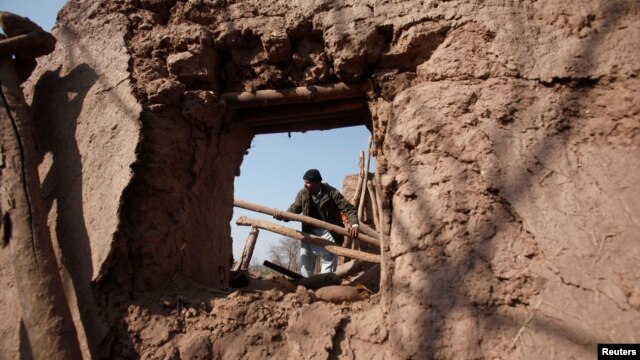
A resident collects items from the rubble of a house after it was damaged by grenades from gunmen on the outskirts of the northwestern city of Peshawar, Pakistan, Feb. 12, 2014.