 |
| A Malaysian Muslim woman pauses, during an event for the missing Malaysia Airline, MH370 at a shopping mall, in Petaling Jaya. |
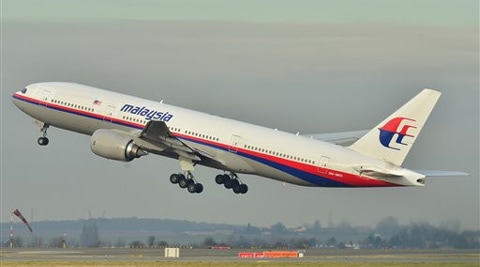
Ten days after a Malaysian jetliner disappeared, Thailand’s military said on Tuesday it saw radar blips that might have been from the missing plane but didn’t report it “because we did not pay attention to it.”
Search crews from 26 countries, including Thailand, are looking for Malaysia Airlines Flight 370, which vanished early March 8 with 239 people aboard en route from Kuala Lumpur to Beijing. Frustration is growing among relatives of those on the plane at the lack of progress in the search.
Aircraft and ships are scouring two giant arcs of territory amounting to the size of Australia — half of it in the remote waters of the southern Indian Ocean.
MH370 missing: Background checks clear Chinese nationals
Cmdr. William Marks, a spokesman for the U.S. 7th Fleet, said finding the plane was like trying to locate a few people somewhere between New York and California.
Early in the search, Malaysian officials said they suspected the plane backtracked toward the Strait of Malacca, just west of Malaysia. But it took a week for them to confirm Malaysian military radar data suggesting that route.
Military officials in neighboring Thailand said Tuesday their own radar showed an unidentified plane, possibly Flight 370, flying toward the strait beginning minutes after the Malaysian jet’s transponder signal was lost.
Air force spokesman Air Vice Marshal Montol Suchookorn said the Thai military doesn’t know whether the plane it detected was Flight 370.
Thailand’s failure to quickly share possible information about the plane may not substantially change what Malaysian officials now know, but it raises questions about the degree to which some countries are sharing their defense data. At a minimum, safety experts said, the radar data could have saved time and effort that was initially spent searching the South China Sea, many miles from the Indian Ocean.
“It’s tough to tell, but that is a material fact that I think would have mattered,” said John Goglia, a former member of the U.S. National Transportation Safety Board.
“It’s just bizarre they didn’t come forward before,” Scott Hamilton, managing director of aviation consultancy Leeham Co., said of Thai authorities. “It may be too late to help the search … but maybe them and the Malaysian military should do joint military exercises in incompetence.”
Flight 370 took off from Kuala Lumpur at 12:40 a.m. March 8 and its transponder, which allows air traffic controllers to identify and track it, ceased communicating at 1:20 a.m.
Montol said that at 1:28 a.m., Thai military radar “was able to detect a signal, which was not a normal signal, of a plane flying in the direction opposite from the MH370 plane,” back toward Kuala Lumpur. The plane later turned right, toward Butterworth, a Malaysian city along the Strait of Malacca. The radar signal was infrequent and did not include data such as the flight number.
When asked why it took so long to release the information, Montol said, “Because we did not pay any attention to it. The Royal Thai Air Force only looks after any threats against our country.” He said the plane never entered Thai airspace and that Malaysia’s initial request for information in the early days of the search was not specific.
“When they asked again and there was new information and assumptions from (Malaysian) Prime Minister Najib Razak, we took a look at our information again,” Montol said. “It didn’t take long for us to figure out, although it did take some experts to find out about it.”
The search area for the plane initially focused on the South China Sea. Pings that a satellite detected from the plane hours after its communications went down eventually led authorities to concentrate instead on two vast arcs — one into Central Asia and the other into the Indian Ocean.
Malaysia said over the weekend the loss of communications and change in the aircraft’s course were deliberate, whether it was the pilots or others aboard who were responsible.
Malaysian police are considering the possibility of hijacking, sabotage, terrorism or issues related to the mental health of the pilots or anyone else on board, but have yet to say what they have uncovered.
Investigators had pointed to a sequence of events in which two communications systems were disabled in succession — one of them before a voice from the cockpit gave an all-clear message to ground controllers — as evidence of a deliberate attempt to fly the plane off-course in a hard-to-detect way. On Monday, they backtracked on the timing of the first switch-off, saying it was possible that both were cut around the same time, leading to new speculation that some kind of sudden mechanical or electrical failure might explain the flight going off-course.
Malaysia Airlines CEO Ahmad Jauhari Yahya said some sort of problem aboard the plane was not out of the question, although he noted it still was intact enough to send a signal to a satellite several hours later.
As further confirmation that someone was still guiding the plane after it disappeared from civilian radar, airline pilots and aviation safety experts said an onboard computer called the flight management system would have to be deliberately programmed in order to follow the route taken by the plane as described by Malaysian authorities.
“If you are going to fly the airplane to a waypoint that is not a straight … route to Beijing, and you were going to command the flight management computer and the autopilot system, you really have to know how to fly the airplane,” said John Gadzinski, a U.S. Boeing 737 captain.
“If you were a basic flight student and I put you in an airborne 777 and gave you 20 minutes of coaching, I could have you turn the airplane left and right and the auto throttle and the autopilot would make the airplane do what you want,” he said. “But to program a waypoint into the flight management computer, if that is what they flew over, is a little bit harder.”
Investigators have asked security agencies in countries with passengers on board to carry out background checks.
China said background checks of the 154 Chinese citizens on board turned up no links to terrorism, apparently ruling out the possibility that Uighur Muslim militants who have been blamed for terror attacks within China might have been involved.
“So far there is nothing, no evidence to suggest that they intended to do harm to the plane,” said Huang Huikang, China’s ambassador to Malaysia.
A Chinese civilian aviation official has said there was no sign of the plane entering the country’s airspace on commercial radar.
A group of relatives of Chinese passengers in Beijing said they decided to begin a hunger strike to express their anger over the handling of the investigation.
One relative displayed a sign reading, “Hunger strike protest. Respect life. Return my relative. Don’t want become victim of politics, Tell the truth.”
The search for the aircraft is among the largest in aviation history.
The U.S. Navy said P-3 and P-8 surveillance aircraft were methodically sweeping over swaths of ocean, known as “mowing the grass,” while using radar to detect any debris in the water and high-resolution cameras to snap images.
Australian and Indonesian planes and ships are searching waters to the south of Indonesia’s Sumatra Island all the way down to the southern reaches of the Indian Ocean.
Huang said China had begun searching for the plane in its territory, but gave no details. When asked at a Foreign Ministry briefing in Beijing what this search involved, ministry spokesman Hong Lei said only that satellites and radar were being used.
China also was sending ships to the Indian Ocean, where they will search 300,000 square kilometers (186,000 square miles) of sea.
The area being covered by the Australians is even bigger — 600,000 square kilometers (232,000 square miles) — and will take weeks, said John Young, manager of Australian Maritime Safety Authority’s emergency response division.
“This search will be difficult. The sheer size of the search area poses a huge challenge,” Young said. “A needle in a haystack remains a good analogy.”
Britain’s Prime Minister David Cameron telephoned his Malaysian counterpart to offer the U.K.’s help in the first direct contact between the two since the flight disappeared, according to Downing Street.
Cameron did not offer specifics on what particular military or civilian assistance could be provided, the prime minister’s spokesman, Jean-Christophe Gray, said Tuesday.
“It was very much inviting any specific requests from the Malaysians,” Gray said. “Prime Minister Najib said he would think about that and let us know if they have any specific requests.”