Showing posts with label movie. Show all posts

Monday, 17 March 2014

Movie Review: Bewakoofiyaan: Fun But Inspiring

Bewakoofiyaan Review
Cast: Rishi Kapoor, Ayushmann Khurrana, Sonam Kapoor
Director: Nupur Asthana
Rating: Three and a Half Stars

Sometimes, love just ain't enough. So there we have two people in love. The pampered but not spoilt bureaucrat's daughter Mayera and her lover beau Mohit whose upward mobility is frozen by an employment meltdown in his airline organization (spicy allusion to the Kingfisher crisis, yes?)

It's Delhi's noveau riche Gurgaon world bathed in cosmetic conceit. Sonam Kapoor and Ayushmann Khurrana blend into this gleaming kingdom's excesses effortlessly. The two of them are so good as a couple, imagining them apart for even a portion of the bitterness that bites into the narrative during the second-half becomes unbearable.

Debutant director Nupur Asthana's film is a bright scrambled world of wealth, luxury and the yuppy club's unstated desperation to move up the corporate ladder. It is also, by its very definition, a ridiculously self-important delusional world.

Miraculously this film with its gleaming polished surfaces neither gasps nor laughs at the ignobility of upward mobility. There is an interestingly crafted fight scene between the film's lead pair where Mayera reminds Mohit that she has not bought a new pair of shoes during the last two months because of his job loss. That she doesn’t realize how ridiculous she sounds to Mohit is a measure of the underlining irony that the narrative scrapes out of these characters while portraying the exacerbated materialism of the go-getting generation.

Habib Faisal's writing is smart and amiable, crowded with quaint colloquialisms culled from the capital youngster's language. The writing also surprises itself by becoming inwardly-drawn and introspective at the most unexpected moments. That the screenplay has got Ayushmann to play the cool guy whose perfectly laid-out plans fall apart, is a stroke of luck for this likeable film.

Ayushmann looks like the guy next-door who wouldn’t mind pulling a few strings to float higher than the level allotted to him by fate. He brings a suave arrogance to his role and creates a cohesive graph for his character. He is an actor to watch.

Of course it helps Ayushmann that he has Rishi Kapoor to play his girlfriend's hawk-like father. Rishi’s character of the IAS officer on the verge of retirement (with a companion from his work place who typically, offers his "humble" advice on every matter) is brilliantly written.

Rishi's Sehgal is a pompous name-thrower with an inflated sense of self-worth, over-possessive about his only daughter's life and preferences. V.K. Sehgal is a striking image of a man on the verge of erupting into a self-deprecatory laughter, if he only he knew how funny his quirks look from the outside.

Rishi brings to the characters a cornocupia of "cool". Seldom in his any other recent film except Do Dooni Chaar has this brilliant actor expressed such pleasure in putting forward his character’s point of view. It’s no coincidence that film too was written by Faisal.

So many of Rishi Kapoor’s scenes with Ayushmann stand tall because of the way the two characters meet as adversaries who fortunately love the same girl in different ways. Sonam as the girl torn between an autocratic dad and unreasonable lover is so in-character you wonder whether the role and its fetish for designer labels were written specially for her.

Bewakoofiyan has nothing new to say. And that is its greatest virtue. It is Meet The Parents where the father and the prospective son-in-law's roles are better played than the original. Yes, Rishi and Ayushmann are better than Robert de Niro and Ben Stiller were in the Hollywood film about the father of the bride.

The narrative sparkles with a mischievous elegance. The winking homage to the go-getting glam-set of Delhi works mainly because the three protagonists are so immersed in the goings-on they make us forget that we've seen most of these conflicts over and over again in the past. In terms of the fluency with which the cliche about the love birds and the girl's disapproving dad is tackled, Bewakoofiyaan is a marked improvement on Yashraj Productions' last two pretentious hammy films Shuddh Desi Romance and Gunday.

Ayushmann's performance is oh not so hammy. A pure delight to behold after Ranveer Singh and Arjun Kapoor's over-energized bravado in Gunday.

Friday, 7 March 2014

Comedian Conan O’Brien to host MTV Movie Awards

imageLOS ANGELES: Comedian and late-night talk-show host Conan O'Brien will host this year's MTV Movie Awards, the unbuttoned show that irreverently honors Hollywood's best kisses and best fight scenes, the MTV network said on Wednesday.
It will be the first time that O'Brien, 50, has hosted the annual show, which will take place on April 13 at the Nokia Theatre in downtown Los Angeles and which serves as lead-in to the summer movie season.

Thursday, 6 March 2014

Shaadi Ke Side Effects movie review


Shaadi Ke Side Effects movie review

Cast:Vidya Balan, Farhan Akhtar, Ram Kapoor and Vir Das
Director: Saket Chaudhary

SPOILERS AHEAD

A man hits on a lonesome woman at a nightclub. The conversation reveals that both are married.

My workaholic husband has no time for me, the lady laments. My wife is busy watching television serials, retorts the guy.

The two head to a hotel room for a one-night stand. They are caught on the security cameras in the corridor.

The errant man is summarily summoned to the manager’s office and sternly ticked off. This is not “that kind of hotel”, he is told.

Turns out that the man and the woman are married to each other and this is their way of spicing up their relationship.

The sheepish hotel manager, left with egg on his face, finds himself at the receiving end of free tips on how best to keep his wife in good humour.

One crucial piece of advice that he receives goes thus: Marriage is… always having to say sorry. When you make a mistake, you apologise. When the wife makes a mistake, you still apologise. And life goes on…

If you think that opening sequence, with its sly but predictable flurry of witticisms, is comical enough, you might also like the rest of Shaadi Ke Side Effects. The film unfolds in pretty much the same vein.

On a basic plot level, director Saket Chaudhary’s second film seems to have drawn inspiration from the 1988 John Hughes comedy, She is Having a Baby.

The Hollywood film ended with a pregnancy; Shaadi Ke Side Effects employs the birth of the baby as the starting point of the story.

The wafer-thin tale is livened up by some snappy writing and competent acting all around.

The principal characters, struggling musician Siddharth and successful adwoman Trisha, are generally likeable and believable.

So are the piquant situations that they must grapple with in their bid to balance their individual compulsions with the demands of bearing and bringing up a child.
A bawling baby, a snoring dad and an overprotective mom are the perfect recipe for severe spousal stress.

Trisha takes to the job of playing mommy with instinctive ease. It is Sid who makes a complete mess of the attempt to be “the best dad in the world”.

The screenplay (Zeenat Lakhani and Saket Chaudhary) ensures that the plot remains firmly rooted in the realms of reality.

However, the efforts to blend humour, emotion and philosophy do not always come off.
One good aspect of Shaadi Ke Side Effects is that it plunges into the business end without much fuss.

So there is no whirlwind romance or fairy-tale wedding or heady honeymoon before the complications brought on by dull domesticity intervene.

The first half of Shaadi Ke Side Effects is somewhat listless. But the film perks up considerably post-intermission.

Staid Sid, egged on by his sis-in-law’s hubby Ranvir (Ram Kapoor), decides to turn overly adventurous in order to put some spart back into his marriage. That triggers a series of missteps that put his relationship with his wife in serious jeopardy.

Shaadi Ke Side Effects, via the words of Ranvir, hands out some dodgy pop psychology to justify a somewhat far-fetched ‘formula’ for a happy marriage.

White lies, some harmless subterfuge and an occasional return to the joys of a “carefree single life” are offered as a way out of marital drudgery.

Sure enough, the side effects of that formula are far too many for comfort and they boomerang many times over on Sid.

Shaadi Ke Side Effects isn’t exceptionally engaging fare. It is essentially a single idea stretched to the very end of its tether.

Yet, the sheer ordinariness of the circumstances that the story hinges on helps the film retain its amusing core.

Trisha, rational working woman turned emotional nut case, puts her career on hold and relegates her hubby to the fringes of her life.

She frets and fumes obsessively and excessively about her daughter’s needs and over putting on weight.

Sid, too, is a guy next door seeking avenues to move beyond singing jingles.

You don’t have the looks of a musician, he is told by a newfound pal – “an accountant, a salesman, a Maoist, but not a musician.” That indeed makes him all the more real.

Sadly, a large part of Shaadi Ke Side Effects, despite charming pivotal performances by Farhan Akhtar and Vidya Balan, has nothing new to offer beyond convenient homilies on gender politics within the confines of a marriage.

The supporting cast members – notably Ram Kapoor, Ila Arun, Purab Kohli and Vir Das (in what is billed as “a not so special appearance”) – are first-rate. However, Rati Agnihotri, in the role of the female protagonist’s widowed mother, is wasted.

Shaadi Ke Side Effects is recommended because, despite its flaws, it is passable fun while it lasts.

bewakoofiyaan Overview

Bewakoofiyaan

Director: Nupur Asthana

Plot: The story is about Mohit, a marketing whiz kid vying for a step up the career ladder and Mayera, a financial brain with a penchant for shoes. A young middle-class corporate couple that’s ambitious and likes the good life too. They work hard and party hard! The couple is passionately in love with each other and believe that they can live on love and fresh air! Too filmy isn’t it?
But, well as every other filmy couple, Mohit and Mayera too have a obstacle in their love life! It’s Mayera’s willful bureaucratic father V.K Sehgal. The obstinate old man believes that only a rich man can bring Mayera happiness and a mid-level executive like Mohit simply isn’t good enough!
Exactly how fragile are relationships in these times where consumer lifestyles dictate their very nature and intensity? Who gets the last laugh when recession strikes and the lack of money tests love… credit-card-junkies private-sector Mohit-Mayera; or safe-playing sarkari, V.K. Sehgal?

Actors: ,
Actress:

Movie Review: Gulabi Gang

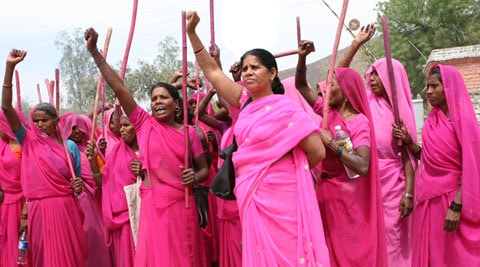
'Gulabi Gang', Nishtha Jain's award-winning documentary gives us an up-close view of Sampat Pal and her gang, which fights for injustice where it is most needed.

The 1.5 hour film is an important document. Because women, usually classified with the 'other' backward classes, and 'dabey-kuchley varg', are for burning, and raping, and humiliating.  
The 1.5 hour film is an important document. Because women, usually classified with the 'other' backward classes, and 'dabey-kuchley varg', are for burning, and raping, and humiliating.


The district is Banda, and the region, Bundelkhand, in UP. And an organization that has steadily been a media magnet for what it has managed to do: in the rural backwaters of North India, where years of heavy-handed, violent patriarchy has stunted the growth of women and killed the girl child, a woman has taken on all comers. ‘Gulabi Gang’, Nishtha Jain’s award-winning documentary gives us an up-close view of Sampat Pal and her gang, which dons pink ‘saris’, and hefts ‘lathis’, and fights against injustice where it is most needed.
The 1.5 hour film is an important document. Because women, usually classified with the ‘other’ backward classes, and ‘dabey-kuchley varg’, are for burning, and raping, and humiliating. Because anyone who takes up cudgels on their behalf is to be acknowledged and praised. And there’s the middle-aged, vocal Pal, one among them, and a natural leader, having it out with surly men-folk of a neighbouring village where a young wife has been charred. The husband claims he wasn’t there. His family says it was an accident which happened while cooking. Her father doesn’t want to take the case further. It is only when we meet the dead woman’s mother, blind and helpless, that we hear the truth.
You watch, in admiration, as Pal and her acolytes (gang-members who, upon signing up, are given ‘gulabi’ saris, and a ‘lathi’-wielding training) shout down a local ‘thanedar’. He starts off belligerent, but when Pal takes the case to his seniors, he becomes a man who may have to listen to a mere woman. And you see the uphill fight Pal has on her hands when one of her ‘gang’ members leaves : the woman, who spent a good many years with the gang, endorses the age-old view of how, if a brother doesn’t like what a sister does (in this instance, fall in love), he is within his rights to put an end to her life. Nothing Pal nor anyone else says can shift her position.
Jain spent five months on and off with Pal, and tracked her as she goes from one village to another. And we see the solid work that has gone into the making of the film. But it did leave me asking a few questions. Why was it called the ‘Gulabi’ gang? In a ‘q and a’ after the film, Jain said that Sampat had talked about other colours being taken already: I would have liked to see that in the film, because it tells me something crucial.
Also, I wanted to know how a village woman, however feisty she may have been, became so comfortable with the knowledge she displays in the film: when did she, for example, first hear of the funds the government has earmarked for the development of districts such as hers? She is also clearly very much at ease with the camera. Was she always so? How did she turn so media savvy? Does the person wielding the camera put words into the mouth of their interviewee when they ask: “aapko gussa nahin aata”? (do you not feel angry). Very rarely will you get a `no’ for an answer, especially when this is asked in a charged situation. Why would you need to have such a leading question in circumstances where you can see the simmering anger? Jain does show Sampat’s other side, though, even if briefly. She appears to be quite belligerent, heckling the men in the village. And also quite an autocrat: we leave her with her hands being pressed by another pink sari-clad woman sitting next to her, which Sampat seems to enjoy and accept as her right.
Clearly, Sampat is a remarkable woman, and a remarkable story.