It's a big day for Nokia today - it just announced the new crop of
Lumia phones, which are the first members of the family to run on the
new Windows Phone 8 platform. The future of the Finnish giant is riding
on the success of these new phones, so the whole tech industry is
watching with bated breath.
The first device Nokia announced is the Lumia 920, "the most
innovative smartphone in the world". As expected, the camera has Carl
Zeiss lens and Nokia's PureView technology.
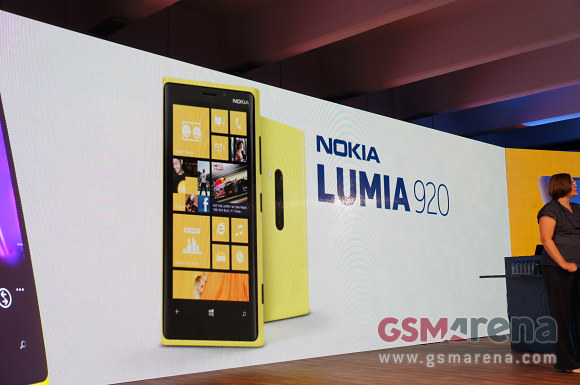
The 920 is the new Nokia flagship and promises better images and
better video than competitors. It has an 8MP sensor, unlike the 808, but
the PureView tech enables better image stabilization and better
low-light performance.
The screen on the Lumia 920 is an LCD with 768x1280 resolution. It's
pixels update "up to 2.5x faster" than other LCD screens and is also the
brightest screen on a smartphone. It is "super sensitive" too, Nokia
demonstrated that it works even through thick winder gloves. The
ClearBlack technology has been improved and is now PureMotion HD+ - it
automatically adjusts the screen tone and brightness according to the
ambient light
Nokia Lumia 920 hands-on
After the Nokia Lumia 920 was handled on stage by various Nokia and
Microsoft employees, we finally got our turn at playing with the
smartphone.
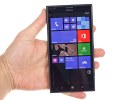
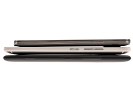
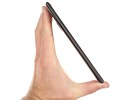
The Lumia 920 is not a small device, but for its 4.5" screen it's
actually not bad - it's only marginally bigger than a Lumia 900. Still,
at 185g it's one of the heaviest smartphones out there. The shell of the
phone is a polycarbonate unibody that's 10.7mm thick and the back is
curved, which really improves handling.
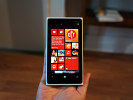 Nokia Lumia 920
The overall design harkens back to the Nokia Lumia 800, though the polycarbonate is glossier.
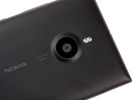
The horizontal camera placed near the center of the back is a nod
towards the Lumia 800 too. The Lumia 920 camera is flush with the back,
even though Nokia added the impressively souding optical image
stabilization - a first for smartphones.
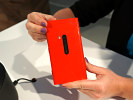
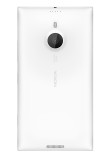
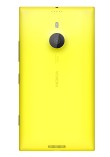
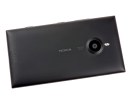
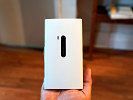 The back of the Lumia 920
The Nokia Lumia 920 has a PureView-branded camera, but misses on the
41MP sensor - it uses an 8.7MP sensor instead. Still it has the image
stabilization and the super bright F/2.0 aperture plus Carl Zeiss lens,
and according to Nokia those allow for unrivaled image quality in
low-light conditions. The phone also comes with three Lens apps be
preloaded - SmartShot, Cinemagraph and Panorama.
"PureView" stands for innovative camera features, not a megapixel
count (Nokia has been saying that right from the start, that's why the
808 PureView shoots 5MP images by default).
By the way, the plate surrounding the camera on the back as well as
the keys on the side of the device are made of ceramic that Nokia tells
us is nearly impossible to scratch.
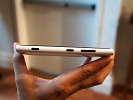
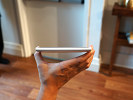
 Durable ceramic keys on one side • nothing on the other side
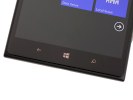
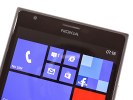
Moving on to the front of the Lumia 920, its IPS LCD screen features
the same curved glass we saw on the Lumia 800 (Nokia calls it "2.5D")
and uses some brand new technologies that Nokia refers to as PureMotion
HD+.
The image on the screen appears as if painted right on the very
surface of the screen - something we really appreciate. Even though it's
not an AMOLED, the viewing angles are great and so are the colors. The
new display tech automatically adjust the screen settings to fit the
ambient light.
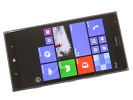
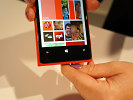 A close-up of the 4.5" PureMotion HD+ display
The screen glass is Gorilla glass and there's Synaptics touch tech.
As we saw during the demonstration, the screen will detect touches even
if you're wearing gloves but it's even better than that - you can use
your fingernails (good for the ladies) or even use your car keys as an
improvised stylus.
The Nokia Lumia 920 comes with two wireless technologies that Nokia
thinks will be huge - NFC and wireless charging. NFC comes into play
with the new Bluetooth speakers, but also for content sharing and NFC
features from WP8.
As for wireless charging, the 920 supports Qi technology, so it will
work with any Qi-compatible charger. There were three chargers that
Nokia showcased - a somewhat boring looking plastic charger, a soft
Fatboy pillow charger and the JBL PowerUp Bluetooth wireless speaker.
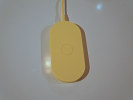
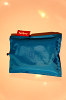
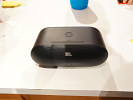 Regular charger • Fatboy • JBL PowerUp
One thing that the Nokia Lumia 920 doesn't have (and we wish it did)
is a microSD card slot - you have to rely on the 32GB built-in storage
(plus that 7GB SkyDrive storage). The design allows it (as we saw on the
N9 and Lumia 800) and the OS supports it too (the new Lumia 820 has a
microSD card slot), so we don't know why Nokia decided to do without it
here.
The battery is also not user-replaceable (a more understandable
consequence of the unibody design), but there's a 2000mAh juice pack in
there. Official numbers promise 17h of 2G talk time and 10h of 3G
talking.
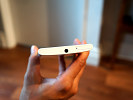
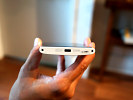
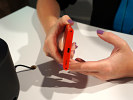
Nokia Lumia 820 hands-on
The second device introduced by Nokia is the smaller brother of the new Lumia flagship, the Lumia 820.
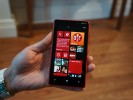
 The Nokia Lumia 820
It features a 4.3" AMOLED display of WVGA resolution and, while the
resolution is lower, the AMOLED part is actually a step up from the 920.
Sadly the Lumia 820 misses on the PureMotion HD+ fun. Inside, there's
the same 1.5 GHz dual-core Krait and 1 GB of RAM, but a smaller 1650 mAh
battery, and 8 GB of storage.
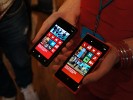
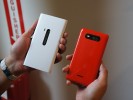 Side-by-side with the Lumia 920
Another advantage of the more affordable Nokia Lumia 820 over the
Lumia 920 is the presence of a micro SD card slot, which supports cards
up to 32 GB in size.
As the Windows Phone 8 interface isn't finalized yet, we can't go
much in depth from that standpoint, but we will give you our impressions
of the hardware.
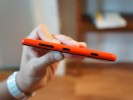
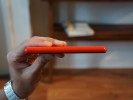 The 820's solid construction
The overall construction of the device does not feature a curved
front glass display like the 920, but has a glossy paintjob which looks
like it will attract fingerprints with regular use.
The WVGA resolution makes the display really pale in comparison with
the 920, but seeing as how they have the same internals, we expect the
820 to be zippier due to the lower amount of pixels it has to push.
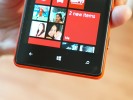 Close-up of the Lumia 820 screen
The construction shows the same meticulous attention to detail characteristic of Nokia, and the device feels very solid in-hand.
The phone also packs features like wireless charging with the Fatboy
pillow (which has Qi tech inside), NFC, Nokia City Lens augmented
reality app and so on.
The second phone announced today is the Nokia Lumia 820. It's a more
compact device than the 920 and uses a 4.3" ClearBlack AMOLED display
with WVGA resolution. It's a polycarbonate unibody design too, but has
protective shells that go on the back to add a new color to your phone
or enable the same wireless charging you get on the 920.
The camera is a 8MP shooter with Carl Zeiss lens, though it's not a
PureView camera. It still gets some of the interesting new camera
features that Microsoft just showed off.
Microsoft had some new features of Windows Phone 8 to announce too, so it's not just new hardware that we saw today.
Join us on the next page for the Nokia Lumia 920 hands-on. The Lumia
820 live photos, garnished with our first impressions are on page 3.
Key Features: 4.5in HD IPS LCD screen;
1.5GHz dual-core processor;
Windows Phone 8 OS;
8.7MP camera with 1080p video and optical stabilisation
Manufacturer: Nokia
Nokia Lumia 920 review
What is the Nokia Lumia 920?
The Nokia Lumia 920 is technically one of the most exciting phones available but it has been supersceded by the
Nokia Lumia 1020.
Not only does it have features like an optically stabilised camera for
blur-free night time shots and inbuilt wireless charging to do away with
pesky cables but it also has the growing in capability Microsoft
Windows Phone 8
operating system that's been imbued with a host of Nokia extras.
However a smartphone isn't about any single feature but the device as a
whole, so how does the Lumia 920 fare?
Nokia Lumia 920 - Design
Nokia
has always had a pretty good eye for design and that was no more in
evidence than on the company's last flagship phone the
Nokia Lumia 800,
which we thought the best looking phone of its time. Here then the
company has simply taken that same design and made it a bit bigger.
The
whole phone is hewn from one piece of polycarbonate plastic into which
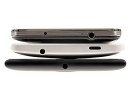
is set the slightly curved screen. To keep the whole thing looking as
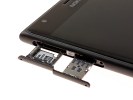
seamless as possible all the ports and slots are kept in the flat ends,
with just the buttons ranged up the right edge. The unbroken effect it
creates gives the phone a wonderfully premium feel, particularly thanks
to the quality of plastic used – the colour is in the plastic so doesn’t
scratch off like paint does.
Read more at http://www.trustedreviews.com/nokia-lumia-920-pureview_Mobile-Phone_review#qif4iA3O8OHQCVeM.99