Showing posts with label shots. Show all posts

Thursday, 26 June 2014

Flu spray better than shots for young kids


ATLANTA: When it comes to flu vaccines, a federal panel says a squirt in the nose is better than a shot in the arm for young children.

The advisory panel voted Wednesday to advise doctors that FluMist nasal spray is a bit better at preventing flu in healthy young kids. The recommendation is specific to ages 2 through 8 only.

Some studies have found that kids within that age group are about half as likely to get the flu if they had the spray vaccine instead of a shot.

Federal health officials usually adopt the recommendations of the Advisory Committee on Immunization Practices. A flu vaccine is now recommended for virtually everyone over 6 months old.

AstraZeneca's FluMist is the only spray vaccine on the market. It was first licensed in 2003 and is approved for healthy people ages 2 to 49. Unlike flu shots made from a killed virus, it is made from a live but weakened flu virus.

Experts say the spray prompts a better immune response in children who may have never been infected with flu before, but there isn't a clear difference in adults.

The nation's largest pediatrician's group, however, objected to giving preference to the spray for kids. A representative of the American Academy of Pediatrics noted FluMist is more expensive, it can't be used for everyone and doctors have already ordered their vaccine doses for the fall flu season.

Dr. Michael Brady of Ohio State University also said the vote hinged on studies that were done before flu vaccine was encouraged for most children and vaccination rates were much lower. It's possible fresher data might not show such a difference, he said.

"We really feel you shouldn't place (doctors) and families in a situation where if they don't receive the live vaccine, they feel they're getting an inferior product. Because it may not be an inferior product," he said.

Health officials at Wednesday's meeting stressed that if doctors don't have FluMist in stock, flu shots are perfectly fine — both work. FluMist costs about $23; shots range from about $8 to $22.

Of children ages 2 to 17 who get a flu vaccine, 44 percent get FluMist, according to AstraZeneca. The company decided to make more for the coming flu season — 18 million doses, up from 13 million last year — partly in anticipation of the panel's vote, said Kathleen Coelingh, senior director of US medical affairs.

Tuesday, 3 June 2014

New allergy tablets offer alternative to shots


TRENTON: For decades, seasonal allergy sufferers had two therapy options to ease the misery of hay fever. They could swallow pills or squirt nasal sprays every day for brief reprieves from the sneezing and itchy eyes. Or they could get allergy shots for years to gradually reduce their immune system's over-reaction.

Now patients can try another type of therapy to train their immune system, new once-a-day tablets that dissolve quickly under the tongue and steadily raise tolerance to grass or ragweed pollen, much like the shots.

"It's been several decades since the last big breakthrough," Cleveland Clinic allergy specialist Dr. Rachel Szekely said.

The downside: The pills must be started a few months before the grass or ragweed pollen season. That means it's too late for people with grass allergies, but the time is now for ragweed allergy sufferers.

The Food and Drug Administration in April approved two tablets from Merck, Grastek for grass pollen and Ragwitek for ragweed, plus a grass pollen tablet called Oralair from Stallergenes.

The tablets could become popular with people who dislike pills that can make them drowsy or don't provide enough relief. They'll likely appeal even more to patients with severe allergies who fear needles or can't make frequent trips to the allergist, key reasons that only about 5 percent of U.S. patients who would benefit from allergy shots get them.

Meanwhile, new treatments for other types of allergies, including to peanuts and eggs, are in various stages of testing and could turn out to be big advances.

Drugmaker Merck & Co. has a tablet for house dust mite allergies in final patient testing that could hit the market in two or three years, and it's considering other therapies. France's Stallergenes SA is testing a tablet for birch tree allergies and, with partner Shionogi & Co. Ltd. in Japan, tablets for allergies to dust mites and Japanese cedar pollen. Britain's Circassia Ltd. has a cat allergy treatment in final testing and six others in earlier testing.

A handful of companies also are looking at possible new ways to administer immunotherapy, including drops under the tongue, capsules and skin patches, said Fort Lauderdale, Florida, allergist Dr. Linda Cox, former president of the American Academy of Allergy, Asthma and Immunology.

The new tablets are not right for everyone, particularly patients with allergies to multiple substances, Szekely cautioned.

That was the case with one of her patients, 10-year-old Samantha Marshall of Mentor, Ohio, who has been getting allergy shots since last fall.

"She's not loving them," said her mother, Rachel, who recently asked Szekely about switching to the tablets. Szekely explained that shots are more effective because Rachel is also allergic to weeds and dust mites, and the shots she receives are a customized mix of extracts to all those substances.

The tablets are also pricey: Merck, based in Whitehouse Station, New Jersey, is charging about $8.25 per daily tablet and Stallergenes about $10. Insurers are expected to cover most of the cost, as they usually do with allergy shots. Those generally cost only $15 to $25 per visit without insurance, because they're given by a nurse.

Allergy tablets are less likely to trigger a dangerous allergic reaction than shots, which have been used for a century, Cox said.

In Merck's testing, about 5 percent of patients experienced tingling, itching or swelling in the mouth or tongue, said Dr. Sean Curtis, Merck's head of respiratory and immunology research. Less than 1 percent had serious reactions, nearly all after the first dose.

Longtime hay fever sufferer Kim Steen of Sidman, Pennsylvania, participated in one of Merck's studies last year.

"After the second, maybe third week, I started noticing a difference in the symptoms," said the 41-year-old contracts administrator. "It was pretty significant, not feeling like you have a cold all the time."

Prevalence of hay fever in the U.S. has declined slightly since 2000, according to National Center for Health Statistics data. In 2012, about 17.6 million adults, or 7.5 percent, reported having hay fever, as did about 6.6 million children, or 9 percent. Millions more don't see a doctor and get by with nonprescription medicines like Benadryl or Claritin.

Treatment can be tricky because of body chemistry differences and the complexity of the immune system, which is still poorly understood.

"You can't just have one size fits all," Szekely said.

For people with mild hay fever, inexpensive pills that suppress immune chemicals called histamines work well. Allegra, Benadryl, Claritin and Zyrtec are available without prescription, often competing with store brands.

Other patients fare better on prescription pills or nasal sprays. But for patients with severe allergies, those aren't enough. They suffer - though hardly in silence - or try allergy shots.

Rarely, the shots cause systemic allergic reactions, from hives and itching to dangerous airway narrowing, because small amounts of allergen circulate in the bloodstream. That's why patients must be observed by a nurse for a half-hour after each shot.

With the new tablets, as they dissolve, the grass extract inside drains into lymph nodes in the neck, which produce protective antibodies against the effects of pollen that's inhaled or gets in the mouth. Since the extract is unlikely to enter their blood, patients need only be watched the first time, then can take the pills at home.

Typically, patients get allergy shots of gradually increasing dosage two or three times a week initially, then once a week for up to nine months, then monthly. After three years, at least two-thirds have minimal symptoms, while most of the rest have reduced symptoms.

With the tablets, patients start at the top dose, at least three months before allergy season, and continue through the season or even year-round.

The grass pollen tablets aren't likely to take off until next spring, although Stallergenes' U.S. marketing partner, Greer Laboratories Inc. of Lenoir, North Carolina, made Oralair available and began promoting it to allergy specialists in May.

Merck has followed study participants through three years of treatment and then two years after that, when patients still reported significantly reduced symptoms.

But Cox, the Florida allergist, expects that benefit to last at least eight years after treatment ends, nearly as long as with allergy shots.

It won't be clear whether the tablets will be a hit with patients or big moneymakers for their manufacturers until next spring, when patients and more doctors will be familiar with them.

Monday, 7 April 2014

Who is calling the shots in BISP?

ISLAMABAD: A powerful District management Group (DMG) officer sacked twice by the Punjab government for dismal performance and negligence is again in hot water for massive irregularities in multi-billion Benazir Income Support Programme (BISP), ‘The News’ has learnt.

According to documents available with ‘The News,’ the new BISP Secretary Rab Nawaz made payment of Rs2.6 million to an NGO owned by a US-national without approval of the scrutiny committee just a few days after assuming his post.

The powerful secretary has also immediately removed an honest internal auditor who had unearthed the corruption of Rs150 million in award of a consultancy contract worth Rs2.63 billion.

When contacted, BISP Chairman Enver Baig confirmed that due process was not followed by the secretary in releasing the payment to the NGO. “It has come to my notice, and I will take necessary action over the issue,” Baig added.

Nawaz, a BPS-20 officer, has already been served notices by BISP Chairman Enver Baig, but he denies both allegations saying that he took these actions on merit.But the past record of the new BISP secretary is far from being ideal. He was removed from the post of the Punjab Irrigation and Power Secretary after he was found guilty of negligence during devastating floods of 2010 by a judicial commission, constituted by Punjab Chief Minister Shahbaz Sharif.

The commission has not only recommended immediate removal of Rab Nawaz from the post but also asked for inquiry against him after he was found responsible for loss of hundreds of lives and of property worth tens of billions of rupees.

The report of the commission concluded that the officer had failed to meet the monumental challenge of two floods in the River Indus during the 2010 monsoon, causing widespread devastation. But the officer of the powerful District Management Group again managed to get the prize posting in the province as secretary energy. However, he could not satisfy the fast-paced chief minister with his performance in the energy sector and was subsequently removed for failing to initiate any new power project in the province.

But sources said this past record could not deter a powerful federal minister from orchestrating his posting as BISP secretary last month. Immediately after his posting, Mr Nawaz released a payment of Rs2.6 million to a US-based NGO which is locally run by two retired military officers. The BISP chairman took serious notice of the irregularity and issued a notice to the secretary to explain as to why the agreed procedure was not followed.

“Chairman has taken serious view of the situation especially when this was emphasised by the BISP secretary during weekly meeting that all outstanding liabilities are to be submitted to secretary after the scrutiny committee meeting,” says the letter No2(9)/DS/HR(CP)BISP-2013, dated April 2, 2014. Sources said the second action taken by the secretary was to remove Muhammad Saleem, Director Internal Audit at BISP, who pointed out massive irregularities in award of a multi-billion contract to a service provider.

In his audit report, titled ‘Internal Audit of BISP Donor Funded Projects for the Financial Year 2011-12 and 2012-13’, Saleem disclosed that some BISP officials gave undue favour to a consultant causing a loss of Rs149.84 million to the programme.

The report says BISP hired consultancy services to the tune of Rs2,630,889,571 for undertaking various activities like Poverty Scorecard Survey, Impact Evaluation, Spot Check and baseline Survey in January 2011. “It has been observed that instead of deducting income tax from the total cost of the contract, additional provision has been made for income tax amounting to Rs149,845,152,” says the report, a copy of which is available with ‘The News’.

“The consultant submitted financial proposal exclusive of taxes which means indirect taxes will be added to the cost, but the BISP management added value of direct tax i.e. income tax which is against the provisions of Section 152 and 153 of the Income Tax Ordinance 2001,” says the report.

Instead of being rewarded for his work, the officer was transferred by the BISP secretary. This is despite the fact that Internal Auditor is supposed to directly report to the chairman and not to the secretary. The influence of the DMG officer is evident from the fact that he managed to get posting of a Grade-21 officer from BISP to Inter-Provincial Coordination (IPC), reversed within 7 days of his transfer.

“The Establishment Division’s notification dated March 27, 2014, regarding transfer of Dr Mukhtar Ahmad, a BPS-21 officer of the Secretariat Group from the post of BISP director general and his posting as IPC Division’s senior joint secretary is hereby withdrawn, ab initio,” says a notification issued on April 3, 2014.

Sources said the BISP chairman was not happy with the performance of Dr Mukhtar, but the secretary managed to bring back his blue-eyed DG in the programme within a week. When contacted for his version, BISP Secretary Rab Nawaz said that the payment of Rs2.7 million was released on merit. He said the service provider had submitted his bill six months ago but the scrutiny committee never met nor examined his case.

“So I asked the service provider to hold a presentation in the presence of the committee members and when no one objected to the performance of the said service provider I directed them to release the payment,” he said.

Referring to the transfer of the internal auditor, Nawaz said the officer had completed his five-year tenure so he was transferred. He also claimed that there were certain audit paras against him.

The secretary added that he was asked to work in BISP on the basis of his past experience with poverty reduction programmes in Pakistan and abroad and with foreign funding agencies.“I have worked with Asian Development Bank, IFAD and UN agencies on poverty alleviation so the government decided to appoint me in BISP,” he said.

When asked about reversal of the transfer of Dr Mukhtar Ahmad, done on his own request, within seven days, the secretary said Mr Ahmad had worked with BISP for four years so he had institutional memory and as a new incumbent he needed his help to get full understanding of the programme.

“During first week of my arrival in BISP, Dr Mukhtar was transferred and there was no one to brief me about important issues so I requested the Establishment Division to allow him to stay back for some time so that I can better understand the programme during my initial period,” he said.

When asked about the reports that he was sacked twice in Punjab over poor performance, Mr Nawaz denied these reports and said that it was a matter of official record if someone would bother to check. And as for his integrity and repute was concerned, that could easily be verified from anyone in the offices he previously served.

He was asked about the reports that the Flood Enquiry Tribunal had held him responsible for poor management of the flood, he replied that Punjab government had not agreed with commission’s findings and therefore, no action was initiated against him.

About the institutional issues in BISP, the secretary said that no proper rules had been framed in BISP to define the roles and guide the work of various offices. Once the rules were framed, there would be no issue in proper working of BISP, he said.


Monday, 10 March 2014

Gunmen fire shots in air during raid at Crimean naval base

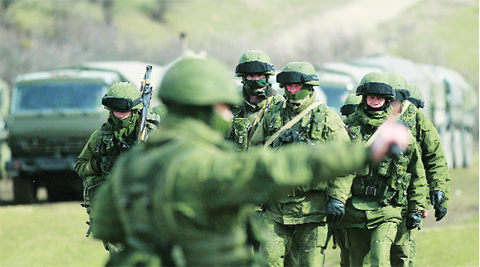
Armed men, believed to be Russian servicemen, march outside an Ukrainian military base in the Crimean city of Simferopol Monday. Reuters
Unidentified armed men fired in the air as they moved into a Ukrainian naval post in Crimea on Monday in the latest confrontation since Russian military groups seized control of the Black Sea peninsula.
With diplomacy at a standstill, Russia said the United States had spurned an invitation to hold new talks on resolving the crisis, the worst East-West standoff since the Cold War.
Ukrainian Prime Minister Arseny Yatseniuk, who said he would address the UN Security Council on Thursday, put the blame for the crisis on Russia and accused Moscow of undermining the global security system by taking control of Crimea.
Russian forces have in little more than a week taken over military installations across Crimea, home to the Russian Black Sea Fleet and Russian territory until Soviet leader Nikita Khrushchev gave it to Ukraine in 1954.
Pro-Russian separatists have taken control of the regional parliament, declared Crimea part of the Russian Federation and announced a referendum for Sunday to confirm this.
President Vladimir Putin says Moscow is acting to protect the rights of ethnic Russians, who make up a majority of Crimea’s population, after Ukraine’s president Viktor Yanukovych was ousted in what Russia says was an unconstitutional coup.
On Monday, a group of about 10 unidentified armed men fired in the air at a Ukrainian naval post in Crimea, a Ukrainian defence spokesman was quoted as saying.
Ukraine’s Channel 5 television quoted Vladislav Seleznyov as saying the shooting took place at a motor pool base near Bakhchisaray. The men in two minibuses drove into the compound and demanded Ukrainian personnel there give them 10 trucks.
Earlier, Interfax Ukraine news agency quoted an unnamed Ukrainian official describing the men as Russian troops and saying none of the Ukrainians at the site was injured.
Russian forces, who have been in control of Crimea for more than a week, have not so far exchanged fire in anger with Ukrainian troops. Shots were fired over the heads of a group of Ukrainians during a standoff at a military airfield last week.
In other armed action, Russian forces took over a military hospital and a missile unit. Reuters correspondents also saw a big Russian convoy on the move just outside the port city of Sevastopol near a Ukrainian air defence base.
It comprised more than 100 vehicles, including around 20 armoured personnel carriers, plus mobile artillery.
Russian Foreign Minister Sergei Lavrov told Putin that Russia’s position on Ukraine remained at odds with the West, but US Secretary of State John Kerry had declined an invitation to visit Russia Monday for talks. “It is all being formulated as if there was a conflict between Russia and Ukraine.,” Lavrov told Putin.