 |
| Ukrainian riot police stand at the entrance of the regional
administrative building during a pro Russian rally in Donetsk, Ukraine.
(AP) |
Dozens of military trucks transporting heavily armed soldiers rumbled
over Crimea’s rutted roads Saturday as Russia reinforced its armed
presence on the disputed peninsula in the Black Sea. Moscow’s foreign
minister ruled out any dialogue with Ukraine’s new authorities, whom he
dismissed as the puppets of extremists.
The Russians have denied their armed forces are active in Crimea, but
an Associated Press reporter trailed one military convoy Saturday
afternoon from 25 miles (40 kilometers) west of Feodosia to a military
airfield at Gvardeiskoe north of Simferopol, over which a Russian flag
flew.
Some of the army green vehicles had Russian license plates and
numbers indicating that they were from the Moscow region. Some towed
mobile kitchens and what appeared to be mobile medical equipment.
Vladislav Seleznyov, a Crimean-based spokesman for the Ukrainian
armed forces, told AP that witnesses had reported seeing amphibious
military ships unloading around 200 military vehicles in eastern Crimea
on Friday night after apparently having crossed the Straits of Kerch,
which separates Crimea from Russian territory.
“Neither the equipment, nor the paratroopers have insignia that
identify them as Russian, but we have no doubt as to their allegiance,”
Seleznyov said.
The amphibious operation appeared to be one of the largest movements
of Russian military forces since they appeared in Crimea a week ago.
Seleznyov also said a convoy of more than 60 military trucks was
spotted Saturday heading from Feodosia toward Simferopol, the regional
capital. An AP reporter caught up with the convoy and trailed it to
Russian-controlled airfield. In the rear of the vehicles, heavily armed
soldiers could be seen, though none appeared to have identifying badges
or insignia. Soldiers spat at the reporters following them.
The regional parliament in Crimea has set a March 16 referendum on
leaving Ukraine to join Russia, and senior lawmakers in Moscow said they
would support the move, ignoring sanctions threats and warnings from
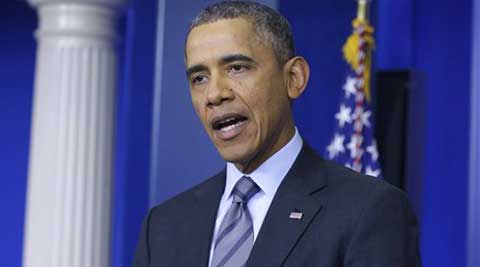
President Barack Obama that the vote would violate international law.
The strategic peninsula in southern Ukraine has become the flashpoint
in the battle for Ukraine, where three months of protests sent
President Viktor Yanukovych fleeing to Russia. A majority of people in
Crimea identify with Russia, and Moscow’s Black Sea Fleet is based in
Sevastopol, as is Ukraine’s.
While the U.S. and the EU urged Russia to engage in dialogue with new
Ukrainian authorities, the Kremlin has refused to do so, denouncing the
change of power in Ukraine as an “unconstitutional coup.”
Russian Foreign Minister Sergey Lavrov said Moscow sees no sense in
having a dialogue with Ukraine’s new authorities because, in his view,
they kowtow to radical nationalists.
“The so-called interim government isn’t independent, it depends, to
our great regret, on radical nationalists who have seized power with
arms,” he said at a news conference. He said that nationalist groups use “intimidation and terror” to control Ukraine.
Despite that tough talk, the Russian Foreign Ministry said Grigory
Karasin met Saturday with Ukrainian Ambassador Volodymyr Yelchenko, the
first such diplomatic contact since the crisis began. In a terse
statement, the ministry said only that they discussed issues related to
Russian-Ukrainian ties in a “sincere atmosphere.”
At a news conference in Kiev, Ukraine’s new foreign minister, Andrii
Deshchytsi spoke hopefully about creation of a contact group made up of
foreign ministers of various countries to mediate the crisis. Forming
the group was an idea discussed during meetings between Ukraine’s prime
minister and European Union leaders in Brussels on Thursday.
Deshchytsi said that he learned from mediators that Russia hasn’t
“categorically’ refused the idea of permitting a contact group to help
broker an end to the dispute.
“The Russians are thinking,” Deshchytsi said, so there is “reason to
hope.” He reiterated that the new Ukrainian government understands it is
vital to need to establish good relations with all neighbors, including
Russia.
Russia’s President Vladimir Putin has said that Moscow has no
intention of annexing Crimea, but that its people have the right to
determine the region’s status in a referendum.
The Crimean referendum has been denounced by Ukraine’s new
government, and Obama has said it would violate international law. The
U.S. moved Thursday to impose its first sanctions on Russians involved
in the military occupation of Crimea.
Speaking on BBC on Saturday, NATO Secretary-General Anders Fogh
Rasmussen said that while there is no military response to the recent
events of Crimea, the crisis was a reminder of threats to European
security and stability.
“I do believe that politicians all over NATO will now rethink the
whole thing about investment in security and defense,” he told the BBC.
“Obviously, defense comes at a cost but insecurity is much more
expensive.”
An international military mission composed of officers from the U.S.
and 28 other nations tried again Saturday to enter Crimea, but it was
turned back around the town of Armiansk by armed men.
An AP reporter traveling with the 54 observers from the Organization
for Security and Cooperation in Europe said that after the group had
stopped, the armed men fired bursts of automatic weapons fire to halt
other unidentified vehicles. No injuries were reported.
In Simferopol, meanwhile, a public ceremony was held for the
swearing-in of the first unit in the pro-Russia “Military Forces of the
Autonomous Republic of Crimea.” About 30 men armed with AK-47s, and
another 20 or so unarmed, turned out. They ranged in age from teenagers
to a man who looked to be about 60. They were sworn in at a park in
front of an eternal flame to those killed in World War II.
Sergei Aksyonov, the Crimean prime minister, came to the ceremony and was greeted by the soldiers with shouts of “Commander!”
He said their main role, at least until the referendum, would be to
“keep the peace.” He said he didn’t foresee any fighting with the
Ukrainian soldiers still at bases in Crimea.
“We are not enemies with those soldiers who pledged loyalty to the
Ukrainian state. They are not our enemies,” Aksyonov said. He said they
would be given the chance to go safely back to Ukraine if they want.
In the week since Russia seized control of Crimea, Russian troops
have been neutralizing and disarming Ukrainian military bases here. Some
Ukrainian units, however, have refused to give up. Aksyonov has said
pro-Russian forces numbering more than 11,000 now control all access to
the region and have blockaded all military bases that haven’t yet
surrendered.
On Friday evening, pro-Russia soldiers tried to take over another
Ukrainian base in Sevastopol, resulting in a tense standoff ensued that
lasted for several hours.
Lt. Col. Vitaly Onishchenko, deputy commander of the base, said three
dozen men wearing unmarked camouflage uniforms arrived late Friday.
While one group climbed over a wall on one side of the base, another
crashed a heavy military truck through the gates, Onishchenko said.
He said Saturday that they turned off power, cut telephone lines and
demanded that about 100 Ukrainian troops, who barricaded themselves into
one of the base buildings, surrender their weapons and swear allegiance
to Russia. The invaders left around midnight.
No shots were fired in and no injuries were reported.
Russia has described the troops who wear green uniforms without
insignia as local “self-defense forces.” But Onishchenko said the troops
who tried to overrun his base were clearly Russian.
“These were Russian servicemen specially ordered,” he said. “Their
watches were set to Moscow time. They spoke with Russian accents and
they didn’t hide their allegiance to the Russian Federation.”


 MOSCOW:
Russia vowed on Monday to unveil its own solution to the Ukrainian
crisis that would run counter to US efforts and would appear to leave
room for Crimea to switch over to Kremlin rule.
MOSCOW:
Russia vowed on Monday to unveil its own solution to the Ukrainian
crisis that would run counter to US efforts and would appear to leave
room for Crimea to switch over to Kremlin rule. BERLIN:
European Energy Commissioner Guenther Oettinger does not expect Russia
to switch off gas supplies to Europe over the Ukraine crisis, he told
German magazine Wirtschaftswoche in an interview published on Saturday.
BERLIN:
European Energy Commissioner Guenther Oettinger does not expect Russia
to switch off gas supplies to Europe over the Ukraine crisis, he told
German magazine Wirtschaftswoche in an interview published on Saturday. KIEV:
Russia's Gazprom is likely to increase the price Ukraine pays for its
gas supplies to $368.5 per 1,000 cubic metres in the second quarter of
this year, Interfax news agency quoted the Ukrainian energy minister as
saying on Sunday.
KIEV:
Russia's Gazprom is likely to increase the price Ukraine pays for its
gas supplies to $368.5 per 1,000 cubic metres in the second quarter of
this year, Interfax news agency quoted the Ukrainian energy minister as
saying on Sunday. BRUSSELS:
Europe's leaders on Thursday sharply condemned Russia's stand on
Ukraine and warned it was readying targeted sanctions within days if
Moscow failed to back off and join peace efforts.
BRUSSELS:
Europe's leaders on Thursday sharply condemned Russia's stand on
Ukraine and warned it was readying targeted sanctions within days if
Moscow failed to back off and join peace efforts. ISLAMABAD:
Federal Minister for Finance Senator Mohammad Ishaq Dar said on
Wednesday that the political leadership has expressed its resolve to
overcome trade issues with Russia and take forward bilateral trade
relations.
ISLAMABAD:
Federal Minister for Finance Senator Mohammad Ishaq Dar said on
Wednesday that the political leadership has expressed its resolve to
overcome trade issues with Russia and take forward bilateral trade
relations.