Showing posts with label Russia’s. Show all posts

Wednesday, 19 March 2014

Putin annexes Crimea, says it is Russia’s in people’s hearts, minds

Putin with three top leaders of Crimea after signing the annexation treaty at the Kremlin on Tuesday. REUTERS
Putin with three top leaders of Crimea after signing the annexation treaty at the Kremlin on Tuesday.

President Vladimir V Putin claimed Crimea as a part of Russia on Tuesday, reversing what he described as a historic mistake made by the Soviet Union 60 years ago and brushing aside international condemnation that could leave Russia isolated for years to come.
Within minutes of delivering a passionate speech to Russia’s political elite, Putin cemented his pledge by signing a draft treaty with Crimean leaders to make the strategic Black Sea peninsula part of Russia. The events unfolded two days after Crimeans voted in a disputed referendum to break away from Ukraine. While the treaty signed Tuesday still needs parliamentary approval, that is regarded as a formality.
“Crimea has always been an integral part of Russia in the hearts and minds of people,” Putin declared in his address, delivered in the chandeliered St George’s Hall in the Grand Kremlin Palace before hundreds of members of Parliament, governors and others.
His remarks, which lasted 47 minutes, were interrupted repeatedly by thunderous applause, standing ovations and at the end chants of “Russia, Russia”. Some in the audience wiped tears from their eyes.
Reaching deep into Russian and Soviet history, Putin said he did not seek to divide Ukraine any further, but vowed that he would protect Russia’s national security from what he described as Western, and particularly American, actions that had left Russia feeling cornered.
He spoke as he has often in the past of the humiliations Russia has suffered in a world with one dominant superpower — from the NATO air war in Kosovo in 1999 against Moscow’s Serbian allies to the one in Libya that toppled Col. Muammar Gaddafi in 2011 on what he called the false pretence of a humanitarian intervention.
He dipped into deep wells of emotion, starting with the 10th century baptism of Prince Vladimir, whose conversion to Orthodox Christianity transformed the kingdom then known as Rus, to the collapse of the Soviet Union, which left many Russians of his generation feeling that they had been stripped of their nation overnight.
“Millions of Russians went to bed in one country and woke up abroad,” he said. “Overnight, they were minorities in the former Soviet republics, and the Russian people became one of the biggest — if not the biggest — divided nation in the world.
“They cheated us again and again, made decisions behind our back, presenting us with completed facts,” he said of the West. “That’s the way it was with the expansion of NATO in the east, with the deployment of military infrastructure at our borders. They always told us the same thing: ‘Well, this doesn’t involve you.’ “
Western reaction was swift. The White House condemned the move, which it said it would not recognize. Britain’s foreign secretary, William Hague, told Parliament on Tuesday that the crisis in Ukraine “is the most serious test of European security in the 21st century so far.”
“No amount of sham and perverse democratic process or skewed historical references can make up for the fact that this is an incursion into a sovereign state and a land grab of part of its territory with no respect for the law of that country or for international law,” he said.
German Chancellor Angela Merkel firmly rejected Moscow’s absorption of Crimea, a position she said was widely supported by international organizations including the United Nations and the European Council.
“The so-called referendum breached international law, the declaration of independence which the Russian president accepted yesterday was against international law, and the absorption into the Russian Federation is, in our firm opinion, also against international law,” Merkel told reporters in Berlin.
(In Paris, French foreign minister Laurent Fabius said Russia had been suspended from the G8 because of the Crimean annexation, wire agencies reported. Russia has the G8’s rotating leadership currently, and Putin was scheduled to host President Barack Obama and other leaders of the group in Sochi in June.
“Concerning the G8… we decided to suspend Russia’s participation, and it is envisaged that all the other countries, the seven leading countries, will unite without Russia,” Fabius said on Europe-1 radio.)
Putin brushed aside concerns about economic sanctions and diplomatic isolation, saying the West had forced Russia’s hand. By supporting the political uprising that toppled Ukraine’s president, Viktor F Yanukovych, the US and Europe crossed “a red line,” he said, forcing him to act to protect Crimea’s population from what he called “Russophobes and neo-Nazis” that had seized control in an illegal coup abetted by foreigners.
“If you press a spring too hard,” he said, “it will recoil.”

Tuesday, 18 March 2014

Vladimir Putin annexes Crimea, says it has always been Russia’s

putin
Putin signed an order “to approve the draft treaty between the Russian Federation and the Republic of Crimea on adopting the Republic of Crimea into the Russian Federation”.

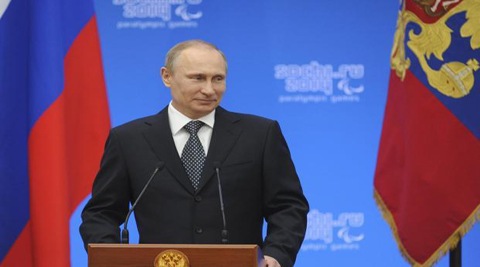
With a historic sweep of his pen, President Vladimir Putin signed a treaty on Tuesday to annex Crimea, describing the move as correcting past injustice and a necessary response to what he called Western encroachment upon Russia’s vital interests.
In a 40-minute speech televised live from the Kremlin, Putin said “in people’s hearts and minds, Crimea has always been an integral part of Russia”.
He dismissed Western criticism of Sunday’s Crimean referendum — in which residents of the strategic Black Sea peninsula overwhelmingly backed breaking off from Ukraine and joining Russia — as a manifestation of the West’s double standards.
At the same time, Putin said  Russia did not want to move into other regions of Ukraine: “We don’t want division of Ukraine.” Thousands of Russian troops have been massed along Ukraine’s eastern border for the last few weeks — Russia says that was for military training while the US and Europe view the troops as an intimidation tactic.
In Paris, French foreign minister Laurent Fabius said Russia had been suspended from the G8 because of the Crimean annexation. Russia has the G8’s rotating leadership currently, and Putin was scheduled to host President Barack Obama and other leaders of the group in Sochi in June.
“Concerning the G8… we decided to suspend Russia’s participation, and it is envisaged that all the other countries, the seven leading countries, will unite without Russia,” Fabius said on Europe-1 radio.
Britain’s foreign Office said Russia was still part of the G8, even though a suspension was not ruled out. British foreign secretary William Hague said Putin had chosen “the route of isolation, denying the citizens of his own country, and of Crimea, partnership with the international community and full membership of a range of international organisations”, and that it was now highly likely that other G8 countries would want to meet without Russia.
Tokyo and Berlin said they were not aware of a decision to suspend Moscow.
In Kiev, the Ukrainian government said it did not recognise the treaty signed in Moscow. “The signing of the so-called agreement on Crimea joining the Russian Federation and the corresponding address by the Russian president has nothing in common with law or democracy or common sense,” foreign ministry spokesman Evhen Perebynis said on Twitter.
“Putin’s address very clearly demonstrates just how real the threat is that Russia poses to international security and international security,” he said.
Speaking at the Kremlin’s white-and-gold St George Hall on the other hand, Putin cast the post-Yanukovych Ukrainian government as illegitimate, driven by radical “nationalists, neo-Nazis, Russophobes and anti-Semites”.
He said the rights of ethnic Russians in Ukraine had been abused by the new Ukrainian government. He insisted that Crimea’s vote to join Russia was in line with international law and reflected its right for self-determination.

US Vice-President rushes to Europe, reassures allies on Russia’s borders

People at a rally in support of Crimea joining Russia, celebrate holding Russian flags at Red Square in Moscow Tuesday. AP
People at a rally in support of Crimea joining Russia, celebrate holding Russian flags at Red Square in Moscow Tuesday.

The United States is considering sending troops for war games in the Baltic states bordering Russia, Vice-President Joe Biden said Tuesday in an effort to reassure NATO allies alarmed at the Kremlin’s intervention in Ukraine.
Moscow’s despatch of troops to Ukraine’s Crimea region and its unilateral declaration that the area is now part of Russia have left NATO member states in eastern Europe worried that they could be next in line.
In the Polish capital on the first leg of a two-day trip to the region, Biden condemned Russia’s actions in Crimea as a land grab, and he said NATO’s commitment to protect any of its members from attack was unwavering.
He also said the United States would work on reducing the dependence of eastern European states on imported Russian fuel, a relationship that, US officials say, the Kremlin uses as a tool of political influence.
Biden’s suggestion of sending US troops for military exercises in the Baltics, if it is implemented, would represent the strongest concrete evidence to date of Washington’s resolve in backing up its NATO allies on Russia’s doorstep.
“We are exploring a number of additional steps to increase the pace and scope of our military cooperation including rotating US forces to the Baltic region to conduct ground and naval exercises and training missions,” Biden told reporters after talks with Estonian President Toomas Hendrik Ilves, who was visiting Warsaw.
Earlier, at a briefing alongside Polish Prime Minister Donald Tusk, Biden described Russia’s actions as an assault on Ukraine’s sovereignty and a violation of international law.
“Russia has offered a variety of arguments to justify what is nothing more than a land grab,” Biden said. “But the world has seen through Russia’s actions and rejected the logic, the flawed logic, behind those actions.”
Russia said it sent troops to Crimea to protect Russian residents, who it said were in danger in the unrest that followed toppling of Ukraine’s pro-Russian president. A referendum in Crimea Sunday backed union with Russia, though the West called that vote a Moscow-orchestrated sham.
Biden said the events in Crimea were a reminder to NATO members that they need to stand together.
The three Baltic states, Estonia, Latvia and Lithuania, are in NATO and the EU. Yet they are particularly vulnerable to any Russian action. They are small, they depend on Russia for energy and trade, and they have sizeable Russian-speaking minorities.
Gorbachev: Crimean vote ‘happy event’
MOSCOW: Former Soviet President Mikhail Gorbachev has hailed Crimea’s vote to join Russia as a “happy event”. Gorbachev said in remarks carried Tuesday by online newspaper Slon.ru that the vote offered the Crimean residents the freedom of choice and justly reflected their will. He said Sunday’s referendum showed that “people really wanted to return to Russia”

Putin annexes Crimea, says it is Russia’s in people’s hearts, minds

Putin with three top leaders of Crimea after signing the annexation treaty at the Kremlin on Tuesday. REUTERS
Putin with three top leaders of Crimea after signing the annexation treaty at the Kremlin on Tuesday.

President Vladimir V Putin claimed Crimea as a part of Russia on Tuesday, reversing what he described as a historic mistake made by the Soviet Union 60 years ago and brushing aside international condemnation that could leave Russia isolated for years to come.
Within minutes of delivering a passionate speech to Russia’s political elite, Putin cemented his pledge by signing a draft treaty with Crimean leaders to make the strategic Black Sea peninsula part of Russia. The events unfolded two days after Crimeans voted in a disputed referendum to break away from Ukraine. While the treaty signed Tuesday still needs parliamentary approval, that is regarded as a formality.
“Crimea has always been an integral part of Russia in the hearts and minds of people,” Putin declared in his address, delivered in the chandeliered St George’s Hall in the Grand Kremlin Palace before hundreds of members of Parliament, governors and others.
His remarks, which lasted 47 minutes, were interrupted repeatedly by thunderous applause, standing ovations and at the end chants of “Russia, Russia”. Some in the audience wiped tears from their eyes.
Reaching deep into Russian and Soviet history, Putin said he did not seek to divide Ukraine any further, but vowed that he would protect Russia’s national security from what he described as Western, and particularly American, actions that had left Russia feeling cornered.
He spoke as he has often in the past of the humiliations Russia has suffered in a world with one dominant superpower — from the NATO air war in Kosovo in 1999 against Moscow’s Serbian allies to the one in Libya that toppled Col. Muammar Gaddafi in 2011 on what he called the false pretence of a humanitarian intervention.
He dipped into deep wells of emotion, starting with the 10th century baptism of Prince Vladimir, whose conversion to Orthodox Christianity transformed the kingdom then known as Rus, to the collapse of the Soviet Union, which left many Russians of his generation feeling that they had been stripped of their nation overnight.
“Millions of Russians went to bed in one country and woke up abroad,” he said. “Overnight, they were minorities in the former Soviet republics, and the Russian people became one of the biggest — if not the biggest — divided nation in the world.
“They cheated us again and again, made decisions behind our back, presenting us with completed facts,” he said of the West. “That’s the way it was with the expansion of NATO in the east, with the deployment of military infrastructure at our borders. They always told us the same thing: ‘Well, this doesn’t involve you.’ “
Western reaction was swift. The White House condemned the move, which it said it would not recognize. Britain’s foreign secretary, William Hague, told Parliament on Tuesday that the crisis in Ukraine “is the most serious test of European security in the 21st century so far.”
“No amount of sham and perverse democratic process or skewed historical references can make up for the fact that this is an incursion into a sovereign state and a land grab of part of its territory with no respect for the law of that country or for international law,” he said.
German Chancellor Angela Merkel firmly rejected Moscow’s absorption of Crimea, a position she said was widely supported by international organizations including the United Nations and the European Council.
“The so-called referendum breached international law, the declaration of independence which the Russian president accepted yesterday was against international law, and the absorption into the Russian Federation is, in our firm opinion, also against international law,” Merkel told reporters in Berlin.
(In Paris, French foreign minister Laurent Fabius said Russia had been suspended from the G8 because of the Crimean annexation, wire agencies reported. Russia has the G8’s rotating leadership currently, and Putin was scheduled to host President Barack Obama and other leaders of the group in Sochi in June.
“Concerning the G8… we decided to suspend Russia’s participation, and it is envisaged that all the other countries, the seven leading countries, will unite without Russia,” Fabius said on Europe-1 radio.)
Putin brushed aside concerns about economic sanctions and diplomatic isolation, saying the West had forced Russia’s hand. By supporting the political uprising that toppled Ukraine’s president, Viktor F Yanukovych, the US and Europe crossed “a red line,” he said, forcing him to act to protect Crimea’s population from what he called “Russophobes and neo-Nazis” that had seized control in an illegal coup abetted by foreigners.
“If you press a spring too hard,” he said, “it will recoil.”