Vladimir Putin is confident
Russia's
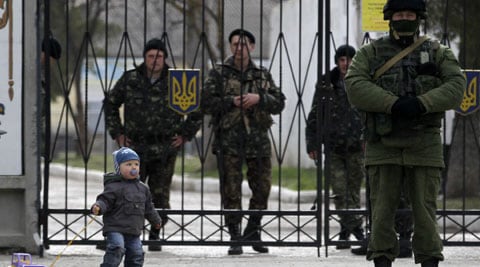
takeover of the Crimean peninsula – where 16,000 pro-Russian troops are
in control of the region's security and administrative infrastructure –
will not descend into war.
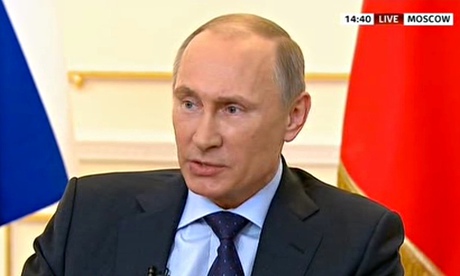
During a live address on Russian television, the president insisted that the armed forces of Russia and
Ukraine were "brothers in arms".
"We
will not go to war with the Ukrainian people. If we do take military
action, it will only be for the protection of the Ukrainian people,"said
Putin, adding that there was no scenario in which Russian troops would
fire "on women and children".
The Russian president continued:
"Ukraine is not only our closest neighbour it is our fraternal
neighbour. Our armed forces are brothers in arms, friends. They know
each other personally. I'm sure Ukrainian and Russian military will not
be on different sides of the barricades but on the same side. Unity is
happening now in the Ukraine, where not a single shot has been fired,
except in occasional scuffles."
Putin denied that the
Russian-speaking soldiers occupying key Crimean military sites were
Russian special forces, describing them as pro-Russian local
self-defence forces.
"There are many military uniforms. Go into any local shop and you can find one," he said.
Putin
was speaking shortly after gunfire rang out at the Belbek airbase in
the Crimean peninsula, where a standoff between pro-Russian and
Ukrainian soldiers threatened to erupt in clashes.
Warning shots
were fired in the air by more than a dozen pro-Russian troops, who had
taken over the military site, after about 300 Ukrainian troops marched
towards them.
Putin also insisted that ousted Ukrainian leader,
Viktor Yanukovych, was the legitimate leader of Ukraine and that the
"so-called" acting president had no authority and the new government in
Kiev illegal.
Putin gave his address as US secretary of state was
due to arrive in Kiev to hold crisis talks with the new Ukrainian
government, hours after Washington suspended all military engagements
with Russia, including exercises and port visits, in response to Moscow
sending troops into Crimea.
Responding to journalists' questions
on the US position and Kerry's involvement, Putin said: "The secretary
of state is important but he does not determine the policy of the
United States. I am hearing many different things."
Barack
Obama had warned that the US government would look at economic and
diplomatic sanctions that would isolate Moscow over Russia's involvement
in the Ukraine crisis. The US also put on hold trade and investment
talks with Russia.
Referring to these threats from the White
House, and other western leaders to eject Russia from the G8 ahead of
looming talks, the president said calmly that he was still preparing for
the talks: "If the leaders don't want to come, fair enough."
During
his impromptu and occasionally rambling address, Putin said he had
advised Yanukovych not to dismiss the feared Ukrainian riot police from
Kiev, warning the ousted leader that "chaos, anarchy" would ensue if he
did. Putin marked the beginning of the "chaos that reigns today" with
Yanukovych's dismissal of these forces.
"Yanukovych has no political future now, I have told him that," Putin said.
Earlier
on Tuesday, the Kremlin ordered Russian troops carrying out exercises
near Ukraine's eastern border to return to their barracks.
Russia's
invasion of Ukraine's Crimean region has so far been bloodless despite
tense standoffs and threats from both sides. A supposed Russian
ultimatum for two Ukrainian warships to surrender passed without action
from either side on Tuesday morning.
The warships remained
anchored in the Crimean port of Sevastopol early on Tuesday, a day after
Ukrainian authorities claimed that Russian forces had issued an
ultimatum for the ships to surrender or be seized. Russian defence
ministry spokesman Vladimir Anikin said on Monday that no ultimatum had
been issued.
Russia's ambassador to the UN claimed on Monday that
Yanukovych had requested that Russian soldiers be sent to Crimea "to
establish legitimacy, peace, law and order".
Vitaly Churkin told a UN security council meeting that Yanukovych wrote to Vladimir Putin on Saturday.
France's
ambassador to the UN, Gérard Araud, said the letter was just a piece of
paper handed to Yanukovych that "got his signature". Asked if the
letter was phony, Araud replied: "It's not a false letter, it's a false
president."
Late on Monday night, a Kremlin-linked analyst and
member of Russia's public chamber, who was in Crimea for talks with
local officials, said he believed there would be an "escalation of
pressure" on Ukrainian forces on Tuesday, but no military action.
Sergei Markov said Ukrainian troops would be reminded that "life will be difficult for them" if they remained loyal to Kiev.
Russian
troops, said to be 16,000 strong, tightened their grip on the Crimean
peninsula on Monday and control all Crimean border posts, as well as
military facilities in the territory and a ferry terminal in the city of
Kerch, just 12 miles (20km) across the water from Russia.
On
Tuesday morning, Putin told troops massed along the Russian side of the
Ukrainian border to return to their permanent bases after calling a snap
drill last week to check their battle-readiness.
"The
commander-in-chief, President Vladimir Putin, gave the order to the
troops and units taking part in military exercises to return to their
permanent bases," his spokesman, Dmitry Peskov, told Russian news
agencies.
The drill involved army, navy and air force troops based
in the central and western military districts, a vast territory that
includes regions bordering Ukraine but also the Arctic.
The drill did not include any regions beyond Russia's borders such as Crimea.
The
Russian defence minister, Sergei Shoigu, had said the drill would
include military exercises "on Russia's borders with other countries,
including Ukraine".
The drill, which was scheduled to finish on
Monday, came shortly before Russian security forces began operating
covertly in Crimea and Putin gained parliamentary approval for military
intervention.
Moscow has insisted its military presence in
Ukraine is essential for the protection of Russian-speakers in Crimea,
threatened by the pro-European revolution in Kiev.
The disclosure
of Yanukovych's support for Russian military intervention came amid
fears that the Kremlin might carry out further landgrabs in pro-Russian
eastern Ukraine.
Russia faced demands from almost all UN security
council members to pull its troops out of Crimea and there was no
support for military action from its close ally China. Several EU
states, including the UK, have said they are considering economic
sanctions against Russia.
A Kremlin aide said on Tuesday that if
the US were to impose sanctions, Moscow could be forced to drop the
dollar as a reserve currency and refuse to pay off any loans to American
banks.
Sergei Glazyev, an adviser to the Kremlin – who is often
used by the authorities to stake out a hardline stance but does not make
policy – added that if Washington froze the accounts of Russian
businesses and individuals, Moscow would recommend that all holders of
US treasuries sell them.



 LONDON:
A mild winter and improved infrastructure mean Europe and Ukraine are
less reliant on Russian natural gas than in past years, easing worries
that the escalating crisis in Ukraine could hurt supplies.
LONDON:
A mild winter and improved infrastructure mean Europe and Ukraine are
less reliant on Russian natural gas than in past years, easing worries
that the escalating crisis in Ukraine could hurt supplies.  WASHINGTON:
US Defence Secretary Chuck Hagel spoke by phone with his Russian
counterpart Sergei Shoigu on Saturday after Moscow approved sending
troops into Ukraine following a bloody three-month uprising there.
WASHINGTON:
US Defence Secretary Chuck Hagel spoke by phone with his Russian
counterpart Sergei Shoigu on Saturday after Moscow approved sending
troops into Ukraine following a bloody three-month uprising there. KIEV:
Dozens of people were hurt in clashes on Saturday when pro-Russia
activists stormed the regional government's headquarters in the eastern
Ukrainian city of Kharkiv and raised the Russian flag, local media said.
KIEV:
Dozens of people were hurt in clashes on Saturday when pro-Russia
activists stormed the regional government's headquarters in the eastern
Ukrainian city of Kharkiv and raised the Russian flag, local media said.
 UNITED
NATIONS: Ukraine urged an emergency session of the UN Security Council
on Saturday to act now to stop Russian "aggression" in Crimea, accusing
Moscow of brutally violating the world body's charter.
UNITED
NATIONS: Ukraine urged an emergency session of the UN Security Council
on Saturday to act now to stop Russian "aggression" in Crimea, accusing
Moscow of brutally violating the world body's charter.