Showing posts with label urges. Show all posts

Friday, 27 June 2014

Pakistan urges Afghanistan to stop terrorists fleeing North Waziristan


ISLAMABAD: Pakistan on Thursday asked Afghanistan to take necessary measures on its side of the border to stop the fleeing terrorists from North Waziristan Agency (NWA) from finding sanctuary on the Afghan soil.
Foreign Office (FO) Spokesperson Tasnim Aslam, in her weekly briefing here at the Foreign Office, said that the purpose of the visit of special envoy Mahmood Khan Achakzai to Kabul was to seek Afghan cooperation in the management of the border.

She said the visit of Afghan National Security Adviser Dr Rangin Dadfar Spanta was also aimed at taking the discussion forward on the matter.The spokesperson recalled that Pakistan had taken extraordinary measures, including restriction of movement and deployment of additional troops on the border, when presidential elections took place in Afghanistan.

She said these security measures were appreciated not only by the Afghans but also by the international community.The spokesperson said the operation had been launched in the North Waziristan Agency (NWA) to eliminate terrorism and it was in Afghanistan’s own interest to cooperate with Pakistan.

She expressed the confidence that Afghan authorities would respond positively to Pakistan’s call for enhanced security on the border.Replying to a question whether any foreign country had offered assistance for the internally displaced families of North Waziristan, the spokesperson said Pakistan had not decided to ask for any foreign assistance in this regard.

The United Arab Emirates (UAE), however, offered some sort of assistance for the IDPs, she added.The spokesperson said, “The people of North Waziristan are our brothers and sisters and as a nation it is our responsibility to come out and extend all out support to the IDPs who have to leave their homes for the peace and security of the entire country.”

Sunday, 4 May 2014

Prof. Ibrahim urges Taliban, army to end war


SWAT: Member Taliban negotiating committee, Professor Ibrahim has stated that neither military operation brought peace nor Taliban attacks enforced shariah in the country, Geo News reported.

Talking to media here Sunday, Professor Ibrahim said this war had claimed thousands of lives from both sides, therefore, this should be ended now.

He said efforts were underway to hold meeting between Tahrik-i-Taliban Pakistan (TTP) and government committees, adding they were making efforts so that time and venue of the meeting could be arranged at the earliest.

Thousands of innocent people are present in the jails and they are not being presented in the courts, he claimed.

Saturday, 3 May 2014

Pakistan urges increased UNGA role in UN chief' s appointment


UNITED NATIONS: Pakistan has called for enhancing the General Assembly's role in the selection and appointment of the United Nations secretary general saying that the world's top diplomat should have the confidence and support of all member states.

The position and the wide ranging role and responsibilities of the secretary general as statesman top diplomat advocate and chief administrative officer are important for the entire UN membership not just the Security Council... Ambassador Masood Khan told a UN panel on Friday while advocating improved coordination between the Assembly and the Council.

A candidate for Secretary general is picked in secret by the Security Council and then recommended for approval by the General Assembly. But each of the five big powers in the council Britain, China, France, Russia and the United States can veto a candidate killing his or her chances of going before the Assembly.

Speaking in a meeting of the Ad hoc Working Group on the Revitalization of the Work of the General Assembly, Masood Khan Pakistan's permanent representative to the UN underscored the need for evolving consensus in the process of UN chief's appointment requiring inclusiveness transparency and interaction.

The General Assembly should not be there to rubber stamp a decision already taken, the Pakistani envoy said, while speaking in a debate on Role and Responsibility of the General Assembly in the Appointment of the Secretary General.

Apparently the recommendation by the Security Council is not exclusive but well established practice would belie that interpretation he said. The challenge is to ensure that the recommendation and the appointment are not isolated acts but part of a process which is underpinned by participation and ownership of both the principal organs and of all member states. In fact he expressed the view that neither the recommendation nor the appointment can or should be made without proper consultation and interaction. This would require increased cooperation and coordination between the Assembly and the Council.

Referring to an Assembly resolution proposing sufficient time for interaction of candidates for the post of UN chief with member states Masood Khan said We can take a start by putting this provision into practice ahead of the next appointment of the Secretary General. In this context Masood Khan added.

The process of consideration of the candidatures by the Security Council should be guided and informed by this prior interaction and sense of the house in the General Assembly. A recommendation emanating from such a process and the appointment by the Assembly on that basis would have fulfilled the requirement of inclusiveness and ownership while also accomplishing this task with consensus and acclamation which is the desired and the best way of doing it.

Friday, 25 April 2014

Kerry urges compromises to advance Mideast peace talks

US Secretary of State John Kerry jokes with Norwegian Foreign Minister Borge Brende during their meeting on Thursday, at the State Department in Washington.
 
AP US Secretary of State John Kerry jokes with Norwegian Foreign Minister Borge Brende during their meeting on Thursday, at the State Department in Washington.
US Secretary of State John Kerry on Thursday called on the Israelis and Palestinians to make compromises so as to forward the stalled peace talks.
The fresh appeal from the top American envoy came as Israel’s security cabinet decided to suspend the negotiations in response to ongoing reconciliation efforts between rival Palestinian factions of Fatah and Hamas, Xinhua reported.
“There’s always a way forward, but leaders have to make the compromises necessary to do that,” Mr. Kerry told reporters before meeting with Norwegian Foreign Minister Borge Brende at the State Department.
“We may see a way forward, but if they’re not willing to make the compromises necessary, it becomes very elusive.”
Washington is trying its best to extend the negotiations that were restarted in late July last year and supposed to end by April 29 with an agreement on all the core issues like security, border, the status of Jerusalem and refugees.
The talks came to a deadlock after Israel refused to release by late March last group of 26 Palestinian prisoners as agreed, and the Palestinians responded by renewing their efforts to apply for joining 15 UN agencies and conventions.
Fatah and Hamas, which runs the Gaza Strip, announced a reconciliation deal on Wednesday, in which they agreed to start discussions to form a unity government within five weeks, and hold elections within six months after the formation of the unity government.
The deal has drawn rebuke from Israel and the US as both have branded Hamas a terrorist organisation.
“We will never give up our hope or our commitment for the possibilities of peace,” Mr. Kerry said. “We believe it is the only way to go. But right now, obviously, it’s at a very difficult point, and the leaders themselves have to make decisions.”
Mr. Kerry spoke to Palestinian President Mahmoud Abbas over the phone on Thursday, reiterating US principles regarding a Palestinian government, namely commitment to non-violence, recognition of the State of Israel, and acceptance of previous agreements reached with Israel, State Department spokesperson Jennifer Psaki said.
“Our position as the United States government, outside of the peace process, has long been that any unified government would have to abide by these principles,” Ms. Psaki told reporters at a regular press briefing.
She said Mr. Kerry and Mr. Abbas also discussed ongoing efforts to extend the negotiations, and the US team led by special envoy Martin Indyk “remains on the ground” and “in close touch” with both parties.

Tuesday, 18 March 2014

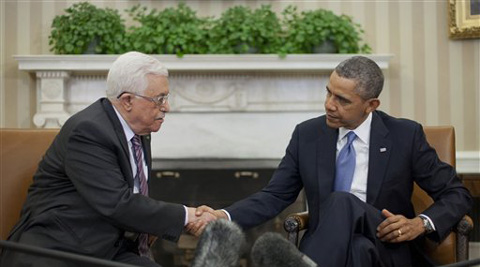
Barack Obama urges Mahmoud Abbas to ‘take risks’ for peace

President Barack Obama shakes hands with Palestinian President Mahmoud Abbas during their meeting in White House, Washington,  March 17, 2014. (AP)
President Barack Obama shakes hands with Palestinian President Mahmoud Abbas during their meeting in White House, Washington, March 17, 2014.

US President Barack Obama told Mahmoud Abbas that the Palestinian leader and Israel’s politicians must be prepared to make tough decisions and take “risks” for peace.
Abbas arrived at the White House two weeks after Israeli Prime Minister Benjamin Netanyahu, warning that time was running short for a final deal and saying Israel could show it was serious by honouring a scheduled release of Palestinian prisoners this month.
Obama, personally supporting Secretary of State John Kerry’s exhaustive Middle East peace drive at a critical moment, is pressing both sides to accept a framework to carry negotiations past an end-of-April deadline. “As I said to Prime Minister Netanyahu when he was here just a few weeks ago, I believe that now is the time… to embrace this opportunity,” Obama said.
“It is very hard, very challenging. We are going to have to take some tough political decisions and risks if we’re able to move it forward.” Obama said that everyone understood the shape of an “elusive” peace agreement between Israel and the Palestinians, saying it would be based on 1967 lines with mutual land swaps.
Abbas sat beside Obama in the same Oval Office chair recently used by Netanyahu, when the Israeli leader complained Israel had done its part over decades of peace talks and the Palestinians hadn’t done theirs.
The white-haired Palestinian leader told Obama: “We don’t have any time to waste.” “Time is not on our side, especially given the very difficult situation that the Middle East is experiencing and the entire region is facing.” Abbas did not use a photo opportunity before the talks to directly address the Israeli government’s demand for the Palestinians to recognise Israel as a “Jewish” state in public. But he did say through a translator that the Palestinians had recognised Israel’s legitimacy in 1988 and in “1993 we recognised the state of Israel.”

Monday, 10 March 2014

Malala Yousafzai urges for better protection of children


LONDON: On Commonwealth Day, Malala Yousafzai has urged the Commonwealth countries to provide better assistance for the protection of children.

She was addressing an event organized in Westminster abbey to celebrate Commonwealth Day.

Malala said it’s an honor for her to be there. She said the forum of Commonwealth is basically like a family for all the nations around the world, where no one is judged on the basis of religion, race or gender.

She said that school-going kids face a lot of trouble every day. Especially children in Pakistan, India and various African countries have to deal with many hurdles like poverty, violence and cultural barriers in order to get education.

The young schoolgirl activist has requested the Commonwealth to guard children worldwide from being exploited through child labour and trafficking.

Queen Elizabeth and other royal family members were also present at the event.

Scientist urges withdrawal of his own ‘breakthrough’ stem cell research


imageTOKYO: A Japanese scientist called on Monday for his own headline-grabbing study on stem cells to be withdrawn from publication, saying its findings had now been thrown into too much doubt.
The research hailed when it came out in January as a breakthrough that could herald a new era of medical biology was covered widely in Japan and across the world after it was published in the highly reputable science journal Nature.
But since then, there have been reports that other scientists have been unable to replicate the Japanese team's results and that there may have been problems with its data and images.
"It is no longer clear what is right," Teruhiko Wakayama, a professor at Japan's University of Yamanashi who was part of the researcher team, told public broadcaster NHK.
The study, described as game changing by independent experts asked to comment on it when it was published, appeared to show a simple way to reprogramme mature animal cells back into an embryonic-like state that would allow them to generate many types of tissue.
The results appeared to offer a promise that human cells might in future be simply and cheaply reprogrammed back into embryonic cell-like cells in this case cells dubbed Stimulus-Triggered Acquisition of Pluripotency, or STAP, cells suggesting a simple way to replace damaged cells or grow new organs for sick and injured people.
"When conducting the experiment, I believed it was absolutely right," Wakayama said. "But now that many mistakes have emerged, I think it is best to withdraw the research paper once and, using correct data and correct pictures, to prove once again the paper is right.
If it turns out to be wrong, we would need to make it clear why a thing like this happened." A Nature spokesperson said "issues relating to this paper" had been brought to the journal's attention and it was conducting an investigation, but made no further comment.
"OPEN MIND":
Robin Lovell-Badge, a stem cell expert at Britain's National Institute for Medical Research, cautioned against premature assumptions on whether the research was flawed.
"I have an open mind on this," he told Reuters. "I'm waiting to hear from several serious stem cell labs around the world on whether they have been able to reproduce the methods."
Wakayama's co-researcher Haruko Obokata, became an instant celebrity in Japan after she spoke during a Nature media briefing to science reporters all over the world about her eye-catching findings.
The Japanese researchers, joined by others from Brigham and Women's Hospital and Harvard Medical School in the United States, took skin and blood cells.
Let them multiply, then subjected them to stress "almost to the point of death", they explained, by exposing them to various events including trauma, low oxygen levels and acidic environments.
One of these "stressful" situations was simply to bathe the cells in a weak acid solution for around 30 minutes. Within days, the scientists said they had found that the cells had not only survived but had also recovered by naturally reverting into a state similar to that of an embryonic stem cell.
Yet no other research team has yet been able to replicate the findings, and the RIKEN Center for Developmental Biology in Japan, where Obokata works, said last week it had "launched an independent inquiry into the content of the paper.
That inquiry would be conducted by a panel of experts from within and outside RIKEN, it said, and would be published as soon as it was concluded.
A RIKEN spokesman declined to comment on Wakayama's call for the paper to be withdrawn.

Tuesday, 4 March 2014

Sartaj urges integrated policies to overcome problems


imageISLAMABAD: Advisor to the Prime Minister on Foreign Affairs and National Security Sartaj Aziz on Tuesday underlined the need for integrated policies to steer country out of prevailing problems.
"The issues cannot be resolved with patch-work and isolated approach. But, we need to have visionary and integrated policies", he said in National Assembly in his statement on foreign policy.
The Advisor deliberated on number of local, regional and global changes and explained that the government is devising future policies keeping in view these changes.
"We are preparing defense and foreign policies that shall be presented before the House within next few weeks", he said and mentioned to four major areas to be taken care of in the upcoming policies.
Giving brief details of these areas, the Advisor said, internal security and policy of non-interference; economic development through trade and not aid; fully benefiting from geographical location; and promoting Pakistan's image by strengthening democracy and economic institutions in the country shall be basic components of our policies.
He said the internal and external threats are also being kept under consideration while framing our policies and he has been briefing the House and Standing Committees on these issues. The opinion of the House will also be fully taken care of while framing these policies.
He said the circumstances in other countries and regions also affect our policies and we are keeping a keen eye on changing regional and global scenario and ensure that Pakistan follows the policy of non-interference.
"We have a clear policy of not interfering in other countries affairs. But, we shall also not accept hegemony of any other country".
Advisor to Prime Minister Sartaj Aziz said the government is focusing on basic reasons inflicting problems and will focus internal and external challenges to address these problems.
He said Pak-Afghan relations are on way to normalcy after the government had made them believe about Pakistan's policy of non-interference. "Bringing in a favorite regime in Afghanistan is no more our policy. We have conveyed them and the previous atmosphere of no trust is now improving towards strong bilateral relations."
In regard to relations with India, he said, way is being paved for composite dialogue through working groups and back channel diplomacy.
About United States, he stated, Pakistan has made US believe that its previous policy had not favored Pakistan. "Pakistan should not be seen through the Afghan lens. During their previous policy the US had ignored Pakistan's internal security challenges. Therefore, internal security will also be a component of strategic partnership with the United States."
Pakistan is also seeking investment in different sectors including the energy sector and investment of US$ 30 to 32 billion in Pakistan will bring about positive changes, he added. The government also keeps a keen eye on changing scenarios and new emerging alliances.
He said regional cooperation is another important component of our policy as menaces like terrorism cannot be overcome without adopting a regional approach because it is not a war between armies of any two countries.
Focusing the basic contours of upcoming foreign policy, the Advisor said, our policy shall focus internal security and economic development through trade and investment. Moreover, Pakistan will fully benefit from its regional importance by extending links to Central Asian states and improve internal security.
He categorically stated that Pakistan is not providing arms to Saudi Arabia for use in Syria while India is not being given one sided relaxation in trade and we shall fully safeguard our interests.
Iran is our nearest Muslim country and the government is engaged with them to resolve bilateral issues. Prime Minister Nawaz Sharif will also be visiting Iran on invitation of Iranian President, Sartaj Aziz said.
He explained that Iran-Pakistan gas pipeline is our priority but this project cannot be completed before next three years. "There is an issue of sanctions but it could have not affected the project if Iran and Pakistan had sufficient resources. But, when we have to seek financial assistance internationally then the sanctions are a problem."
He said the government would assure that it creates and pursues a clear, balanced and effective sovereign foreign policy in the light of sayings of founder of the nation Quaid-e-Azam Muhammad Ali Jinnah to safeguard our national and international interests.

Saturday, 1 March 2014

Ukraine urges UN Security Council to stop Russian aggression


imageUNITED NATIONS: Ukraine urged an emergency session of the UN Security Council on Saturday to act now to stop Russian "aggression" in Crimea, accusing Moscow of brutally violating the world body's charter.
"We call on the Security Council now to do everything possible to stop aggression of the Russian Federation to Ukraine. There is still a chance," Ukrainian Ambassador Yuriy Sergeyev said.
Russian troops entered Ukrainian territory illegally as an "act of aggression against the state" and "their number is increasing every coming hour," he added.
Sergeyev called for the deployment of international monitors and said Russia had "brutally violated the basic principles of the charter of the United Nations."
"We urge all member states of the United Nations to demonstrate solidarity with the Ukrainian nation to protect the sovereignty and territorial integrity of the country," Sergeyev added.