Showing posts with label peace. Show all posts

Tuesday, 10 June 2014

Karachi airport attack: Last nail in peace talks coffin

ISLAMABAD: The bloody Fidayeen attack targeting the Jinnah International Airport has not only exposed the inability of law enforcement agencies to protect the vital national installations from terrorist attacks but has also proved to be the last nail in the coffin of peace talks between the Pakistan government and the Tehrik-e-Taliban Pakistan (TTP).

The dreadful assault has set alarm bells ringing for the law enforcement agencies which had earlier been criticised due to their failure to stop at least three similar Fidayeen attacks in the past — on May 22, 2011 targeting the Mehran Naval Base in Karachi, on August 16, 2012 targeting the PAF Kamra Airbase and on September 15, 2012 targeting the joint civil-military airport in Peshawar that houses the Bacha Khan International Airport and Pakistan Air Force and Army Aviation bases.

Subsequent investigations revealed that all these attacks were well planned, which could not have been possible without inside help.From the time Osama was gunned down in Abbottabad on May 2, 2011, the TTP has launched a bloody campaign of retribution against the Pakistani security forces and civil and military installations.

The June 8 Fidayeen attack by the TTP has given credence to the apprehensions of security establishment that the talks by the Taliban are just a ploy to gain time and space and to evade a possible military operation in North Waziristan. Even otherwise, by entering into unconditional negotiations with a terrorist group that is accused of having killed over 50,000 Pakistanis, the government has only undermined the writ of the state and security of the nation.

With the TTP’s responsibility claim, which in fact is an open declaration of war against the government, the civilian administration seems to have been left with no other option but to react with full military might by launching the much-delayed military operation in North Waziristan, which is being used by the Taliban as a launching pad to plan and launch terrorist attacks all over Pakistan. The government’s policy of one step forward, two steps back cannot bring peace — only more death and destruction.

While describing the airport assault an act of revenge for the November 1, 2013 killing of Hakimullah Mehsud in a US drone attack, TTP spokesman Shahidullah Shahid has also dismissed the Pakistani government’s recent offer of a new round of peace talks as a ruse.

Threatening more terrorist attacks in the days and weeks to come, he said: “Pakistan used the peace talks as a tool of war. We have yet to take revenge for the deaths of hundreds of innocent tribal women and children in Pakistani air strikes. It’s just the beginning, we have taken revenge for one (Mehsud), we have to take revenge for hundreds.”

In fact, the June 8 Jinnah airport attack came 48 hours after the country’s civilian and military leaderships conveyed a clear message to the tribal elders in North Waziristan to flush out the miscreants, especially the foreign militants, from the volatile area within 15 days. The message was conveyed on June 6 when a Jirga of the Utmanzai tribe, led by Haji Sher Mohammad, held separate meetings with Khyber Pakhtunkhwa Governor Sardar Mehtab Ahmad Khan and Corps Commander Lt Gen Khalid Rabbani.

The tribal elders were told that they had failed to honour the six-point peace agreement, signed in 2006, as per which the Utmanzai tribe and the Shura Mujahideen North Waziristan leader Hafiz Gul Bahadur, who is considered to be a “good Taliban”, were bound to expel the foreigners from the area.

The bottomline of the tribal elders’ meetings with the governor and corps commander was that they would get rid of the foreign militants, especially the Uzbeks; otherwise, the Government of Pakistan would have no other option but to initiate a military action. The tribal elders had actually formed the Jirga to request the federal government to put off the imminent military action in North Waziristan.

However, the fact that the TTP has already claimed responsibility for the Karachi Fidayeen attack clearly indicates that the Taliban Ameer Mullah Fazlullah has already made up his mind to completely abandon the peace talks. Earlier, on May 14, Fazlullah had sacked the pro-talks Khalid Mehsud alias Said Khan Sajna as the Ameer of the South Waziristan chapter of the TTP without consulting the Taliban Shura.

Three days later, on May 18, Fazlullah had ordered [in a video message] the TTP suicide bombers or Fidayeen attackers to get ready to face the tanks and guns of the enemy forces. “The suicide bombers who are able to receive his message should convey the same to others who are still unaware of my orders. Like the Taliban militants, the Pakistan government, the armed forces and the intelligence agencies would also have to accept the writ of Allah Almighty by enforcing Shariah which is the mission of my life and which I will continue to pursue come what may,” said Fazlullah, who has already been accused of having ordered the killing of several senior Pakistani military officials, including the General Officer Commanding of Swat.

Following Mullah Fazlullah’s open declaration of war against the state of Pakistan, the pro-talks Said Khan Sajna faction of the Taliban announced to discard the TTP umbrella on May 28. The development was being described by security analysts as a major setback not only for Mullah Fazlullah but also for the military might of the TTP given the fact that Sajna enjoys the support of 12 major Mehsud tribes of South Waziristan, which had played an important role in the past in establishing the Tehrik-e-Taliban as a force to reckon with.

However, the audacious attack on the Jinnah International Airport has proved that the parting of ways by Sajna has hardly affected the military might of the TTP, courtesy the availability of Uzbek militants belonging to the Islamic Movement of Uzbekistan.

Those investigating the Karachi airport attack have conceded that a group of foreign fighters, especially the Uzbeks, seem to have played a major role in the Fidayeen attack. “Three militants blew themselves up and seven were killed by security forces,” said DG Rangers Rizwan Akhtar in televised remarks. “The militants appear to be Uzbeks.”

The Uzbek militants living in North Waziristan had already denounced the 15-day deadline set by the Pakistani authorities for the foreign militants to leave the area. Irked by hoisting of national flag by tribesmen in Miramshah and Mirali areas as a proof of their allegiance to the state of Pakistan in order to escape bombings, the Islamic Movement of Uzbekistan had declared on June 7 that it has decided to respond by hoisting black flags. In fact, the sale of the national flag had increased as more and more people in North Waziristan want to hoist it to demonstrate their allegiance to the state and escape bombing.

However, the IMU has criticised those hoisting the Pakistani flag, stating that those doing so were “weak-hearted Muslims” who are using the flags as a “defence” to ward off bombing. In a message posted on a militant website, the IMU’s spokesman, Abu Ibrahim, said the local tribesmen frightened by army attacks and bombings by military planes and helicopters and artillery had begun hoisting the national flag on roofs of their houses. “We still have not understood how effective this ‘defence system’ is against bombs and rockets,” he said. The IMU, comprising militants from Uzbekistan and of Turkic origin, has its main base in the town of Mirali.

To tell the truth, the TTP and IMU have long been collaborating and conducting joint terrorist attacks, especially targeting the Pakistani security forces. The last time they carried out a jointly coordinated terrorist operation was on December 16, 2012 when the terrorists targeted the Pakistan Air Force base in Peshawar. Four attackers were later identified as Uzbeks belonging to the IMU. The TTP and IMU had earlier joined hands to form a special unit of deadly Fidayeen attackers called the “Ansar Al Aseer” (the supporters of prisoners) whose prime mission would be to secure freedom for the imprisoned militants by carrying out jail-break Fidayeen operations all over Pakistan.

Monday, 2 June 2014

Peace can only be achieved through dialogue: Ibrahim


KHYBER AGENCY: Member Taliban negotiating committee, Professor Ibrahim said on Monday that peace could only be achieved through dialogue.

Speaking to Geo News, Professor Ibrahim said the operation will bear disastrous results. “We will continue holding dialogue until they are successful.”
Professor Ibrahim added that he had warned the government that if there is an operation in North Waziristan people would flee to Afghanistan.

Sunday, 1 June 2014

PM consults officials for restoring peace talks with Taliban


ISLAMABAD: Prime Minister Nawaz Sharif has held consultations with some important officials in connection with restoring the peace talks with the Taliban.
According to the sources, despite the military operation in North Waziristan and other agencies against the militants, Prime Minister Nawaz Sharif and Interior Minister Chaudhry Nisar Ali Khan are in favour of restoring the process of the peace dialogue with the Taliban.

The sources in the capital said that two days before the meeting of political and military leadership on Friday, the prime minister had held talks with former ambassador Rustam Shah Mohmand regarding the restoration of peace talks with the Taliban.

The sources said that the government still wanted to create an atmosphere for talks so that durable peace could be established in the troubled areas.

When The News contacted Rustam Shah in this regard, he said that the prime minister was hopeful and the process was moving forward positively.

Friday, 2 May 2014

TTP says it doesn’t know who to talk to for peace


ISLAMABAD: Accusing the government of using the dialogue process as a political tool and to increase military operations, the Tehrik-i-Taliban Pakistan (TTP) on Thursday said they did not know who to talk to in Islamabad, as they believed the government had no powers to reach an amicable solution.
In a statement, TTP spokesman Shahidullah Shahid said they did not know whether they should talk to the government or the military.Shahid said talks and war could not go together adding that the Taliban had the right to defend themselves. He said, on the one hand, the government claimed it was interested in the dialogue but, on the other hand, it hurled threats at the Taliban.

He said the army had imposed a war on the people in Babar and Shaktoi areas of South Waziristan in the last two days. He also condemned the police action against the relatives of missing persons in Islamabad and said such a situation could not provide an environment for a meaningful and serious dialogue.

“The TTP has insisted that it is ready to talk in the interest of Islam and the Muslims of Pakistan. But we will not accept that the dialogue is used as a political tool and to pursue war startegy,” he said.

Shahid said the TTP had shown sincerity and seriousness during the talks and gifted a 45-day ceasefire to the people and the country but the government had not shown any seriousness since the talks took off.

He said the Taliban had left it to the people of Pakistan to decide whether a war or talks could go together and asked if it was the responsibility of the Taliban only to make the process successful.

He said the Taliban will not step back from serious and useful talks but would not accept the politics of threats and war.“We are fighting for the supremacy of Sharia and our Mujahideen have the capability to face any difficult situation and know how to give a befitting response to the enemy,” the TTP spokesman said

Tuesday, 29 April 2014

Kerry in apartheid row as Mideast peace deadline arrives


JERUSALEM: Washington´s deadline for reaching a Mideast peace deal arrived Tuesday with no breakthrough and US Secretary of State John Kerry mired in a row over allegations that he said Israel risks becoming an "apartheid state".

After more than a year of intensive shuttle diplomacy by Kerry, with the initial aim of brokering a deal by April 29, Washington´s patience appeared to be growing thin as both Israel and the Palestinians moved to distance themselves from the crisis-hit talks. Kerry on Monday vehemently denied calling Israel an apartheid state, as a furore grew in the Jewish state over comments the top US diplomat reportedly made during a private meeting.

"I do not believe, not have I ever stated, publicly or privately that Israel is an apartheid state or that it intends to become one," Kerry said in a strong statement after calls for him to resign or at least apologise for the alleged comments, which appeared on US online news site The Daily Beast.

But Kerry, who has seen his dogged efforts to broker peace between Israel and the Palestinians collapse, did suggest that he had used a poor choice of words during his speech Friday to international political experts at the Trilateral Commission.

Kerry insisted that although the peace process was at a point of "confrontation and hiatus", it was not dead -- yet. But both the Palestinians and the Israelis appear to have drawn their own conclusions about the life expectancy of the US-led negotiations, which have made no visible progress since they began nine months ago.

Last week, Palestinian leaders in the West Bank and the Hamas-run Gaza Strip announced a surprise unity deal aimed at ending years of occasionally violent rivalry. Israel denounced the deal as a death blow to peace hopes and said it would not negotiate with any government backed by Hamas, the Islamist movement whose charter calls for the destruction of Israel. Washington called the deal "unhelpful".

Under the agreement, the Palestine Liberation Organisation and Hamas will work to establish a new unity government of political independents headed by president Mahmud Abbas, whose Fatah party dominates the PLO.

Abbas has said the new government will recognise Israel, as well as renouncing violence and abiding by existing agreements, in line with key principles set out by the Mideast peacemaking Quartet.

But Netanyahu has ruled out any negotiation with the new government unless Hamas gives up its vision of destroying Israel.

Saturday, 26 April 2014

Palestinians meet on peace talks, reconciliation


RAMALLAH: A key Palestine Liberation Organisation body began on Saturday talks after Israel pulled out of US-sponsored peace negotiations in response to a Palestinian reconciliation deal with Hamas.

The meeting of the PLO´s Central Council at its West Bank headquarters in Ramallah started shortly after 0800 GMT.A member of the Islamist movement Hamas was attending the meeting and Palestinian Authority president Mahmud Abbas was expected to deliver a speech during the opening session.

The council had called the meeting over the crisis in negotiations, but will also discuss the deal struck Wednesday between Hamas, which rules the Gaza Strip, and Fatah, a key PLO faction.

Israel suspended the peace talks over the deal, saying it would have no dealings with a Palestinian government backed by Hamas, which is pledged to the destruction of the Jewish state.

Israel and the United States had been hoping to extend the faltering peace talks beyond their April 29 deadline, but the efforts hit a wall last month when Israel refused to release a final batch of Palestinian prisoners.

The Palestinians retaliated by applying to adhere to 15 international treaties and then Abbas, who also heads the PLO and Fatah, listed conditions for extending the talks beyond the deadline.

Abbas said he would agree to an extension if Israel freezes settlement construction in the occupied West Bank and annexed east Jerusalem, frees the prisoners and begins discussions on the future borders of a promised Palestinian state.

Israel dismissed the conditions.

In the unity deal penned this week, the rival Palestinian factions agreed to bury their differences and establish a "national consensus" government under Abbas within weeks.

The move infuriated Israel, which said it would "not negotiate with a Palestinian government backed by Hamas, a terror organisation that calls for the destruction of Israel".

Israel also vowed unspecified "measures" in response.

On Friday, State Department spokeswoman Jen Psaki said US efforts to broker a peace deal had not failed, but were currently in a "holding period" as Palestinians and Israelis decide their next move.

She noted Abbas had insisted that any government formed with Hamas backing would "represent his policies, and that includes recognition of Israel, commitment to non-violence, adherence to prior agreements and commitment to peaceful negotiations toward a two-state solution."

Palestinian prime minister Rami Hamdallah told Abbas on Friday that he would resign if the president deemed it necessary for the formation of the new unity government, official Palestinian news agency Wafa reported.

Friday, 25 April 2014

Kerry urges compromises to advance Mideast peace talks

US Secretary of State John Kerry jokes with Norwegian Foreign Minister Borge Brende during their meeting on Thursday, at the State Department in Washington.
 
AP US Secretary of State John Kerry jokes with Norwegian Foreign Minister Borge Brende during their meeting on Thursday, at the State Department in Washington.
US Secretary of State John Kerry on Thursday called on the Israelis and Palestinians to make compromises so as to forward the stalled peace talks.
The fresh appeal from the top American envoy came as Israel’s security cabinet decided to suspend the negotiations in response to ongoing reconciliation efforts between rival Palestinian factions of Fatah and Hamas, Xinhua reported.
“There’s always a way forward, but leaders have to make the compromises necessary to do that,” Mr. Kerry told reporters before meeting with Norwegian Foreign Minister Borge Brende at the State Department.
“We may see a way forward, but if they’re not willing to make the compromises necessary, it becomes very elusive.”
Washington is trying its best to extend the negotiations that were restarted in late July last year and supposed to end by April 29 with an agreement on all the core issues like security, border, the status of Jerusalem and refugees.
The talks came to a deadlock after Israel refused to release by late March last group of 26 Palestinian prisoners as agreed, and the Palestinians responded by renewing their efforts to apply for joining 15 UN agencies and conventions.
Fatah and Hamas, which runs the Gaza Strip, announced a reconciliation deal on Wednesday, in which they agreed to start discussions to form a unity government within five weeks, and hold elections within six months after the formation of the unity government.
The deal has drawn rebuke from Israel and the US as both have branded Hamas a terrorist organisation.
“We will never give up our hope or our commitment for the possibilities of peace,” Mr. Kerry said. “We believe it is the only way to go. But right now, obviously, it’s at a very difficult point, and the leaders themselves have to make decisions.”
Mr. Kerry spoke to Palestinian President Mahmoud Abbas over the phone on Thursday, reiterating US principles regarding a Palestinian government, namely commitment to non-violence, recognition of the State of Israel, and acceptance of previous agreements reached with Israel, State Department spokesperson Jennifer Psaki said.
“Our position as the United States government, outside of the peace process, has long been that any unified government would have to abide by these principles,” Ms. Psaki told reporters at a regular press briefing.
She said Mr. Kerry and Mr. Abbas also discussed ongoing efforts to extend the negotiations, and the US team led by special envoy Martin Indyk “remains on the ground” and “in close touch” with both parties.

Sunday, 13 April 2014

No going forward without education, peace: Imran Khan


LAHORE: Chairman Pakistan Tehreek-e-Insaf (PTI), Imran Khan Sunday said moving ahead was impossible sans peace and that the country will have to be pulled out of the quagmire of war-on-terror to pave the way for restoration of peace.

Addressing a gathering at a private university during a programme here, Imran Khan said today’s Waziristan is a reflection of the flawed policies and that an atmosphere of counter-terrorism could be created through promotion of education.

“We promoted the culture of weapons and adopted other’s war for dollars,” the PTI Chief lamented, adding ‘Islam produced some of the best scientists of the world’.

He said the biggest Leader of the world preached promotion of education. “No nation can make progress in the absence of education,” he added.

Imran Khan went on to say that only the government should have access to weapons and not the individuals.

Wednesday, 9 April 2014

Regional peace prerequisite to economic development: PM


SANYA: Prime Minister Nawaz Sharif has urged the Asian countries to wage coordinated efforts for realization of the goal of economic prosperity.

He was delivering his keynote address at the Boao conference in China's Hainan province Thursday.

Nawaz said top priority should be given to the resolution of disputes as regional peace is a prerequisite to economic development.

The Prime Minister particularly appreciated China's economic revival and growth in the last several years.

Nawaz Sharif said the Asian countries should particularly focus on regional connectivity to strengthen mutual contacts through road, sea, and train links.

He said Pakistan-China Economic Corridor would open new avenues for the development in the region.

The Prime Minister said the Asian countries should take effective steps to tap the energies of their youth.

He said the Pakistani government has started the Prime Minister's Youth Business Loans scheme and announced scholarship for youth to integrate the youth into the national economic mainstream.

Nawaz Sharif said the government is also concentrating on overcoming the energy shortfall to ensure its economic development.

The Prime Minister said Pakistan has emerged from the lengthy war on terror, which has negatively affected its economy, trade and industry.

Chinese Prime Minister Li Keqiang in his speech has called for strengthening of cooperation among the Asian countries.

He stated this while inaugurating the Boao conference in China's Hainan province this morning. It has been organised by Boao Forum for Asia.

The Chinese Premier said that development remains the top priority of the Asian countries.

He emphasized the need for shared interest and common development of the regional countries.

Li Keqiang said Boao Forum is significant for the economic development of Asia.

Monday, 7 April 2014

New play 'Camp David' retraces 1978 peace accord


WASHINGTON: Thirty-six years after President Jimmy Carter made peace between Egypt and Israel, "Camp David" is now both history and theater.

Carter and his wife, Rosalynn, returned to Washington on Thursday night to open a new play at Arena Stage about one of their greatest achievements in the White House. "Camp David" retraces 13 days of tense negotiations in 1978 at the presidential retreat in Maryland that produced an unlikely but lasting peace agreement.

By the time the lights came up, the former U.S. president had tears in his eyes and was hugging actor Richard Thomas who played him on stage. The Carters cooperated in making the play, providing their diaries and sitting for interviews, but did not review or edit on the script.

While a story of the remarkable peace accord may at first sound like theater for political wonks, the drama of the negotiations and characters involved make for a compelling story that's real, raw with emotion and ever relevant to the ongoing conflict in the Middle East.

Before the show, Carter said the 13 days he spent secluded with Israeli Prime Minister Menachem Begin and Egyptian President Anwar Sadat were among the most dramatic of his life.

"We were three men of faith," Carter said. "I think that our common faith worshipping the same God in different ways was a factor that broke the barriers that did exist between us."

Sadat's widow, Jehan Sadat, also attended the opening in Washington and joined the cast on stage at the end.

Carter said he felt a higher calling to make peace his top priority as president. The Georgia farmer-turned-governor and president had taught Sunday school all his life. The lesson from Camp David, he said, is that "peace is possible."

The prospects were grim, though, considering Sadat was a former Nazi collaborator and Begin had been considered a terrorist. After just three days, Carter had to separate them to prevent a collapse in the talks.

It was those characters that convinced former White House communications director Gerald Rafshoon decades ago that the story could be a great movie, though he couldn't sell it to Hollywood. Rafshoon eventually resurrected the idea and made his pitch to Arena Stage for the story an orthodox Jew, devout Muslim and born-again Christian going behind closed doors and coming out with an enduring peace treaty.

"There's so much emotion. There's so much risk. And I saw that as ultimate drama," Rafshoon said. "It is not a negotiation. It is a personal story."

Each man put everything on the line, he said. In the aftermath of the Camp David Accords, Carter lost his bid for re-election, Sadat lost his life to an assassin, and Begin fell into political obscurity.

But could diplomatic talks be entertaining theater?

For Molly Smith, the artistic director at Arena Stage who is directing the play, it was a no brainer. The theater has made it a priority to commission new works about U.S. presidents.

"If it was just political wonks talking, I don't think it would be so interesting," she said. "But when it is three leaders who clearly put their lives and their careers and their countries on the line to create this agreement, that's great theater."

Arena commissioned journalist Lawrence Wright as playwright and would send him to Georgia to interview the Carters and to Israel and Egypt to talk with surviving members of their delegations.

Still, Wright had reservations about the project at first. The hardest thing was trying to figure out who would be in the play and who would be left out from the more than 100 who were at Camp David.

"It was the addition of Rosalynn Carter that really made it into a play," Wright said. "She made peace among the peacemakers."

In the production, Thomas plays President Carter, Ron Rifkin plays Begin and Egyptian actor Khaled Nabawy plays Sadat. Hallie Foote plays Rosalynn Carter, relieving some of the tension with laughs and practical advice.

In Carter, Thomas said he found an interesting mix of idealism and pragmatism.

"Here you have a man whose idealism, I think, is very genuine," he said. "So there is this warmth but there is also steel underneath it, so getting those two things together is one of the challenges and one of the pleasures of playing the part."

"Camp David" runs through May 4 in Washington.

Sunday, 6 April 2014

Pakistan to work with new Afghan govt for peace: PM


ISLAMABAD: Prime Minister Nawaz Sharif while felicitating the people of Afghanistan on the successful presidential and provincial council polls said on Sunday that Pakistan would work in collaboration with the new leadership in Afghanistan to bring peace and tranquillity in the region.
The prime minister hoped that the participation in the democratic process by the Afghan people would play a significant role in bringing peace and stability to the region.The message of the premier on the occasion has symbolic significance since he took the lead in expressing good wishes to the people of the brotherly country and also referred to the incumbent president of that country who is bound to vacate the office in the third quarter of this year.

Diplomatic sources told The News that Pakistan has made it clear to all the stakeholders in the Afghan elections that Islamabad didn’t bet on any of the candidates as it has no favourites among the contestants. The non-interference from Pakistan has been acknowledged by almost everyone in the run to head the war-torn country.

Prime Minister Nawaz Sharif in his statement said, “Making decisions through ballot boxes by the Afghan people reflected their determination and keen interest for adopting a democratic culture.”

He congratulated President Hamid Karzai and the people of Afghanistan on successfully holding and completing the election process.“Afghanistan is a brotherly country of Pakistan,” he said, adding, “Pakistan would not only help and support Afghanistan in strengthening democracy but would also work in collaboration with the new leadership in Afghanistan for bringing peace and tranquillity in the region.”

The prime minister expressed the hope that a peaceful transfer of power would take place in Kabul like in Pakistan after the last general elections and wished that democracy will flourish in the neighbouring country. “This election will prove a historic moment for the Afghan people in their democratic journey,” the prime minister said.

He was of the view that these elections would be instrumental in creating unity and harmony among the people of the war-torn country. Interestingly, the statement issued by the spokesperson of the Foreign Office conspicuously omitted the Afghan president in the congratulatory message and said Pakistan congratulates the brotherly people of Afghanistan on the milestone of presidential and provincial council elections.

In her statement, the spokesperson said the people of Afghanistan braved the security threat and inclement weather and turned up in the millions to exercise their democratic right to choose their future leadership. “We wish the Afghan electoral institutions well as they take the next key steps in ensuring the successful completion of the electoral process. Like always, the people of Pakistan stand in strong solidarity with the Afghan nation at this historic moment, as it moves forward in its peaceful democratic transition,” the spokesperson said.

Pakistan facilitated the Afghan refugees living on its soil in the 2004 presidential elections to exercise their right to franchise and for the purpose, polling booths were set up in all the refugee camps. Pakistan offered the same facility this time but the authorities concerned in Afghanistan opted not to avail the offer. The Afghan election authorities also deprived the refugees to use their right to cast their vote in the 2009 presidential polls. Meanwhile, the Foreign Office has received the initial situation report regarding Saturday’s elections in Afghanistan submitted by Pakistan’s envoy Syed Ibrar Ahmad and the same has worked as a basis for the issuance of the message of felicitations, sources said. The United Nations has also provided assistance to the Afghan election authorities in conducting the elections.

Monday, 31 March 2014

PPP, MQM forming alliance to thwart peace talks: Taliban sources


KARACHI: Taliban sources have claimed that the Pakistan Peoples Party (PPP) and the Muttahida Qaumi Movement (MQM) in Sindh are engaged in making alliance in a bid to thwart peace talks.

The Taliban sources said that during their one-month ceasefire Sindh government continued to arrest Taliban activists and tortured them in prison.

Nawaz, Nisar discuss peace talks, Musharraf affairs


ISLAMABAD: Interior Minister Chaudhry Nisar Ali Khan had an important and extensive meeting with Prime Minister Nawaz Sharif here at the Prime Minister’s House on Monday.
The minister had to skip the National Assembly session for the meeting, and it is understood that the two leaders have evolved a strategy to deal with the upcoming developments with regard to dialogue with the Tehrik-e-Taliban Pakistan (TTP) and the former military ruler General (retd) Pervez Musharraf.

The leaders had discussions pertaining to the next round of dialogue with Taliban in the wake of so-called ceasefire expiry from today (Tuesday). It was a scheduled meeting, and the Prime Minister’s Special Secretary Fawad Hasan Fawad was also took part in the discussions. Fawad is also an important member of the government committee that ventured direct talks with Talban in North Waziristan last month.

Well placed sources of the Prime Minister’s House told The News here on Monday evening that Chaudhry Nisar Ali had a scheduled meeting with Prime Minister Nawaz Sharif. The primary subject of the meeting was to chalk out a strategy regarding talks with Taliban, but Pervez Musharraf case also came under discussion as part of the current issue. The sources indicated that the prime minister is determined to follow the verdicts of the judiciary in the case of Musharraf. It is unlikely that the government would grant him permission to leave the country without obtaining certain assurances, the sources said. It is expected that Prime Minister Nawaz will take the matter in the federal cabinet if the government will have to consider any relaxation for the retired General.

Meanwhile, the government is ascertaining the health condition of Pervez Musharraf’s ailing mother through diplomatic channels. The report is likely to reach Islamabad in the wee hours of Tuesday. It will also help in reaching conclusion for the government, the sources said.

A meeting between the civil and military leadership will be held in two days here in Islamabad where the issue of talks with Taliban would be discussed. Chief of the Army Staff (COAS) General Raheel Sharif will also attend the meeting. The meeting would be concentrating exclusively on the dialogue with Taliban, the sources said.

Sunday, 30 March 2014

Karzai accuses Pakistan of blocking Kabul’s peace deal with Taliban

KABUL: In a phone call with US Secretary of State John Kerry, Hamid Karzai accused Pakistan of being behind a recent series of attacks and of blocking his government from striking a peace deal with Taliban, the Afghan president’s office said on Sunday.

Karzai routinely makes such accusations against Islamabad, but his tone in recent days has been particularly pointed and direct. They come after three attacks in five days in the capital Kabul, the latest coming on Saturday when assailants fired machine guns and rocket-propelled grenades at the country’s electoral commission ahead of next week’s general election.

Karzai told Kerry on Saturday the attacks were complex in nature and stage-managed by “foreign intelligence agencies,” a reference to Pakistan’s Inter-Services Intelligence. He also told Kerry that he did not accept US arguments that it had no influence “over countries that support terrorism,” and said the US’s refusal to go after the Pakistani intelligence agency could further hurt its relations with Afghanistan. The Taliban have claimed responsibility for the recent violence in Kabul. Islamabad has a long and complicated relationship with the group, but few analysts accept Karzai’s allegations that Pakistani intelligence agencies and not the Taliban are staging attacks.

Pakistan denies that it is assisting the Taliban. “It is highly disturbing that attempts are being made to somehow implicate Pakistan in this terrorist incident,” the Pakistani foreign ministry said in a statement issued after the Afghan presidency blamed Pakistan a March 21 assault on the Serena Hotel that left nine dead. “We reject the insinuation. The tendency to immediately blame Pakistan is unhelpful and should be discarded.

“Karzai is not allowed to run for re-election in the April 5 ballot, as he is barred by the constitution from seeking a third term in office. He is seen as positioning himself for life after the presidency, depicting himself as a tough-speaking nationalist.

Karzai has also refused to sign a bilateral security agreement with the United States which would allow for the US and Nato to leave behind a residual force of about 12,000 soldiers after the final withdrawal of international combat troops takes place at the end of this year.

Despite widespread support for the agreement, Karzai says he first wants the US to move forward with a peace pact with the Taliban, presumably by putting pressure on neighbor Pakistan.

During the telephone conversation, according to the Afghan presidency, Karzai told Kerry that the Taliban were willing to talk to his High Peace Council, an 80-member body tasked by the president to spearhead reconciliation with his armed opposition, but Pakistan was preventing them. The presidency did not provide further details.

The Taliban has denied any talks with Karzai and say it does not want to speak with the Afghan president. However several Taliban leaders have met with members of Karzai’s High Peace Council in the United Arab Emirates, according to both Taliban and high peace council members, who have previously spoken to The Associated Press on condition of anonymity so as not to disrupt the delicate diplomacy.

Also on Sunday, a roadside bomb killed a Romanian service member with the international military coalition in Afghanistan in a southeastern province, said Coalition spokesman Capt. Patrick Simmons. The bomb was set off by remote control as a convoy reached the outskirts of Qalat, capital of Zabul province, said district governor Abdul Khaliq Ayubi. He said another three troops were wounded.

The Romanian defense ministry said Claudiu Constantin Vulpoiu died in the early Sunday attack. Romania has 1,029 troops serving in the Nato mission in Afghanistan and 23 have been killed. Most of Afghanistan’s security is now in the hands of the Afghan National Security Forces ahead of the withdrawal of international combat troops at the end of December. Still, international service personnel occasionally patrol troubled areas and assist Afghan troops when requested.

In Tirin Kot, the capital of southern Uruzgan province, a remotely detonated explosive devise apparently planted in a car killed one person and injured 14 others, according to Provincial Deputy Police Chief Mohammed Aslam Kochi. No one took responsibility for either incidents but the Taliban are suspected in both explosions. A stubborn insurgency still rages in Afghanistan’s south and east.

Thursday, 27 March 2014

Peace talks: Confidence building process begins, says Ibrahim


ISLAMABAD: Taliban peace committee member Professor Ibrahim has said that negotiations between the government and the Taliban are progressing in a positive way.

Exclusively talking to Geo News, Professor Ibrahim said the process of confidence building has begun, adding that they wanted to settle all issues amicably.

Appreciating the steps of the prime minister in a bid to restore peace in the country, he expressed hope that trust would be built between the military and the Taliban after some time.

Professor Ibrahim further said that announcement to extend ceasefire is likely soon.

Tuesday, 18 March 2014

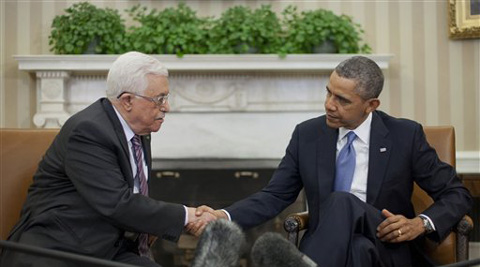
Barack Obama urges Mahmoud Abbas to ‘take risks’ for peace

President Barack Obama shakes hands with Palestinian President Mahmoud Abbas during their meeting in White House, Washington,  March 17, 2014. (AP)
President Barack Obama shakes hands with Palestinian President Mahmoud Abbas during their meeting in White House, Washington, March 17, 2014.

US President Barack Obama told Mahmoud Abbas that the Palestinian leader and Israel’s politicians must be prepared to make tough decisions and take “risks” for peace.
Abbas arrived at the White House two weeks after Israeli Prime Minister Benjamin Netanyahu, warning that time was running short for a final deal and saying Israel could show it was serious by honouring a scheduled release of Palestinian prisoners this month.
Obama, personally supporting Secretary of State John Kerry’s exhaustive Middle East peace drive at a critical moment, is pressing both sides to accept a framework to carry negotiations past an end-of-April deadline. “As I said to Prime Minister Netanyahu when he was here just a few weeks ago, I believe that now is the time… to embrace this opportunity,” Obama said.
“It is very hard, very challenging. We are going to have to take some tough political decisions and risks if we’re able to move it forward.” Obama said that everyone understood the shape of an “elusive” peace agreement between Israel and the Palestinians, saying it would be based on 1967 lines with mutual land swaps.
Abbas sat beside Obama in the same Oval Office chair recently used by Netanyahu, when the Israeli leader complained Israel had done its part over decades of peace talks and the Palestinians hadn’t done theirs.
The white-haired Palestinian leader told Obama: “We don’t have any time to waste.” “Time is not on our side, especially given the very difficult situation that the Middle East is experiencing and the entire region is facing.” Abbas did not use a photo opportunity before the talks to directly address the Israeli government’s demand for the Palestinians to recognise Israel as a “Jewish” state in public. But he did say through a translator that the Palestinians had recognised Israel’s legitimacy in 1988 and in “1993 we recognised the state of Israel.”

Sunday, 9 March 2014

Restrictions, poor equipment hinder Darfur peace mission: Ban

imageKHARTOUM: Restrictions by Sudan's government and the inadequate equipment of some peacekeepers in the Darfur region are hindering their ability to protect civilians and aid workers while violence increases, the UN chief says.
Ban Ki-moon made the comments in a review of the African Union-United Nations Mission in Darfur (UNAMID) which the UN Security Council ordered last July, according to a copy received Sunday by AFP.
He also called on the Security Council to endorse a set of measures, to be implemented over 12 months, "so that UNAMID can more effectively assist the many civilians affected by violence, insecurity and deprivation in Darfur".
While UNAMID has "some impact" in protecting civilians and aid delivery, "its effectiveness is seriously constrained by access restrictions and mobility constraints and shortfalls in the operational capabilities of several troop and police contingents," Ban's report says.
The six-year-old mission with more than 19,000 soldiers and police is one of the world's largest peacekeeping operations.
But the dynamics of Darfur's 11-year-old conflict, where clashes between rebels and government forces continue sporadically, have changed recently, prompting the review.
"Eleven years since the rebellion began, the situation in Darfur remains deeply troubling," Ban said.
Over the past two years, Sudan's deteriorating economy has led to worsening crime and intercommunal clashes, the report says, adding that some cash-poor paramilitaries have joined the tribal fighting over gold and other resources.
UNAMID itself has increasingly become a victim of the region's violence.
"In 2013, UNAMID suffered 19 attacks, resulting in 16 dead and 27 injured and a significant loss of vehicles, weapons and ammunition," Ban says.
The UN says 380,000 people were uprooted in Darfur in 2013 -- more than in any year since 2004 at the height of the conflict.
Fresh fighting has forced thousands more to flee their homes, the UN said last week, putting further pressure on an already stretched aid system dealing with almost two million displaced.

Thursday, 6 March 2014

TTP’s pre-conditions for peace-talks

Wednesday, 5 March 2014

All parties for collective effort to ensure peace

imageISLAMABAD: Government and Opposition Parties are at same page for moving ahead with the peace process and stand together for eliminating terrorism and extremism from the country.
Talking to APP, Chief of Awami Muslim League Sheikh Rashid Ahmed said leadership of the country must sit together and make all arrangements to fight against those elements who were involved in terrorism adding that it was encouraging the opposition and government working together for peace process in the country.
PML-Q Leader Chudhary Pervez Elahi said opposition was supporting the government on national issues and that it was responsibility of the government to take opposition into confidence before making final decisions.
MNA Jamsheed Dasti said the government was needed to take necessary steps for taking all political parties and civil society representative on broad on all important issues including the menace of terrorism to ensure peace and harmony in the country.
PML-NMNA Parveen Masood Bhatti said PML-N government was making solid efforts to effectively meet present day challenges and make efforts for extending relief to common man through social welfare projects.

Tuesday, 4 March 2014

Govt committee submits recommendations to resume peace talks


ISLAMABAD: The committee formed by the government to hold peace talks held a meeting with Prime Minister Nawaz Sharif on Tuesday.

During the meeting, the committee submitted recommendations to the prime minister to resume the dialogue process. Prime Minister Sharif directed the committee to continue consultations and it was decided that a meeting with the committee nominated by the Taliban will be held in the next few days.

Participants of the meeting agreed that attacks such as the one on a court in Islamabad are harmful for the dialogue process.

Prime Minister Sharif said all efforts should be made for peace as this was a necessity. He added that efforts for permanent peace should countiue.

The meeting was held to deliberate on the Taliban’s announcement of a month-long ceasefire and the future course of action regarding the dialogue process.

The Taliban announced a month-long ceasefire after fighter jets and gunship helicopters conducted surgical strikes against militant hideouts in the tribal areas. The strikes were carried out after 20 FC personnel were killed by the Tehrik-i-Taliban Pakistan despite the ongoing peace talks.

Following the Taliban’s announcement, the government stopped the strikes. In a statement issued by Interior Minister Chaudhry Nisar Ali Khan the decision was taken after consultations with Prime Minister Nawaz Sharif and Army Chief General Raheel Sharif.