Showing posts with label Government. Show all posts

Thursday, 12 June 2014

Sindh government had been warned of threats to old airport gates: Nisar


ISLAMABAD: Interior Minister Chaudhry Nisar Ali Khan said on Thursday that the Sindh government had been warned of threats to the Karachi old airport gate which was used by terrorists during an attack on Sunday night.

Speaking to media outside Parliament, Nisar said the federal government had written to the Sindh government in March about specific old airports gates not being secure. The report mentioned that terrorists were aware of these unsecure gates at the Karachi airport. Nisar added that despite the warning no measures were implemented by the provincial government.

The interior minister further said six security alerts had been sent to the Sindh government. He asked what action had been taken in light of these alerts by those individuals who were apologising daily for the Karachi airport attack. Nisar questioned why no security checks had been setup in the sensitive area used by the terrorists to enter the airport.

Chaudhry Nisar said upon his arrival in Karachi the chief minister and IG Sindh were informed of a meeting; however he failed to understand the logic of the meeting being at any other location when the attack had taken place at the airport.

“Is this airport in India that it is not the responsibility of the Sindh government,” Nisar said while questioning if the terrorists had entered the airport via parachutes or helicopters.

Nisar said he was informed that the airport had been cleared and he had asked for the wall of the cold storage to be broken. According to Nisar rescue and relief was the responsibility of the chief minister but he was the one who called for machinery to aid in rescue efforts.

The interior minister said only the truth should be told to the people as he called for a judicial inquiry of the incident by a Sindh High Court judge.

Monday, 9 June 2014

Modi government makes economic revival 'paramount' goal


NEW DELHI: India´s new government pledged Monday to make the revival of the flagging economy its "paramount" target as it laid out its legislative agenda following Prime Minister Narendra Modi´s landslide election victory.

In an address to the two houses of parliament which was drawn up by Modi´s new cabinet, President Pranab Mukherjee said India´s economy faced "extremely difficult" times and that inflation was "unacceptably" high.

The speech also included a series of ambitious policy goals that had been laid out in the election manifesto of Modi´s Bharatiya Janata Party (BJP), including the creation of 100 new cities and a revamp of the railway network. "The country is passing through an extremely difficult phase on the economic front," said Mukherjee. "Putting the economy back on track is paramount for my government."

"My government will strive to get India on a high growth path, reign in inflation, restart the investment cycle....(and) restore investor confidence," he said.

India´s economy has been growing at below five percent for the past two years, way below the level needed to lift millions of people out of poverty, while inflation is currently running close to nine percent.

Modi´s right-wing BJP, which thrashed the ruling centre-left Congress party in marathon polls in April and May, made reviving the economy the main platform of its campaign as well as promising to clean up government.

In the speech, the president said that "my government ... will be predictable, transparent and fair" and "was committed to providing a clean and efficient administration focused on delivery".

The government would "make every effort" to fulfil its pre-election promise to bring in a new general sales tax and would also "embark on rationalisation and simplification of the tax regime" to make it less "adverserial", Mukherjee said.

Elders fear government has decided to launch NWA operation


PESHAWAR: The recent talks between the government and North Waziristan tribal jirga in Peshawar proved a futile exercise as both sides had reportedly stuck to their demands that made the jirga members understand that the government was going to launch a full-scale military operation, said a senior member of the jirga, Hafiz Noorullah Shah.
“In our meetings with the corps commander and later with the government, the only thing we noted was the government has made up its mind to conduct a military operation in North Waziristan,” said Hafiz Noorullah Shah, a cleric who runs a madrassa in Miranshah, the headquarters of North Waziristan.

Earlier, another member of the jirga, Maulana Gul Ramazan had stated that the government had given them a two-week deadline to expel all foreign militants from North Waziristan and the government would not use force there.

However, Hafiz Noorullah Shah seemed quite disappointed and said they were going to Waziristan to bring their families and valuables out of the tribal region as, according to him, the government was preparing for the operation there.

Talking to this correspondent on phone while on his way to Miranshah, he said they demanded of the government to remove the recently installed five military observation posts in Mir Ali and Miranshah, which, according to him, had caused unrest among the local tribespeople and Taliban leadership.

Hafiz Noorullah Shah said that the government had agreed with them to remove the military observation posts but the jirga would need to expel all foreign and non-local Pakistani militants from the tribal region.

The jirga members had spent two days, Friday and Saturday, in hectic meetings mostly with senior military officials in Peshawar and tried their best to convince the military authorities and government to issue a statement that they would not launch a military operation so that the tribespeople could stop fleeing their houses and villages.

Tribal elder Haji Sher Mohammad Wazir, the grandson of late freedom fighter Mirza Ali Khan alias the Faqir of Ipi, and a religious leader Maulana Gul Ramazan, had led the tribal jirga that comprised tribal elders and clerics.On Saturday evening, the North Waziristan Taliban leader Hafiz Gul Bahadur called some of the jirga members and wanted to learn from them about the outcome of their meetings with the governor and corps commander.

“Obviously we didn’t have good news for the Taliban shura and the people of Waziristan. Hafiz Gul Bahadur agreed that foreign people had to leave the tribal region for the sake of the people but not at this time when the government had put a gun to his head,” Hafiz Noorullah Shah explained.

Fearing a military operation, the local Taliban had asked tribespeople to shift their families out of Waziristan before June 10. Also, they had asked the tribespeople to avoid taking shelter in the government-run camps meant for the internally displaced persons (IDPs) and advised them to go to neighbouring Afghanistan, if fighting erupted.

Asked whether the Taliban would extend the deadline, Hafiz Noorullah Shah said the Taliban shura wasn’t satisfied with the meetings between the jirga and government, therefore they should extend the June 10 deadline.

According to sources, the military authorities and particularly the Corps Commander Peshawar Lt Gen Khalid Rabbani had made it clear to the jirga members that the time has come they should realise their responsibilities as elders after signing a peace accord with the government in 2006-7 and pledged that they would be responsible for maintaining order and would not allow foreigners to stay there.

In the past, the tribal elders after sensing military action would come to Peshawar and Islamabad and make promises of taking action against foreigners and under tribal traditions would succeed in avoiding the use of force there.

This time, the jirga members admitted that the tone of the government and military officials had changed.Malik Sher Mohammad Waziri however hoped they would avoid the use of force through negotiations.

“The task is no doubt difficult but we will talk to our elders in Waziristan to find a peaceful solution. We would tell the people that we don’t want to fight against our armed forces and if someone is willing to fight then we would vacate Waziristan and let them do their work. But I must say the people of Waziristan are peace loving Pakistanis. Mehsud tribespeople are our brothers and would convince them to leave their area,” Sher Mohammad Wazir said.


Friday, 2 May 2014

EU calls on Pak government to protect media freedom


BRUSSELS: The European Union (EU) has called on the Pakistani government to protect media freedom in a statement issued here on Friday.

In its statement the EU said an atmosphere should be created in the country in which the media can operate with freedom and it was ready to assist Pakistan in this regard. Expressing concern over media freedom in Pakistan, the EU in its statement said freedom of expression was essential in a democratic society.

The EU welcomed the Pakistani government’s investigation on the attack on senior Geo News anchor Hamid Mir, stating that people should be kept aware of probes conducting into attacks on journalists.

According to the EU 34 journalists had been killed since 2008 and Pakistan was the most dangerous country for journalists. The EU said that trials were not held in several cases of attacks on journalists and the Pakistani government should investigate them.

Tuesday, 29 April 2014

Crackdown on government electricity bill defaulters


ISLAMABAD: State Minister for Water and Power Abid Sher Ali has ordered Islamabad Electricity Supply Company (IESCO) to disconnect supply to government institutions that have not cleared their dues.

The list of defaulters includes the Presidency, Parliament Lodges, PM Secretariat,Parliament House, Cantonment Board, Supreme Court, residence of the Chief Justice along with government offices of NADRA and CDA. Orders have also been issued to disconnect electricity supply to Frontier Works Organisation, Punjab Jail, Sindh and Balochistan House and Motorway Police.

During a news conference Abdi Sher Ali said the Sindh government had dues of Rs56 billion while the provincial governments of Punjab, Balochistan and Khyber Pakhtunkhwa also had to clear their outstanding dues.

The state minister added that he had been given directives by Prime Minister Nawaz Sharif to collect dues and stop electricity theft within one month. According to Abid Sher Ali protests against load shedding were taking place in areas where electricity theft was common.

The minister also announced to issue the load shedding schedule soon.

Electricity Cut Off

Following the orders of Abid Sher Ali, IESCO cut off power supply to the Supreme Court, Parliament House and PM Secretariat. IESCO officials said supply had been cut due to non-payment of dues. However, on the directives of Prime Minister Nawaz Sharif, electricity supply to the Supreme Court was resumed.

Monday, 14 April 2014

Pakistan to resume talks with new Indian government: Basit


NEW DELHI: High Commissioner to India Abdul Basit said on Sunday that Pakistan would hold talks with the new Indian government for the resolution of issues and disputes between the two countries for lasting peace.

Talking to Indian media, the high commissioner said that Pakistan is looking forward to engaging with India's next prime minister and any government which comes to power, and hopes the two countries do not lose much time in this process.

Basit expressed hope that the upcoming Indian government would give a positive response to Nawaz Sharif's vision and would help remove all irritants on permanent basis.

"Pakistan looks forward to the point when a new government takes over in India and, obviously, it is not for us to say who should be the next prime minister or the next government," Basit said.

"It is for the people of India to decide. We would be willingly and readily engaging with that government. At the same time, we hope that we will not lose much time in this process.” (Monitoring Desk)

Thursday, 10 April 2014

Government determined to keep PPO enforced


ISLAMABAD: The government is determined to keep the Pakistan Protection Ordinance (PPO) enforced and for the purpose it has evolved a strategy which has three tiers.
The government is confident that it will sail through the legislation even if it is blocked by the Senate provided its allies stand by it in the two houses.Highly-placed sources told The News on Thursday that the ruling PML-N will take the piece of legislation to the joint sitting of the two houses of parliament once blocked by the Senate.

The government’s procedure would be in line with the Constitution. The Article 70 of the Constitution deals with the subject under the title of “Introduction and passing of Bills,” the sources reminded. It says as under:

(1) “A Bill with respect to any matter in the Federal Legislative List may originate in either House and shall, if it is passed by the House in which it originated, be transmitted to the other House; and, if the Bill is passed without amendment, by the other House also, it shall be presented to the President for assent.

(2) If a Bill transmitted to a House under clause (1) is passed with amendments it shall be sent back to the House in which it originated and if that House passes the Bill with those amendments it shall be presented to the President for assent.

(3) If a Bill transmitted to a House under clause (1) is rejected or is not passed within ninety days of its laying in the House or a Bill sent to a House under clause (2) with amendments is not passed by that House with such amendments, the Bill, at the request of the House in which it originated, shall be considered in a joint sitting and if passed by the votes of the majority of the members present and voting in the joint sitting it shall be presented to the President for assent.”

The sources reminded that the ruling alliance enjoys the support of 251 members of the two houses. And it needs 223 votes out of 445 members of both the houses.

The comfort enjoyed by the ruling alliance will fizzle out in case the JUI-F opts not to support the government. Maulana Fazlur Rehman has already announced his opposition to the legislation as during the passage of the PPO in the National Assembly, his party had supported the opposition.

The ruling alliance has enough support in the joint house for the PPO in case it decides to opt for a joint sitting, the sources said.

According to sources, the PML-N has 206 members of its own in the two houses of parliament while its ally PML-F 6, Pakhtunkhawa Milli Awami Party (PkMAP) 5, National Party 2, NPP 3, PML-Z 1, APML (Pervez Musharraf) 1 and Independents 15 will support the government for the adoption of the PPO, the sources said.

The other option is also available to the government in the shape of promulgation of the same legislation with a different title and some reshuffle in the text of the original law. This option would be the last resort if the idea of holding a joint sitting is ruled out, the sources said.

Meanwhile, the government is also considering discussions with the opposition parties to make the legislation acceptable to the whole house through amendments. Mian Raza Rabbani, the leader of the PPP Parliamentary Group in the Senate, has already hinted at bringing amendments to the bill passed by the National Assembly, the sources reminded.

Tuesday, 1 April 2014

Government to fulfil legal needs on Musharraf issue: PM


ISLAMABAD: Prime Minister Muhammad Nawaz Sharif said on Tuesday that his government will fulfil all the legal and constitutional requirements on the Pervez Musharraf issue.
The prime minister said this while chairing an informal consultative meeting of senior PML-N leaders held here to discuss key issues.

Nawaz said the government will uphold the supremacy of the Constitution in all circumstances. He said the rule of law can ensure development of the country. He said there was an independent judiciary in the country and the government respects its every decision.

The prime minister said a way out would be found for peace in the country by continuing the dialogue process with the Taliban. He said preserving the national interest was the top priority of the government.

The meeting was attended by Defence Minister Khawaja Muhammad Asif, Interior Minister Chaudhry Nisar Ali Khan and Information Minister Pervaiz Rashid and other party leaders.

According to sources, the meeting reviewed the process of negotiations with the Taliban and former president General (retd) Pervez Musharraf’s request for removal of his name from the Exit Control List (ECL).

Sources said most party members were against removing the former president’s name from the ECL. The party leaders believed that a decision to allow Musharraf to leave the country would have a negative impact.

Sources said the prime minister has decided to hold thorough consultations over the issue.It may be mentioned here that the three-member special court hearing the treason case against Musharraf rejected his application on Monday advising him to approach the federal government to seek the removal of his name from the ECL.

The court said it had no jurisdiction to bar Musharraf from leaving the country as he was not under arrest.Separately, a meeting headed by the prime minister discussed developments in the ongoing dialogue process with the Taliban. The leaders also discussed the future course of action in the meeting.

Agencies add: During the consultative meeting, some PML-N leaders suggested that the government should move towards resolving the Musharraf issue instead of further complicating it. Some leaders said if the government removed Musharraf’s name from the ECL it would cause huge damage to the credibility of the PML-N which had followed a hard line against military dictatorship.

Most of the party leaders were of the opinion that if the government allowed Musharraf to travel abroad, it would give the impression that it has entered into a deal with the former president on the pattern of the NRO and closed the matter of his trial for high treason. They said once out of the country, Musharraf would not return home.

Some key ministers, however, advised the prime minister that if a High Court or the Supreme Court grants permission to Musharraf to leave the country, the move should not be resisted. Meanwhile, Prime Minister Nawaz Sharif held a telephonic conversation with former president Asif Ali Zardari over the issue of Musharraf’s treason trial.Media reports quoting the PPP leader Farhatullah Babar said that during the conversation, the overall political situation in the country was also discussed.

Thursday, 27 March 2014

MQM keen on joining Sindh government: Bilawal


KARACHI: Pakistan Peoples Party (PPP) patron-in-chief, Bilawal Bhutto Zaradi in a message Twitter said the MQM was keen on joining the provincial government in Sindh.

Bilawal tweeted it would be impossible to work with the MQM if they did not retract their support for martial law and breaking Sindh.

On Wednesday, MQM leader Faisal Sabzwari said talks between his party and the PPP were holding discussions over joining the provincial government. Sabzwari added

A meeting was also held on Wednesday between Sindh Chief Minister Qaim Ali Shah, Former Interior Minister Rehman Malik and Governor Sindh Dr Ishratul Ebad wherein relations between the PPP and MQM were discussed.

Nisar meets government committee


ISLAMABAD: Pakistan’s Interior Minister Chaudhry Nisar Ali Khan met with the government committee tasked with holding peace talks with the Taliban.

Nisar was briefed by the committee over their first direct meeting with the Tehrik-i-Taliban Pakistan (TTP) Shura which took place at an undisclosed location in North Waziristan yesterday (Wednesday).

The interior minister and government committee discussed demands put forward by the TTP Shura during yesterday’s meeting.
 

MQM gets offer to join Sindh government


KARACHI: The Muttahida Qaumi Movement (MQM) confirmed on Wednesday that the party had received an offer to join the Sindh government, but said that it was holding deliberations within party ranks following the talks held in Karachi between former interior minister Rehman Malik, the Sindh governor and the chief minister.
This was disclosed to The News by MQM leader and member Coordination Committee Waseem Akhtar just after Rehman Malik held a meeting with Dr Ishratul Ebad Khan at the Governor House and later called on Sindh Chief Minister Syed Qaim Ali Shah.

Waseem said that the ruling Pakistan People’s Party (PPP) has offered the MQM to join the government, adding that the MQM has not demanded any portfolios as being reported in a section of the press.

He said that it was the second meeting in Karachi between Qaim Ali Shah, Rehman Malik and Dr Ishratul Ebad but added that the MQM Coordination Committee would take a final decision on whether to join the government or not.

Waseem was again asked to when the MQM would be joining the government, to which he said, “No decision has been taken as yet…Discussions are under way in this regard”.He mentioned that Governor Ebad had earlier met former president Asif Ali Zardari in Dubai to sort out various issues.

Waseem said that departments and ministries did not matter for the MQM.It may be noted here that Sindh Minister for Information Sharjeel Inam Memon had told a press conference at the Sindh Assembly that he would neither confirm nor contradict reports about the MQM joining the government.

He had further said that ministries or departments did not matter for the ruling party as the same could be changed at any time.However, Speaker Sindh Assembly had told The News that important departments could not be given to Muttahida.

It may be noted here that the MQM normally takes time to join the government as they say that they have had bitter experiences in the past and that they are accountable to their people and voters.Rehman Malik has been playing a vital role to bridge the gap between the PPP and the MQM.

Earlier, the ruling PPP and the opposition MQM remained engaged in negotiations to evolve a power-sharing formula and both sides were hopeful that the issues would be resolved amicably.

Sources said that both sides were busy settling the remaining issues and clearing the way for the MQM to join the Sindh government. However, independent sources claimed that the ruling party was trying to convince the MQM not to insist on the local government and excise portfolios, as the PPP had been holding both portfolios in the previous tenure and there were reservations in the party ranks on this demand.

The MQM spokesperson rejected the impression that the process of talks was affected due to the statements of some PPP leaders against the MQM and pointed out that the dialogue was still in process as per the advice of the top leadership of both parties. He pointed out that the party leaders were bound to follow the instructions of the party chief and avoid talking to the media as the high command of both parties agreed that no party leader would speak against each other in the media.

PPP leader Syed Khurshid Shah had recently raised objections against MQM chief Altaf Hussain for his statement regarding the role of the army, while Speaker Sindh Assembly Agha Siraj Durrani also criticised the MQM’s demand for the local government and excise portfolios.

However, the MQM spokesman said that the party leaders would not speak in the media against any PPP leader and hoped that the PPP would also follow the instruction of their party high command in this regard.

The Governor’s House issued a statement that during their meeting, Dr Ishrat-ul-Ebad, Qaim Ali Shah and Rehman Malik agreed that both the PPP and the MQM believed in political harmony and reconciliation. They also said the leaderships of the two parties were engaged in talks to become coalition partners.

Monday, 24 March 2014

Taliban, government committee to meet in FATA: Prof Ibrahim


PESHAWAR: Professor Ibrahim has informed Geo News that the meeting between the Taliban shura and government committee will be held in FATA in the next two days.

The Taliban committee member said the location for the meeting had been decided but was being kept secret. Professor Ibrahim added that he was not aware of the agenda for the meeting.

According to Ibrahim members of the Taliban committee will also be present during the meeting.
 

Tuesday, 18 March 2014

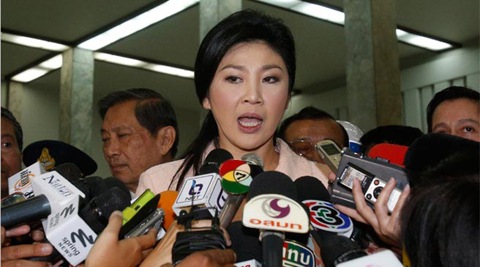
Thai government lifts two month long emergency

(PTI)
Violence had erupted in Bangkok in February demanding the ouster of Prime Minister Yingluck which led to a 60 day emergency period .

Thai Prime Minister Yingluck Shinawatra Tuesday lifted a nearly two-month-old emergency in Bangkok and surrounding areas and replaced it with a security law after political violence against her government eased.
The Cabinet lifted the state of emergency and enforced the Internal Security Act (ISA). Department of Special Investigation Chief Tarit Pengdith, a member of the Centre for Maintaining Peace and Order, said the ISA enforcement will continue till April 30.
For the past few months the CMPO, formed by the Yingluck government, had been handling the protests. On January 22, the Shinawatra-led caretaker government imposed a state of emergency for 60 days to quell protests.
The emergency was due to expire on March 22. The emergency had expanded the power of security forces to issue orders and search, arrest and detain people.
Tarit said the caretaker prime minister and defence minister Yingluck will have to set up a new agency to replace the CMPO to enforce the ISA to maintain security.
But caretaker Deputy Prime Minister and Foreign Minister Surapong Towichukchaikul said the government would continue to use the same CMPO structure to enforce the ISA.
Violence had erupted in Bangkok and other parts of the country ahead and during the February 2 snap polls, boycotted by main opposition Democrat Party demanding the ouster of Prime Minister Yingluck.
Twenty-three people have been killed and over 700 injured in the political conflict since November.
Surapong Tovichakchaikul, chief advisor to the government’s Centre for Maintaining Peace and Order (CMPO) which has been set up to handle anti-government protests, had yesterday said the body will ask for the state of emergency to be lifted.
Thailand has been in a political crisis since mass rallies began in November. The protesters are demanding an unelected People’s Council to replace the Yingluck regime.
Opposition-backed protesters had blocked polling in several opposition stronghold provinces and in some parts of Bangkok on February 2 and during advance polling on January 26.
The protesters accuse Yingluck of acting as a proxy for her fugitive brother, former premier Thaksin Shinawatra, who was ousted in a coup in 2006. He lives in self-exile in Dubai to escape a jail term on a corruption conviction.

Monday, 3 March 2014

Government efforts for peace being undermined: PM


ISLAMABAD: Prime Minister Nawaz Sharif says efforts are being made to undermine the government’s efforts for peace. The Prime Minister’s comments came as he chaired a high level meeting focusing on matters of national security and the Taliban’s announcement of a month-long ceasefire as well as today’s attack in Islamabad.

The meeting was attended by Chief of Army Staff General Raheel Sharif, Director General Inter-Services Intelligence (ISI) Lt. Gen Zaheeurl Islam, Interior Minister Chaudhry Nisar Ali Khan, Finance Minister Ishaq Dar and Defence Minister Khawaja Muhammad Asif.

Earlier the Prime Minister and COAS General Raheel Sharif held a one-on-one meeting.

Wednesday, 26 February 2014

In Ukraine, Naming of Interim Government Gets Mixed Response


KIEV, Ukraine — Standing before a crowd of tens of thousands in Independence Square, the center of the three-month civic uprising that ousted President Viktor F. Yanukovych, the lawmakers temporarily controlling Ukraine announced an interim government on Wednesday night to be led by Arseniy P. Yatsenyuk, a veteran public official.

The public presentation of Mr. Yatsenyuk, who will serve as acting prime minister, and more than 20 other proposed cabinet members, was a frenetic effort by establishment politicians to win the backing of the street protesters, whose persistence in the face of the deaths of more than 80 people last week in clashes with the police ultimately forced Mr. Yanukovych from power.
As the names of the proposed ministers were read from a stage — with flowers and candles blanketing the square in memory of the dead — it became clear just how completely the ordinary people on the street had seized control of the direction of Ukraine. Desperate for the crowd’s legitimacy, officials felt compelled to present the slate on stage in the square before putting it up for a vote by Parliament.
The reaction from the crowd was decidedly mixed.
Jeers and whistles greeted some established politicians, and cheers for some figures with no government experience chosen because of their role in the uprising. But with Ukraine hurtling toward an economic catastrophe, and no time for protracted negotiations, the gesture of deference to the crowd seemed sufficient to move the process forward.
“We need to change these faces,” said Alyona Murashko, a 28-year-old marketing specialist who was carrying groceries and had stopped in the square on her way home from work. Ms. Murashko said that she approved of the choice of Olga Bogomolets, a doctor, singer and activist, as deputy prime minister for humanitarian affairs, and of Tatyana Chornovil, an activist and journalist, to lead Ukraine’s anticorruption bureau.
Ms. Murashko, however, said she opposed Mr. Yatsenyuk and many of the other choices. “I wouldn’t like to see him even temporarily,” she said. “No one from current political parties.” Ms. Murashko said she was glad that presidential elections would be held in May but wanted parliamentary elections “as soon as possible.”
Among those eliciting loud boos was Oleksandr V. Turchynov, who was elected by colleagues on Saturday as the new speaker of Parliament and who has been authorized to carry out the duties of president, effectively putting him in charge of the country. Mr. Turchynov was not part of the slate announced Wednesday night and will continue in his position even after the interim government is approved.
On the whole, the makeup of the interim government suggested that Ukraine would now move more swiftly to improve ties with the West, potentially reviving the sweeping political and trade agreements with the European Union that Mr. Yanukovych scuttled in November, setting off protests in Kiev and other cities.
Mr. Yatsenyuk is an ally of Mr. Yanukovych’s archrival, the former prime minister Yulia V. Tymoshenko. Ms. Tymoshenko was released from a prison hospital and is expected to run for president in the May elections, although she has received only a lukewarm reception in recent days. Many Ukrainians say they view her as too closely connected to the country’s existing political system, which has been hobbled by corruption and mismanagement for years.
Mr. Yatsenyuk, by contrast, is largely viewed as an able technician with a firm grasp of economic policy and foreign affairs. He has served as speaker of Parliament, foreign minister, economics minister and acting head of the central bank. Ukraine’s economy is in tatters, and it is in desperate need of a rescue package from the International Monetary Fund, which has said it will demand painful austerity measures and long-delayed economic changes in return for any assistance.
A $15 billion bailout that Mr. Yanukovych had secured from Russia has been suspended as a result of the recent political upheaval, which the Kremlin views with alarm.
Mr. Yatsenyuk was one of three opposition leaders in Parliament who were among the chief organizers of the street demonstrations. Another, the former boxing champion Vitali Klitschko, who leads a party called the Ukrainian Democratic Alliance for Reform, has already announced his candidacy for president. The third, Oleg Tyagnybok, is the leader of the nationalist Svoboda party, which is popular in Western Ukraine but has limited support elsewhere.
Officials in Parliament, led by Mr. Turchynov, had struggled to reach a deal on the interim government in part because of the demands by civic activists that it include a number of people who did not have previous experience in public life.
Among the choices in this regard were Dmitro Bulatov, the leader of a group called AutoMaidan, who was designated as minister of youth and sport; and Eugene Nyschuk, an actor who has served as M.C. from the stage in Independence Square throughout the protests and who was selected as culture minister.
The crowd, however, was divided even on these choices, underscoring the near-impossible challenge faced by officials hoping to win the approval of the street.
Volodymyr Hrysiv, 36, an unemployed martial arts instructor from Kiev, said he had been part of the protests from the very beginning and had booed Mr. Turchynov.
“I did not see him here last week when bullets were firing,” Mr. Hrysiv said. “I have not seen him earlier during fights on Hrushevskovo Street. Some people sacrifice their lives, while others are now dividing seats.”
Still, many people in the crowd acknowledged that there was no way to please everyone.
Officials said that Andrey Dashchitsa, a veteran Ukrainian diplomat, had been chosen as minister of foreign affairs.
Andrey Parubiy, a member of Parliament and leader of the protest movement, was chosen as the head of the national security council, while Arsen Avakov, who is already working as interior minister, was chosen to remain in that post.