Showing posts with label phone. Show all posts

Thursday, 5 June 2014

Samsung sees Tizen phone as gateway for bigger things


SAN FRANCISCO: Samsung on Tuesday unwrapped its new smartphone using the Tizen platform, a move aimed at breaking away from Google's Android and staking a claim to the "Internet of Things."

The South Korean consumer electronics colossus showed off the Samsung Z, its first Tizen-powered smartphone, in a major shift away from the ubiquitous Android operating system used in the majority of its devices.

Samsung touted Tizen as a platform not just for phones, but for a range of connected devices from home appliances to door locks and watches which may communicate with one another in the future.

The unveiling came a day after Apple -- a few blocks away in San Francisco -- unveiled a coming new version of its iOS mobile operating system with capabilities that could have iPhones, iPads, and iPod touch devices vying for that same spot in the middle of a what is billed as the booming Internet-of-Things.

The world's biggest smartphone maker made its pitch at the Tizen Developer Conference, a forum that aims to help the platform become a rival to Android and Apple's iOS.

Samsung showed off a line of Tizen-powered devices ranging from Tizen-Android cameras to its freshly announced smartphone powered entirely by the South Korean technology firm's open-source operating system.

Samsung even teased a prototype smart television that connects to rich online content using Tizen.

- Cash prizes for apps -

Along with being enticed with contests offering cash prizes for winning applications, the approximately 1,000 developers at the keynote presentation were urged to check out an Open Smart Home project for "monitoring and controlling devices in the home or on the body all together" whether from one's living room or from half a world away.

"The goal of this project is to have it evolve into services for the entire Internet-of-Things," Samsung executive vice president and Tizen technical steering committee co-chair Jong-Deok Choi said during an on-stage presentation.

"We plan to have this project implemented through Tizen."

Samsung announced Monday the launch of a new smartphone based on its own operating system, in a step towards independence from the Google Android platform that dominates its popular handsets.

The Samsung Z, which has been specially developed to run on the Tizen platform, will go on sale in Russia in the third quarter of this year before reaching other markets.

The vast majority of Samsung's devices, including its flagship Galaxy S smartphones, use the Android operating system.

- Exploding 'IoT' -

International Data Corporation (IDC) on Tuesday forecast that the global Internet-of-Things market will grow from $1.9 trillion last year to $7.1 trillion in the year 2020.

People are embracing the "IoT" in their homes, vehicles and elsewhere, while businesses are being lured by promises of efficiency and revenue, according to IDC.

"The worldwide IoT market is exploding," said IDC mobile services vice president Carrie MacGillivray.

California-based Google has long pitched the potential for its free Android operating to be used to power broad arrays of devices in homes in a vision that goes far beyond smartphones and tablet computers.

Developer Henry Yu of Silicon Valley-based RGB, which specializes in streamlining video formats, was among those at the Tizen conference and suspected that no single platform would rule the IoT.

"At the end of the day, they will have to work together," Yu said of rivals such as Samsung, Apple and Google vying to be at the center of the IoT.

"The Internet-of-Things has been around, but it is hodgepodge. People will want to get along because they want each other's market."

Saturday, 12 April 2014

MH370 co-pilot made mid-flight phone call: repor


KUALA LUMPUR: The co-pilot of missing Malaysian airliner MH370 attempted to make a mid-flight call from his mobile phone just before the plane vanished from radar screens, a report said Saturday citing unnamed investigators.

The call ended abruptly possibly "because the aircraft was fast moving away from the (telecommunications) tower", The New Straits Times quoted a source as saying.

But the Malaysian daily also quoted another source saying that while Fariq Abdul Hamid´s "line was reattached", there was no certainty that a call was made from the Boeing 777 that vanished on March 8.The report -- titled a "desperate call for help" -- did not say who he was trying to contact.

Fariq and Captain Zaharie Ahmad Shah have come under intense scrutiny after the plane mysteriously vanished en route from Kuala Lumpur to Beijing with 239 people on board. Investigators last month indicated that the flight was deliberately diverted and its communication systems manually switched off as it was leaving Malaysian airspace, triggering a criminal investigation by police that has revealed little so far.

The fate of flight MH370 has been shrouded in mystery, with a number of theories put forward including a hijacking or terrorist attack and a pilot gone rogue.

There have been unconfirmed previous reports in the Malaysian media of calls by the captain before or during the flight but no details have been released.

The NST report said that Flight 370 flew low enough near Penang island on Malaysia´s west coast -- after turning off course -- for a telecommunications tower to pick up the co-pilot´s phone signal.

The phone line was "reattached" between the time the plane veered off course and blipped off the radar, the government-controlled paper quoted the second source as saying.

"A ‘reattachment’ does not necessarily mean that a call was made. It can also be the result of the phone being switched on again."

Malaysia´s transport ministry told that it was examining the NST report and will issue a response.

The Malaysian government and media have repeatedly contradicted each other and themselves over details of the search and criminal investigation.

Saturday, 5 April 2014

No respite in phone tapping by agencies


ISLAMABAD: While there has been an overall failure in countering terrorism, instances of unnecessary and unethical recording of common citizens and government officials’ telephone calls have multiplied.
Prime Minister Nawaz Sharif’s decision to grant an extension to the chief of a big intelligence agency is also against his own publicly-made pledges. The government has started a controversial process of bestowing extensions which was the benchmark of the Musharraf and Zardari regimes.

The prime minister’s decision to grant extension is a violation of the Supreme Court’s clear judgment not to give extensions unnecessarily, especially on cadre posts where other eligible officers are present. The PML-N had condemned previous regimes on this count on many occasions. Officials believe that accepting the extension is the first major negative point of a spotless career of the chief of the big intelligence agency, who otherwise enjoys a reputation of being an honest and competent officer.

Under the principles of good governance, impartiality and justice, no officer is indispensable for the system, and new officers are always trusted and given opportunities to serve. This is considered the hallmark of a system which is trying to get rid of the status quo. Extensions are mostly granted in the name of honesty and competence, but experts believe that a strong system always prepares and trains officers, gives them top assignments and, consequently, this practice becomes instrumental in the transformation of a corrupt system into a comparatively better system.

When the head of the big agency was asked the same questions by The News he said, “I have stood by the same principle throughout my career and always preached the same.” He said that during his last meeting with the head of the government on the eve of his retirement, the prime minister asked him: “You have worked 37 years for yourselves and now your country needs your services.” He said that he was speechless and was unable to counter this argument. “I was also fearing that the next sentence from the chief executive of the federation could be that I have no time for Pakistan,” he said adding, “I can never hear this sentence.”

The civilian as well as army-controlled intelligence outfits had completely failed to apprehend any single major terrorism activity in the recent past. Even the district courts of the federal capital were attacked in a bizarre fashion by the terrorists a few weeks back and so far there is no clue to any terrorist group involved in the heinous and terrible act.

However, there have been a large number of instances where the illegal recording of calls have been reported and this practice is on the rise as days pass. The intelligence agencies not only tap calls but also use the transcripts to achieve certain objectives, including pressuring individuals. Intelligence agencies also remain unable to control some of the cellular operators from indulging in the same illegal activity only because they themselves do the same instead of pursuing terrorists and anti-state actors.

However, senior government officials say that the present government is not interested in using the intelligence agencies for tapping calls. These top government officials argue by quoting some instances to make their point. Officials say that the political party ruling the federation mostly makes the government in Quetta, and the intelligence agencies are extensively used to achieve this objective. However, the present ruling party opted to give the government of Balochistan to another party. Similarly, the political party ruling Islamabad also successfully makes the government in AJK with the help of the agencies, but Prime Minister Nawaz Sharif has stopped a move in the past to empower the PML-N in Muzaffarabad.

These top officials also argue that the agencies can remove the provincial government in Peshawar in a few days but it has never been on the agenda of the present federal government.

All these points are fine. However, it is a fact that instances of recording common citizens’ calls are increasing and there is no check in this regard. This has badly affected the performance of the intelligence agencies and officials at the helm of affairs in these institutions are unable to defined the priorities for such practices.

Monday, 10 March 2014

Micromax Canvas Knight A350 review: This phone does not look Indian

Micromax Canvas Knight will be priced at Rs 26,999
Micromax Canvas Knight will be priced at Rs 19,999

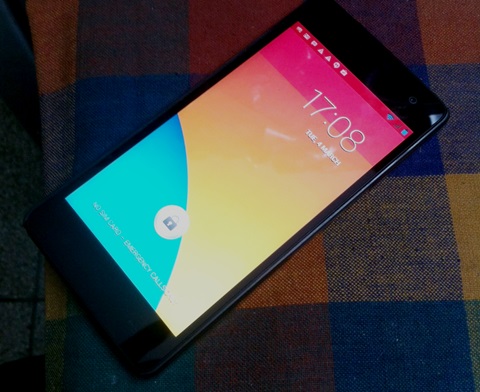
First things first. This is a phone from Micromax, but it does not look like a phone from Micromax. In fact, it looks like a phone from a well-heeled international brand, the sort that Micromax wants to become in the near future. This is the Micromax Canvas Knight, the phone that will take over the flagship mantle for the company from today.
Quick Tech Specs: 5-inch IPS display (1920×1080 pixels, 443 ppi) | 2GHz Tru Octa core MediaTek MT MT 6592 processor | 2GB RAM | 32 GB storage + no microSD slot | 16MP rear camera, 8MP front camera, 1080p Full HD video | 3G, Wi-Fi 802.11 b/g/n, Bluetooth 4.0 | 2350mAh battery | Android 4.2 JellyBean
Price: Rs 19,999
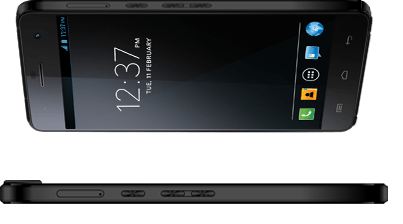
Power and volume keys on the side 
Power and volume keys on the side
Design: As I said this phone does not look like a Indian phone. In fact, it has the cuts and sides of the Apple iPhone 5s and even reminded me a bit of the Lava Iris Pro 30, which also had a similar design language. The unibody design is reinforced by what seems, and feels, like a graphite frame. There are mico-SIM slots on both sides that can be accessed by a pin. And, no there is no space for a SD card. Another thing that sets this phone apart is the power key, that is now placed along with the volume keys on the right. This take a bit of getting used to.
canvas-knight1
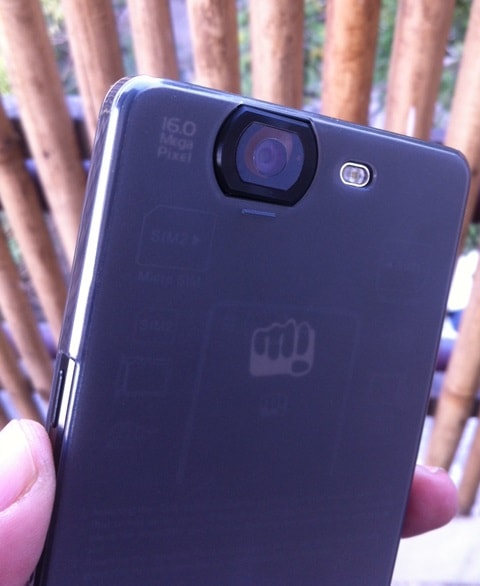
The camera, the 16 MP sensor that it houses, results in a significant bump on the rear and there is an extra rear cover to sort of protect it. This feature is a bit like the one on the Nokia Lumia 502 and it becoming common in slim phones with large cameras. The phone is very light and easy to handle despite the large screen.
canvas-knight3
Screen & Audio: The Full HD IPS panel is one of the best features of this phone. To start with, there is hardly any light bleed on the sides. The phone can be bright enough to be legible in bright sunlight. The audio quality is good, but not great. The overall experience, however, is quite good.
Performance: This is a Tru Octa core phone. So performance should not be, and is not, and issue at all. In fact, the Antutu benchmark scored it in the top draw and exclaimed ‘amazing’. Yes, that doesn’t mean much for an average used. What matter for him is the fact that there is no lag anywhere and that multi-tasking is a breeze. We tried multi-tabbed browsing on Chrome and the experience was superb. However, with some games we noticed that the device did heat up quite a bit near the camera. Remember, the heat is coming through an extra layer of protection due to the rear cover.
MMX Canvas Knight 3 
Memory: The phone has 32GB internal memory, out of which you get to use about 24GB. That is decent as you can download large apps and run them comfortable. The 2GB RAM should also stand you in good stead.
Software: The phone runs Android Jelly Bean with a tweaked UI that I did not like all that much. I suggest you switch to a new launcher that gives the slick look a phone with these specs needs. There is quite a bit of bloatware that you can easily delete.
Camera: The two cameras certainly show a lot numbers. The rear camera for a change gives decent pictures even in low light and indoors. It is not great, but much better that most other Android cameras in this price range. There is a bit of noise in the images, but then there is also good detail when needed. The 8MP front camera is better than most phones, but is sluggish and is best used only for video calls and the occasional selfie. The camera comes with features like 3D panaroma, which is too much of work if you ask me.
This is shot early in the morning with hardly any sunlight.  

This is shot early in the morning with hardly any sunlight.


  See the detail here. There is a bit of noise too if you blow up. 

See the detail here. There is a bit of noise too if you blow up.
Battery: The 2350 mAh battery lasted a full day with average use and on low brightness. With full brightness and regular use with video and gaming, you will be lucky to get 10 hours out of this battery. This means the phone will be good for a regular day in office or college and last till the time you come back home. But if you are planning to hang out with friends on a gaming face-off, or want to go on a binge  video watching spree on a long train journey, you will need to invest on a power bank.
Special Mention: For some time now, Micromax has been packaging its phones in boxes that mean business. It does this again with the Canvas Knight, the packaging gives a reassurance to the customer that they have bought something good. Even the printed material in the box and the accessories make you feel good.
Verdict: If you are looking for a high-end phone, but don’t want to spend a month’s salary on the same, the Micromax Canvas Knight can be a good pick. It packs almost everything you expect from an Android phone. The Micromax canvas Knight shows how Indian companies can also produce world class hardware that is stylish, functional and durable (or feels like it). The Knight is right there in the league of top-end Android phones, even though we know that it won’t cost that much. This one costs just Rs 19,999.

Tuesday, 4 March 2014

News UK news NI paid phone hacker's legal fees to stop him 'naming names', court hears


NI paid phone hacker's legal fees to stop him 'naming names', court hears

Rebekah Brooks says News International believed Glenn Mulcaire 'could say anyone or anything' in Max Clifford civil case
Glenn Mulcaire
News International agreed to pay Glenn Mulcaire's legal fees to stop him implicating other reporters in a court case brought by Max Clifford, Rebekah Brooks told the phone-hacking trial. Photograph: Oli Scarff/Getty Images
News International agreed to pay phone hacker Glenn Mulcaire's legal fees to stop him implicating other reporters in a court case that loomed after PR Max Clifford launched civil proceedings for damages over hacking, the Old Bailey has heard.
Giving evidence for a seventh day in the phone-hacking trial, Rebekah Brooks said she was not involved in the decision taken in 2009 but she agreed with it at the time.
The firm's lawyer Tom Crone agreed to pay for Mulcaire to be represented after it transpired that he could be forced to identify who had commissioned him to hack phones if Clifford's case came to court.
Brooks told the court: "We were opposing that order – again this is in the context of a civil liability – on the basis that he was an unreliable witness going forward naming names, and both financially and reputationally we didn't want that to happen. "The view was that he could say anyone or anything."
She said there were concerns after it emerged during police disclosure that Mulcaire's notes appeared to include the names of other people apart from the five victims named in the proceedings against him in 2008 which included Clifford but also sports agent Sky Andrews.
"The list of potential civil claimants was growing sideways if you like," she said under examination by her defence counsel Jonathan Laidlaw QC.
"Our decision at News International was to settle as confidentially as possible to prevent further damage reputationally and financially."
She said he "inherited" that policy and "maintained it with Max Clifford".
Brooks, who became News International chief executive in 2009, said that News Group Newspapers, publisher of the News of the World and the Sun had fallen out with Clifford and her predecessor Les Hinton had imposed a ban on working with him. He had earned "millions and millions of pounds" for stories from the publisher, she said.
The jury heard that Brooks struck a deal with Clifford for £200,000 a year in 2009 to resume business with the Sun and the News of the World, ending the three- or four-year ban.
Brooks said he felt he needed to be compensated for loss of earnings over the blackout period.
Asked if the civil case caused her concern that hacking might have taken place during her editorship, she replied: "Absolutely not, at this stage we are still dealing with 2005 or 2006."
Asked whether whether "throughout 2010" she ever had concerns that hacking took place on the News of the World, which she edited between 2000 and 2003, she responsed: "No".
The court heard that the Guardian reported that Sienna Miller had launched civil proceedings for hacking in 2010 but Brooks felt suspending the NoW reporter the paper claimed to be involved was not the right course of action.
At the time News Corp had launched a takeover bid for BSkyB and the Guardian revelation led to an exchange of emails with the then head of corporate affairs, Matthew Anderson.
Brooks said that announcing the journalist's suspension was not going to "change Vince Cable's view" of the bid.
She commented on BBC political editor Nick Robinson's view of the Miller article, jurors heard. "He rubbished the whole thing and said it was one side of the civil case and total unprofessional reporting," she said.
Brooks denies four charges that she conspired to hack phones, conspired to conceal evidence from police, and conspired to pay public officials for stories.
The trial continues.

Monday, 24 February 2014

Nokia unveils line of low-cost, Android-powered smartphones

Nokia announced three low-cost smartphones that run the Google Android operating system.
In recent years, Nokia primarily powered its smartphones with the Windows Phone operating system, but limitations of that platform prevented the phone maker from building low-priced, entry-level devices.
Nokia changed that Monday by introducing the Nokia X line, which includes the Nokia X, the Nokia X+ and the Nokia XL. The devices will be available for 89, 99 and 109 euros, respectively, or about $122, $135 and $150, all before any carrier subsidies.
VIDEO: Pebble's latest Steel smartwatch is functional and stylish
The Nokia X comes with a 4-inch screen, 512 megabytes of RAM and a 3-megapixel camera. The Nokia X+ also includes a 4-inch screen and 3-megapixel camera, but it has 768 megabytes of RAM and comes with a 4-gigabyte MicroSD card. The Nokia XL has a 5-inch screen, 768 megabytes of RAM, a 4-gigabyte MicroSD card and a 5-megapixel camera. All three use a 1-gigahertz Qualcomm Snapdragon Dual Core processor.
Each model will be available in numerous color options.
Nokia posted a YouTube video promoting the new line.
The devices are powered by Android, but Nokia designed the three smartphones to maintain a Windows Phone feel. The interface of the Nokia X line mimics that of Windows Phone and includes numerous apps that are available only through Nokia and Microsoft, including Microsoft OneDrive cloud storage, Nokia MixRadio and Skype. Users will be able to download Android apps through the Nokia Store.
The Nokia X will be available for purchase immediately in Asia, Europe, Latin America and Africa. The Nokia X+ and the Nokia XL will go on sale in those markets in the second quarter. No word on when the devices will be available in the U.S.

Sunday, 16 February 2014

Normandy may not be Nokia's only Android phone this year

Is Normandy just the beginning of Nokia's Android ambitions?

Rumors of the Nokia Normandy are heating up, but new whispers say it may only be the first of a whole pack of Android-powered phones from the Finnish firm.
Word from an Artesyn Technologies source is that says the phone company will have more Android phones coming this year, including several higher-end models.
Supposedly this new slew of phones powered by Google's mobile OS will be revealed sometime between May and June.
The source says the phones will come at different price points, but there's no word if it will be able to reach the Play Store unlike Normandy.

But phones may stay low end

Microsoft, which is in the final stages of finalizing its purchase of Nokia, has reportedly put its new acquisition through the chop shop and leaving it with the low-end Asha and feature phone departments.
Meanwhile, teams involved with Nokia's more notable hardware bits including PureView cameras, HAAC microphones, and ClearBlack displays have been moved to Redmond.
Taking these technology shifts into account, its possible that a majority of Nokia's Android phones could come as budget handsets with the Asha overlay - essentially a faux-smartphone tiled, touchscreen interface.

Nokia's Android pathfinder

Thus far, the only Android Nokia handset we've seen evidence for is Normandy. The phone will reportedly debut at MWC 2014 and it's already shaping up to be an abnormal little droid.
Instead of accessing the Play Store, Microsoft plans to supply the handset with its own apps, including Here Maps, MixRadio, and Nokia's own shop of Android apps.
It's already odd enough to see an almost-Microsoft-owned company putting anything but a Windows Phone OS on any handset let along multiple, but we'll let you know if we spot any other goodies from Nokia featuring Google's green bot.